
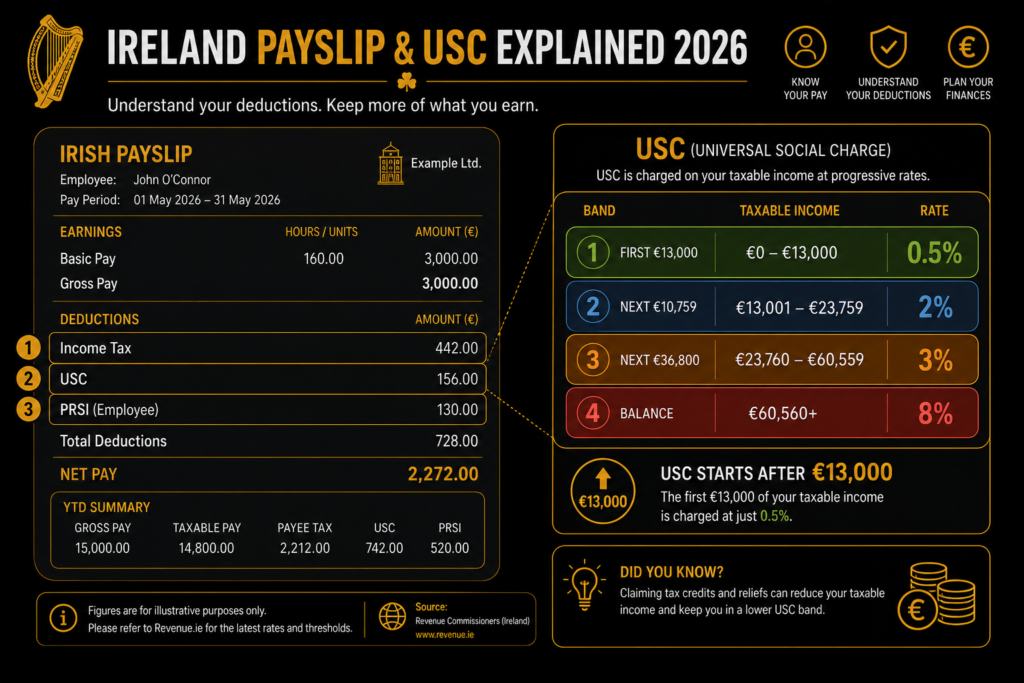
Every Irish payslip shows three deductions: Income Tax, PRSI, and USC. Most employees understand income tax. Many have a rough idea about PRSI. But the Universal Social Charge remains the deduction that people find most confusing — and the one most likely to cause an unexpected underpayment at year-end.
USC is a tax on gross income. Unlike income tax, it cannot be reduced by tax credits. It applies from the very first euro once you cross the €13,000 annual threshold — and that threshold is a cliff edge, not a gradual taper. Earn €13,001 and you suddenly owe approximately €76 in USC that you would not owe on €13,000. For 2026, the rates range from 0.5% on the first €12,012 to 8% on income above €70,044, with a self-employed surcharge pushing the top rate to 11%.
This guide covers every 2026 USC band, the only Budget 2026 change, who qualifies for reduced rates, how pension contributions can lower your USC bill, and worked examples at common salary levels.
USC Rates and Bands — 2026
| Income Band | USC Rate | Max USC in Band |
|---|---|---|
| First €12,012 | 0.5% | €60.06 |
| €12,013 – €28,700 | 2% | €333.76 |
| €28,701 – €70,044 | 3% | €1,240.32 |
| Above €70,044 | 8% | No cap |
| Self-employed above €100,000 | +3% surcharge (11% total) | No cap |
The only change in Budget 2026 was widening the 2% band ceiling from €27,382 to €28,700. This saves approximately €13 per year for anyone earning above €28,700 — a modest adjustment that keeps full-time minimum-wage earners within the lower USC bands. All other rates and thresholds were unchanged.
The €13,000 Cliff Edge
This is the single most misunderstood feature of USC. If your total gross income for the year is €13,000 or less, you pay absolutely zero USC. Full exemption. But if your income is €13,001, USC applies to your entire income from the first euro — not just the €1 above the threshold.
At €13,001, the USC bill is approximately €76.50. That single euro above the threshold generates €76.50 in tax. This is a genuine cliff edge that matters most for part-time workers, students with seasonal jobs, and anyone managing multiple small income sources near the threshold.
If you are approaching €13,000 in annual earnings, it may be worth managing your income carefully. A final shift or bonus that pushes you from €12,900 to €13,100 does not just cost USC on the extra €200 — it costs USC on the entire €13,100.
Worked Examples: USC at Common Salary Levels
| Annual Salary | Annual USC | Monthly USC | Effective USC Rate |
|---|---|---|---|
| €13,000 or less | €0 (exempt) | €0 | 0% |
| €25,000 | €319.82 | €26.65 | 1.3% |
| €35,000 | €582.82 | €48.57 | 1.7% |
| €50,000 | €1,032.82 | €86.07 | 2.1% |
| €70,000 | €1,632.82 | €136.07 | 2.3% |
| €100,000 | €4,030.30 | €335.86 | 4.0% |
The effective USC rate stays remarkably low for most earners — under 2.5% for anyone earning below €70,000. The rate jumps sharply once income crosses €70,044, where the 8% band begins. On €100,000, the effective USC rate is 4.0%, but on income at the marginal euro above €70,044, you are paying 8% USC plus 40% income tax plus 4.35% PRSI — a combined marginal rate of 52.35%.
USC vs Income Tax vs PRSI: The Full Picture
USC is one of three payroll deductions in Ireland. Together, they determine your total marginal tax rate — the percentage taken from the last euro you earn.
| Income Range | Income Tax | USC | PRSI | Combined Marginal |
|---|---|---|---|---|
| Up to €28,700 | 20% | 0.5–2% | 4.35% | 24.85–26.35% |
| €28,701 – €42,000 (single) | 20% | 3% | 4.35% | 27.35% |
| €42,001 – €70,044 (single) | 40% | 3% | 4.35% | 47.35% |
| Above €70,044 | 40% | 8% | 4.35% | 52.35% |
The jump from 47.35% to 52.35% at €70,044 is caused entirely by USC moving from the 3% band to the 8% band. For every additional euro earned above this point, the government takes more than half. This is why the €70,044 threshold is critical for salary negotiation and financial planning.
How Pension Contributions Reduce USC
Here is the key rule most employees miss: occupational pension contributions are deducted from gross pay before USC is calculated. This is different from income tax credits, which cannot reduce USC.
If you earn €50,000 and contribute €5,000 to your employer’s pension scheme, USC is calculated on €45,000 — saving approximately €150 in USC on top of the income tax relief. For someone earning €80,000 and contributing €10,000 to a pension, the USC saving is around €800 because the pension contribution pulls income below the 8% USC threshold.
PRSA (Personal Retirement Savings Account) contributions receive the same treatment when deducted at source by your employer. This makes pension contributions one of the most effective tools for reducing your total payslip deductions in Ireland.
Reduced USC Rates
Certain groups qualify for reduced USC rates instead of the standard bands:
| Who Qualifies | Reduced Rates |
|---|---|
| Aged 70+ with income ≤ €60,000 | 0.5% on first €12,012, 2% on balance |
| Medical card holders with income ≤ €60,000 | 0.5% on first €12,012, 2% on balance |
| Income ≤ €13,000 | Fully exempt (0%) |
The reduced rate of 2% on all income above €12,012 is significantly lower than the standard 3% and 8% rates. For a medical card holder earning €55,000, the annual USC saving compared to standard rates is approximately €1,500. However, if income exceeds €60,000, the reduced rates no longer apply and the full standard rates kick in — another cliff edge to be aware of.
Self-Employed USC Surcharge
Self-employed individuals with income above €100,000 pay an additional 3% surcharge on the portion exceeding that threshold. This brings the USC rate on self-employment income above €100,000 to 11% (8% standard + 3% surcharge). Combined with income tax at 40% and PRSI at 4.35%, the total marginal rate for high-earning self-employed workers is 55.35%.
The surcharge applies to self-employment income only. If you have both employment and self-employment income, only the self-employment portion above €100,000 attracts the surcharge.
Income Exempt from USC
Certain types of income are fully exempt from USC regardless of your total income level. These include Department of Social Protection payments (such as Jobseeker’s Benefit, State Pension, Maternity Benefit, and Illness Benefit), income already subject to DIRT (Deposit Interest Retention Tax), and income from the National Childcare Scheme.
However, almost everything else is subject to USC: salary, bonuses, overtime, rental income (net of expenses), investment income, and ex-gratia payments. Even your employer’s contribution to your BIK (Benefit in Kind) is included in your USC calculation.
Common USC Mistakes
The most expensive mistake is assuming tax credits reduce USC. They do not. Your personal tax credit, employee tax credit, and any other credits reduce income tax only. USC is calculated separately on gross income and cannot be offset by any credit.
The second most common issue is underpayment when changing jobs mid-year. If you start a new job and your employer applies USC on a week-by-week basis without your full year-to-date records, you may be placed in the wrong band. Revenue corrects this at year-end, but the resulting underpayment can be a nasty surprise.
The third mistake is not claiming the pension deduction. If your employer offers an occupational pension scheme, opting in reduces your USC-liable income and saves you money on both USC and income tax simultaneously.
Calculate Your USC
The FinzoTools Ireland Salary Calculator applies all four USC bands automatically alongside income tax and PRSI to show your exact take-home pay. For more on how all three payroll deductions work together, see our Ireland take-home pay guide and our PRSI contributions guide.
Source: USC rates and bands verified against Revenue.ie USC guidance and Budget 2026 Summary, August 2026.