
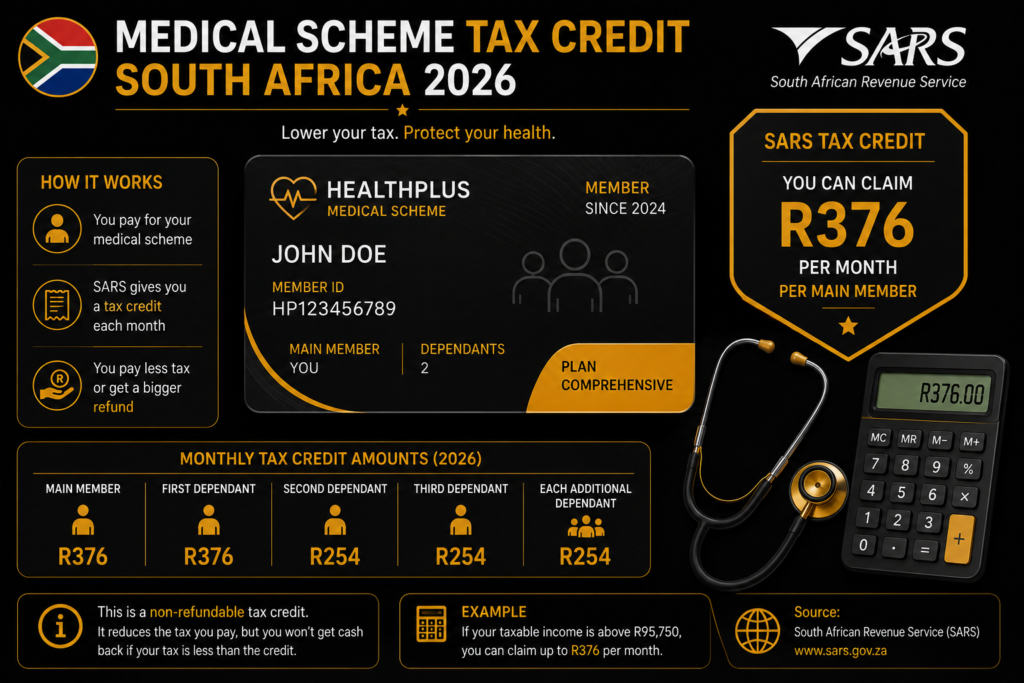
Every South African on a registered medical scheme gets a direct tax reduction through SARS — automatically, every month, through PAYE. For 2026/27, the Medical Scheme Fees Tax Credit is R376 per month for the main member and first dependant, and R254 for each additional dependant. A family of four saves R15,120 per year in tax before the additional medical expenses credit is even considered.
But most taxpayers only know about the first credit. The Additional Medical Expenses Tax Credit (AMTC) — which covers out-of-pocket medical costs your scheme did not pay — is where the real unclaimed money sits. SARS estimates that billions of rands in legitimate AMTC claims go unfiled every year simply because taxpayers do not know they qualify or do not keep the right records.
This guide covers both credits in full: the fixed MTC rates, the AMTC formulas for under-65s and over-65s, what expenses qualify, what does not, and exactly how to claim on your ITR12.
Part 1: Medical Scheme Fees Tax Credit (Section 6A)
The MTC is the simpler of the two credits. It is a fixed monthly amount based on how many people are covered on your medical scheme — your income level does not matter. Whether you earn R10,000 or R100,000 per month, the credit is the same.
| Beneficiary | 2025/26 Monthly | 2026/27 Monthly | 2026/27 Annual |
|---|---|---|---|
| Main member | R364 | R376 | R4,512 |
| First dependant | R364 | R376 | R4,512 |
| Each additional dependant | R246 | R254 | R3,048 |
For common family sizes, the annual MTC is:
| Family Size | Monthly Credit | Annual Credit |
|---|---|---|
| Single member | R376 | R4,512 |
| Member + spouse | R752 | R9,024 |
| Member + spouse + 1 child | R1,006 | R12,072 |
| Member + spouse + 2 children | R1,260 | R15,120 |
| Member + spouse + 3 children | R1,514 | R18,168 |
The MTC is applied automatically through PAYE by your employer. You do not need to claim it on your tax return — your employer applies the correct credit each month based on the number of dependants recorded on your medical scheme. However, it is worth checking your payslip to confirm the right number of dependants is reflected.
Critically, the MTC is a tax credit, not a deduction. It reduces the tax you owe directly — not your taxable income. This means it benefits all taxpayers equally regardless of their tax bracket. A person in the 18% bracket and a person in the 45% bracket both save the same R4,512 per year from a single-member MTC.
Part 2: Additional Medical Expenses Tax Credit (Section 6B)
The AMTC is where most of the unclaimed money sits. It covers two things: the portion of your medical scheme contributions that exceeds the MTC, and qualifying out-of-pocket medical expenses your scheme did not pay. The calculation differs depending on your age and disability status.
Under 65, No Disability
The formula for taxpayers under 65 without a qualifying disability:
AMTC = 25% × [(contributions paid − 4 × annual MTC) + qualifying expenses − 7.5% of taxable income]
Only the positive result counts — if the formula produces a negative number, the AMTC is zero. The 7.5% of taxable income floor is the key barrier for under-65s. On a taxable income of R500,000, this floor is R37,500. Your combined excess contributions and qualifying expenses must exceed R37,500 before you get any AMTC benefit.
This means the AMTC is most valuable to under-65 taxpayers who either have very high medical expenses or relatively lower taxable income — or both.
Age 65+, or Qualifying Disability
Taxpayers aged 65 and over, or those where the taxpayer, spouse, or child has a SARS-recognised disability, use a more generous formula:
AMTC = 33.3% × [(contributions paid − 3 × annual MTC) + qualifying expenses]
There is no 7.5% taxable income floor for this group. Every rand of excess contributions and qualifying expenses generates a credit at 33.3%. This makes the AMTC significantly more valuable for older taxpayers and those with disabilities.
Worked Example: Family of Four, Under 65
Thabo, aged 42, covers himself, his wife, and two children on a medical scheme. His monthly contributions are R4,500, and his taxable income is R400,000.
| Step | Amount |
|---|---|
| Annual contributions paid (R4,500 × 12) | R54,000 |
| Annual MTC (R1,260 × 12) | R15,120 |
| 4 × annual MTC | R60,480 |
| Excess contributions (R54,000 − R60,480) | −R6,480 (nil) |
| Qualifying out-of-pocket expenses (year total) | R18,000 |
| 7.5% of taxable income (R400,000 × 7.5%) | R30,000 |
| AMTC formula: (R0 + R18,000 − R30,000) | −R12,000 (nil) |
| AMTC result | R0 — no additional credit |
In this case, Thabo’s out-of-pocket expenses of R18,000 are below the 7.5% floor of R30,000, so no AMTC is available. He still benefits from the R15,120 annual MTC. If his out-of-pocket expenses had been R50,000, the AMTC would be 25% × (R0 + R50,000 − R30,000) = 25% × R20,000 = R5,000 additional credit.
Worked Example: Pensioner Aged 68
Margaret, aged 68, covers herself only. Her monthly contribution is R3,200 and she had R25,000 in qualifying out-of-pocket expenses during the year.
| Step | Amount |
|---|---|
| Annual contributions (R3,200 × 12) | R38,400 |
| Annual MTC (R376 × 12) | R4,512 |
| 3 × annual MTC (65+ formula) | R13,536 |
| Excess contributions (R38,400 − R13,536) | R24,864 |
| Qualifying expenses | R25,000 |
| AMTC: 33.3% × (R24,864 + R25,000) | R16,594 |
| Total annual medical credits (MTC + AMTC) | R21,106 |
Margaret saves R21,106 in tax from medical credits alone. The difference between the under-65 and 65+ formulas is dramatic — no 7.5% floor, a lower multiplier on the MTC, and a higher credit rate (33.3% vs 25%) make the AMTC far more accessible for older taxpayers.
What Qualifies as a Medical Expense?
| Qualifies ✓ | Does NOT Qualify ✗ |
|---|---|
| Doctor and specialist consultations | Cosmetic surgery (non-medical) |
| Hospital and day-clinic bills | Gym memberships |
| Prescribed medicines (from a pharmacist) | Over-the-counter medicines (cough syrup, vitamins) |
| Dental treatment | Health supplements |
| Optical: eye tests, glasses, contact lenses | Non-prescribed reading glasses |
| Physiotherapy, occupational therapy | Alternative/unregistered treatments |
| Disability-related expenses (prescribed by SARS) | Travel to medical appointments |
| Medical expenses incurred outside SA (similar services) | Medical tourism for non-qualifying procedures |
The single most important rule: keep every receipt and invoice. SARS requires proof of every expense claimed, and a verification or audit can happen at any time within the five-year prescription period. Receipts must show the provider’s name, the date, the nature of the service, and the amount paid by you (not the portion covered by your scheme).
How to Claim on Your ITR12
The MTC is applied automatically — you do not need to claim it. Your employer applies it through PAYE each month based on the IRP5 information from your medical scheme.
The AMTC must be claimed manually on your annual ITR12 tax return. When you file via SARS eFiling or at a SARS branch, there is a medical section where you enter your total contributions paid, the number of months and dependants covered, and your total qualifying out-of-pocket expenses. SARS calculates the credit based on the formula for your age category.
Your medical scheme sends you a tax certificate each year (usually by May/June) showing your total contributions and dependants. Match this against your IRP5 to ensure consistency. For out-of-pocket expenses, compile your receipts and invoices into a spreadsheet with date, provider, description, and amount — SARS may request this detail during a verification.
Common Mistakes That Cost You Money
The biggest mistake is not claiming the AMTC at all. Many taxpayers assume the automatic MTC is the only medical credit available and never explore Section 6B. If you paid even R5,000 in out-of-pocket medical expenses during the year, it is worth running the AMTC calculation.
The second mistake is wrong dependant count. If you added a child to your medical scheme mid-year but your employer’s payroll was not updated, you may be getting fewer months of MTC credit than you are entitled to. Check your IRP5 against your scheme’s tax certificate.
The third mistake is claiming non-qualifying expenses. Over-the-counter medicines purchased without a prescription, gym memberships, health supplements, and cosmetic procedures do not qualify. Including them triggers a SARS verification and delays your assessment.
Calculate Your Medical Credits
The FinzoTools South Africa Income Tax Calculator applies MTC automatically based on the number of medical scheme dependants you enter. For a full breakdown of how medical credits interact with SARS tax brackets and UIF deductions, see our related guides.
Source: Medical tax credit rates verified against SARS Budget 2026 FAQ and the Income Tax Act (Sections 6A and 6B), August 2026.