
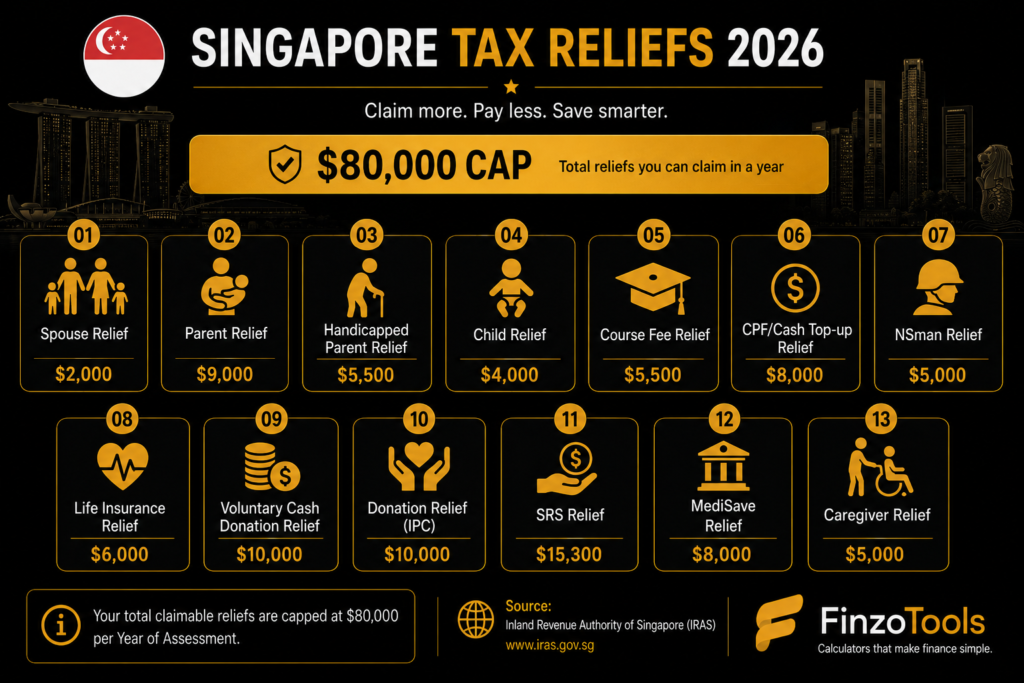
Singapore’s personal income tax rates are already among the lowest in the developed world — but the right combination of tax reliefs can reduce your bill even further. For Year of Assessment 2026, IRAS offers 13 personal tax reliefs covering work income, CPF contributions, retirement savings, national service, and family support. Used strategically, these reliefs can reduce your chargeable income by up to S$80,000 — the maximum personal relief cap.
But two previously popular reliefs have been discontinued, the dependent income threshold has doubled, and the Working Mother’s Child Relief has shifted from a percentage to a fixed dollar amount for newer children. This guide covers every relief available for YA 2026, who qualifies, how much you can claim, and a worked example showing how the $80,000 cap operates in practice.
The S$80,000 Personal Relief Cap
Before diving into individual reliefs, the most important rule: the total of all personal reliefs you claim cannot exceed S$80,000 per Year of Assessment. Even if your individual reliefs add up to $120,000, IRAS caps the deduction at $80,000. This cap has applied since YA 2018 and affects high earners with multiple reliefs — particularly working mothers combining child, parent, CPF, and SRS reliefs.
The cap applies to personal reliefs only. Donations (which receive a 2.5x deduction), rental expenses, and employment expenses are not counted towards the $80,000 limit.
Complete Tax Relief Table — YA 2026
| Relief | Who Qualifies | Maximum (S$) |
|---|---|---|
| Earned Income Relief | All employed/self-employed residents | 1,000 / 6,000 / 8,000 |
| CPF/Provident Fund Relief | Employees and self-employed with CPF | 37,740 |
| CPF Cash Top-Up Relief | Voluntary top-ups to SA/RA/MA | 8,000 (self) + 8,000 (family) |
| SRS Relief | SRS contributions | 15,300 (SC/PR) / 35,700 (foreigner) |
| Spouse Relief | Spouse income < $8,000/year | 2,000 |
| Handicapped Spouse Relief | Maintaining a handicapped spouse | 5,500 |
| Qualifying Child Relief (QCR) | Child under 16 or in full-time education, income < $8,000 | 4,000 per child |
| Child Relief (Disability) | Handicapped child | 7,500 per child |
| Working Mother’s Child Relief | Working mothers (SC children) | 8,000 / 10,000 / 12,000 |
| Parent Relief | Dependant parent/grandparent, income < $8,000 | 9,000 (with) / 5,500 (apart) |
| Handicapped Parent Relief | Handicapped parent/grandparent | 14,000 (with) / 10,000 (apart) |
| Grandparent Caregiver Relief | Working mothers using grandparents for childcare | 3,000 |
| NSman Self Relief | Active NSmen | 1,500–5,000 |
| NSman Wife/Parent Relief | Wives and parents of NSmen | 750 each |
| Life Insurance Relief | CPF contributions below $5,000 | 5,000 less CPF contributions |
| Total Relief Cap | 80,000 |
Earned Income Relief
Every working resident automatically qualifies for earned income relief. The amount depends on your age:
| Age | Relief Amount |
|---|---|
| Below 55 | S$1,000 |
| 55 to 59 | S$6,000 |
| 60 and above | S$8,000 |
The relief is capped at the lower of the amounts above or your actual earned income. If you are a handicapped person, the amounts double: $4,000 (below 55), $10,000 (55–59), and $12,000 (60+). This relief is claimed automatically by IRAS based on your employment records.
CPF Relief and CPF Cash Top-Up Relief
Your mandatory CPF contributions are automatically deducted from your taxable income. For an employee aged 55 and below earning S$8,000 per month, the annual CPF deduction is S$19,200 (20% × $8,000 × 12). The maximum CPF relief is S$37,740 — the CPF Annual Limit.
On top of mandatory contributions, you can claim additional relief by making voluntary cash top-ups to your Special Account, Retirement Account, or MediSave Account under the Retirement Sum Topping-Up Scheme. The relief is S$8,000 for top-ups to your own account and another S$8,000 for top-ups to a family member’s account (parents, spouse, siblings, grandparents) — a combined S$16,000.
For someone in the 15% tax bracket, a $16,000 CPF top-up relief saves $2,400 in tax while simultaneously boosting retirement savings at a guaranteed 4% interest rate. This makes CPF top-ups one of the most effective financial moves available to Singaporean taxpayers.
SRS Relief: The Hidden Tax Shelter
The Supplementary Retirement Scheme allows Singapore Citizens and PRs to contribute up to S$15,300 per year (S$35,700 for foreigners) and deduct the full amount from taxable income. At retirement (from age 63), only 50% of withdrawals are taxed — effectively halving your tax rate on SRS savings.
For a worker in the 15% bracket, a $15,300 SRS contribution saves $2,295 in tax now. When withdrawn at retirement, only $7,650 (50%) is taxable — and if retirement income is low enough, the effective tax on that could be near zero. SRS is particularly powerful for higher-income earners who are already maximising their CPF contributions.
Family Reliefs: Spouse, Child, and Parent
Spouse Relief: If your spouse’s annual income is below S$8,000 (doubled from S$4,000 effective YA 2025), you can claim $2,000. For a handicapped spouse, the relief increases to $5,500 with no income threshold.
Qualifying Child Relief: S$4,000 per child who is under 16 or in full-time education, provided the child’s annual income is below S$8,000. For handicapped children, the relief is $7,500 per child. Parents can agree to share the relief between them in any proportion.
Working Mother’s Child Relief (WMCR): For children born or adopted on or after 1 January 2024, WMCR is a fixed dollar amount: S$8,000 for the first child, S$10,000 for the second, and S$12,000 for the third and subsequent children. This replaced the previous percentage-based system. Only working mothers can claim WMCR, and the children must be Singapore Citizens. WMCR is claimed on top of QCR.
Parent Relief: If you support a dependant parent or grandparent whose annual income is below S$8,000, you can claim $9,000 (if they live with you) or $5,500 (if they do not). For handicapped dependants, the amounts increase to $14,000 and $10,000 respectively.
Grandparent Caregiver Relief: Working mothers who engage their parents, grandparents, parents-in-law, or grandparents-in-law to care for their children can claim an additional $3,000. Only one working mother can claim this per caregiver.
NSman Reliefs
National Service-related reliefs recognise the contribution of NSmen and their families:
| Relief | Amount (S$) |
|---|---|
| NSman Self (active, non-key appointment) | 3,000 |
| NSman Self (non-active) | 1,500 |
| NSman Self (key appointment) | 3,500–5,000 |
| NSman Wife | 750 |
| NSman Parent | 750 |
NSman reliefs are granted automatically by IRAS based on MINDEF records — you do not need to claim them manually.
Discontinued Reliefs — YA 2026
Two reliefs that were previously available are no longer claimable from YA 2026:
Course Fees Relief: Previously allowed a deduction of up to S$5,500 for approved course fees. This relief has officially lapsed from YA 2026. Taxpayers should use SkillsFuture Credits for upskilling instead, which provide direct subsidies rather than tax deductions.
Foreign Domestic Worker Levy Relief: Lapsed from YA 2025. Working mothers who employed foreign domestic workers can no longer claim the levy as a tax relief.
Worked Example: The $80,000 Cap in Action
Mrs Lee, aged 38, earns $150,000 per year and has three children aged 1, 8, and 12. Her reliefs for YA 2026:
| Relief | Amount (S$) |
|---|---|
| Earned Income Relief | 1,000 |
| CPF Relief (mandatory) | 19,200 |
| CPF Cash Top-Up (own account) | 8,000 |
| QCR (3 children × $4,000) | 12,000 |
| WMCR ($8,000 + $10,000 + $12,000) | 30,000 |
| Grandparent Caregiver Relief | 3,000 |
| Total calculated reliefs | 73,200 |
| Reliefs allowed (within cap) | 73,200 ✓ |
Mrs Lee’s total reliefs of $73,200 fall under the $80,000 cap, so the full amount is deductible. Her chargeable income drops from $150,000 to $76,800 — moving her from the 15% bracket to the 7% bracket for most of her income. If she also contributed $15,300 to SRS, her total would hit $88,500 — but IRAS would cap the deduction at $80,000, meaning $8,500 of relief is effectively wasted.
Parenthood Tax Rebate: Not a Relief
The Parenthood Tax Rebate (PTR) is often confused with tax reliefs, but it works differently. PTR is a direct reduction of your tax bill, not a reduction of your taxable income. It is not subject to the $80,000 relief cap.
| Child Order | Rebate (S$) |
|---|---|
| First child | 5,000 |
| Second child | 10,000 |
| Third and subsequent children | 20,000 each |
PTR can be shared between parents and carries forward to future years if your tax bill is less than the rebate amount. A couple with three Singapore Citizen children qualifies for $35,000 in total rebates — enough to eliminate several years of income tax entirely for moderate earners.
Calculate Your Tax After Reliefs
The FinzoTools Singapore Income Tax Calculator applies all YA 2026 reliefs automatically based on your inputs — age, CPF contributions, family status, and SRS. For a breakdown of how Singapore’s progressive tax brackets work and how CPF contributions reduce your taxable income, see our related guides.
Source: All relief amounts and eligibility rules verified against IRAS Tax Reliefs guidance and PwC Singapore Individual Deductions summary, August 2026.