
✅ Last verified: July 2026 — Source: HMRC, gov.uk, Money Saving Expert 2026/27
⚡ QUICK ANSWER
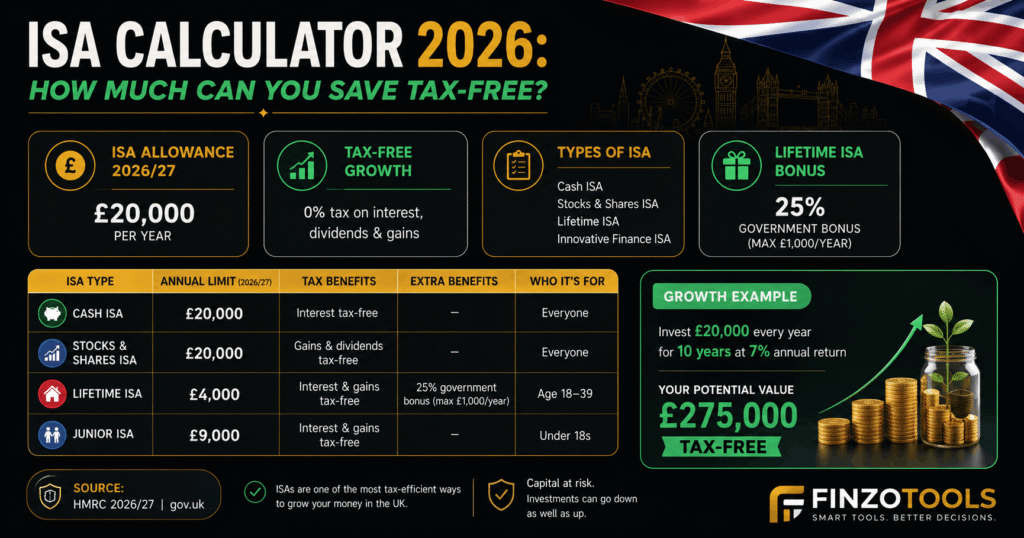
The ISA allowance for 2026/27 is £20,000 per year — completely tax-free. You pay zero tax on interest, dividends, and capital gains inside an ISA. The Lifetime ISA gives a 25% government bonus (up to £1,000/year) for first-time buyers or retirement. Use our free ISA Calculator to see exactly how much your ISA could grow. Source: HMRC gov.uk.
An ISA (Individual Savings Account) is one of the most powerful tax-saving tools available to UK residents — yet millions of people either do not use their full allowance or do not understand the differences between ISA types.
In this guide, we cover everything you need to know about ISAs in 2026/27 — the allowance, the four main types, how much your savings could grow tax-free, and which ISA is right for you.
ISA allowance 2026/27 — the key numbers
The ISA allowance is the maximum amount you can save or invest into ISAs in a single tax year (6 April 2026 to 5 April 2027). Here are the official 2026/27 figures from HMRC:
| ISA Type | Annual Allowance | Tax on Growth | Who Can Open |
|---|---|---|---|
| Cash ISA | Up to £20,000 | 0% on interest | Age 18+, UK resident |
| Stocks & Shares ISA | Up to £20,000 | 0% on gains/dividends | Age 18+, UK resident |
| Lifetime ISA (LISA) | Up to £4,000 | 0% + 25% bonus | Age 18–39 |
| Innovative Finance ISA | Up to £20,000 | 0% on interest | Age 18+, UK resident |
| Junior ISA (JISA) | Up to £9,000 | 0% on all growth | Under 18 |
Source: HMRC — Individual Savings Accounts 2026/27. Total ISA allowance across all types (except LISA and JISA): £20,000 per year.
💡 Important: You can split your £20,000 allowance across multiple ISA types in the same tax year — for example, £10,000 in a Cash ISA and £10,000 in a Stocks & Shares ISA. However, you cannot pay into two ISAs of the same type with different providers in the same tax year.
🧮 Calculate your ISA growth: Use our free ISA Calculator 2026 to project exactly how much your ISA savings could grow over 5, 10, 20 or 30 years — tax-free.
Cash ISA 2026/27 — is it worth it?
A Cash ISA works like an ordinary savings account but all interest is completely tax-free. With the Personal Savings Allowance (PSA) giving basic rate taxpayers £1,000 of tax-free interest per year anyway, many people wonder whether a Cash ISA is still worth it in 2026.
When a Cash ISA makes sense:
- You are a higher rate taxpayer (40%+) — your PSA is only £500, so a Cash ISA shelters more interest
- You have large savings — if your savings generate more than £1,000 interest/year, a Cash ISA protects the excess
- You want a safe, guaranteed return with no investment risk
- You are saving for a short-term goal (1–3 years)
| Savings Amount | Interest Rate | Annual Interest | Tax Outside ISA (40%) | Tax Inside ISA |
|---|---|---|---|---|
| £10,000 | 4.5% | £450 | £0 (within PSA) | £0 |
| £25,000 | 4.5% | £1,125 | £50 (above PSA) | £0 |
| £50,000 | 4.5% | £2,250 | £700 tax bill | £0 |
| £100,000 | 4.5% | £4,500 | £1,600 tax bill | £0 |
Higher rate taxpayer (40%). PSA for higher rate taxpayers is £500. For additional rate taxpayers (45%), PSA is £0 — every penny of interest is taxable outside an ISA.
Stocks & Shares ISA 2026/27 — the growth engine
A Stocks & Shares ISA lets you invest in shares, funds, bonds, and ETFs — with zero tax on any gains or dividends. This is where the real long-term power of an ISA lies.
Outside an ISA, you pay Capital Gains Tax (CGT) at 18% (basic rate) or 24% (higher rate) on investment gains above the £3,000 annual CGT allowance in 2026/27. Inside a Stocks & Shares ISA, you pay nothing — ever.
ISA growth example — £20,000/year for 10 years
| Years Invested | Annual Contribution | Total Invested | Value at 7%/year | Tax-Free Gain |
|---|---|---|---|---|
| 5 years | £20,000 | £100,000 | £115,000 | £15,000 |
| 10 years | £20,000 | £200,000 | £275,000 | £75,000 |
| 20 years | £20,000 | £400,000 | £820,000 | £420,000 |
| 30 years | £20,000 | £600,000 | £1,890,000 | £1,290,000 |
Illustrative only. Past performance is not a guarantee of future returns. 7% annual growth is the historic long-term average for global equity markets. No tax is payable on gains inside a Stocks & Shares ISA.
✅ The ISA millionaire is real: Investing the full £20,000 ISA allowance every year for 30 years at 7% average annual returns produces a pot of nearly £1.9 million — completely tax-free. Even investing just £500/month for 30 years at 7% produces over £600,000 tax-free.
📈 See your ISA growth: Try our ISA Growth Calculator — enter your monthly contribution and see your projected tax-free pot at any time horizon.
Lifetime ISA (LISA) 2026/27 — the 25% bonus explained
The Lifetime ISA is one of the most generous savings products available — the government adds a 25% bonus on everything you save, up to a maximum bonus of £1,000 per year.
| LISA Feature | Detail |
|---|---|
| Annual contribution limit | £4,000/year |
| Government bonus | 25% on contributions (max £1,000/year) |
| Age to open | 18 to 39 years old |
| Age contributions allowed | Up to age 50 |
| Maximum lifetime bonus | £33,000 (32 years × £1,000) |
| When can you withdraw? | First home purchase or age 60+ |
| First home price limit | £450,000 |
| Withdrawal penalty (other reasons) | 25% charge (effectively loses the bonus) |
Source: HMRC — Lifetime ISA 2026/27
LISA example — saving for a first home
- You save £4,000/year for 5 years = £20,000 contributed
- Government adds £1,000/year bonus = £5,000 in bonuses
- Total available for first home deposit = £25,000+ (plus growth)
- Property must be priced at £450,000 or less
⚠️ LISA withdrawal penalty warning: If you withdraw from a LISA for any reason other than buying your first home or reaching age 60, you pay a 25% withdrawal charge. This means you lose not just the government bonus but a small portion of your own savings too. Do not open a LISA unless you are confident you will use it for its intended purpose.
Junior ISA (JISA) 2026/27 — saving for your children
A Junior ISA lets parents and grandparents save up to £9,000 per year tax-free for a child under 18. The child cannot access the money until they turn 18 — at which point it automatically becomes an adult ISA.
- Annual allowance: £9,000 per child
- Available as Cash JISA or Stocks & Shares JISA
- Anyone can pay in — parents, grandparents, relatives, friends
- Child cannot withdraw until age 18
- Becomes an adult ISA automatically at 18
JISA growth example — £9,000/year from birth to 18
Saving £9,000/year from birth at 7% average annual growth produces approximately £320,000 by age 18 — completely tax-free.
Which ISA is right for you? — comparison
| Your Goal | Best ISA Type | Why |
|---|---|---|
| Safe short-term savings | Cash ISA | Guaranteed interest, no risk, easy access |
| Long-term wealth building | Stocks & Shares ISA | Higher growth potential, all gains tax-free |
| Buying first home (under 40) | Lifetime ISA | 25% government bonus on top of your savings |
| Retirement (under 40) | Lifetime ISA | 25% bonus + tax-free growth, withdraw at 60 |
| Saving for children | Junior ISA | £9,000/year, tax-free growth until 18 |
| Higher rate taxpayer with savings | Cash ISA first | PSA only £500 — ISA shelters more interest |
💷 Know your take-home pay first: Before deciding how much to save in an ISA, use our UK Salary Calculator 2026/27 to see exactly how much you take home each month after tax and NI — then work out what you can afford to save.
ISA vs pension — which is better in 2026?
Both ISAs and pensions offer tax advantages — but they work differently:
| Feature | ISA | Pension |
|---|---|---|
| Tax relief on contributions | ❌ No | ✅ Yes (20–45%) |
| Tax on withdrawals | ✅ None — ever | ❌ Taxed as income |
| Employer contributions | ❌ No | ✅ Yes (valuable!) |
| Access age | ✅ Anytime | ❌ Age 57+ (2028) |
| Annual allowance | £20,000 | Up to £60,000 |
| Inheritance tax | ❌ Included in estate | ✅ Often outside estate |
The verdict: Always max your employer pension match first (it is free money). Then use your ISA for flexible, tax-free savings. If you can do both — even better.
5 ISA mistakes to avoid in 2026/27
- Not using your allowance: The £20,000 ISA allowance cannot be carried forward — if you do not use it by 5 April 2027, it is gone forever.
- Leaving cash in a low-rate ISA: Easy-access Cash ISAs often pay poor rates. Shop around — best rates in 2026 are 4–5% for fixed-term Cash ISAs.
- Confusing LISA rules: Do not open a LISA for general savings — the 25% withdrawal penalty is brutal if you need the money for anything other than a first home or retirement.
- Not investing in a Stocks & Shares ISA for long-term goals: Cash ISAs are safe but rarely beat inflation over 10+ years. For long-term goals, a Stocks & Shares ISA in a low-cost global index fund typically does far better.
- Missing the LISA bonus deadline: The government pays the LISA bonus monthly — make sure contributions are in before the end of the tax year to maximise your bonus payments.
Calculate your ISA & UK salary
Free tools — no signup required. Used by thousands of UK savers every month.📈 ISA Calculator → 💷 UK Salary Calculator → 🏠 UK Mortgage Calculator →
Frequently asked questions — ISA 2026/27
What is the ISA allowance for 2026/27?
The ISA allowance for 2026/27 is £20,000 per year per person — completely tax-free. You can split this across Cash ISA, Stocks & Shares ISA, and Innovative Finance ISA in the same tax year. The Lifetime ISA has a separate £4,000 limit (which counts toward the £20,000 total).
How much can I save in a Lifetime ISA?
You can contribute up to £4,000 per year to a Lifetime ISA (LISA). The government adds a 25% bonus — so a £4,000 contribution earns a £1,000 bonus, giving you £5,000 per year. The maximum lifetime bonus is £33,000. You must be aged 18–39 to open a LISA and can only use it for a first home (up to £450,000) or retirement from age 60.
Is a Cash ISA worth it in 2026?
Yes — especially for higher rate taxpayers (40%+) whose Personal Savings Allowance is only £500, and for anyone with large savings generating more than £1,000 of interest per year. The best easy-access Cash ISAs in 2026 pay around 4–5% — always compare rates before opening one.
Can I have more than one ISA?
Yes. You can hold multiple ISAs — but you can only pay new money into one ISA of each type per tax year. For example, you can pay into one Cash ISA and one Stocks & Shares ISA in 2026/27, as long as your total contributions do not exceed £20,000.
What happens to my ISA when I die?
When you die, your ISA loses its tax-free status and forms part of your estate for inheritance tax purposes. However, your spouse or civil partner can inherit your ISA allowance via an Additional Permitted Subscription (APS) — allowing them to add the value of your ISA to their own without counting against their annual allowance.
How much could £20,000/year in a Stocks & Shares ISA grow?
Investing £20,000 per year in a Stocks & Shares ISA at 7% average annual return (historic long-term average for global equities): after 10 years ≈ £275,000, after 20 years ≈ £820,000, after 30 years ≈ £1.9 million — all completely tax-free. Use our ISA Calculator to model your own figures.
Can I withdraw money from my ISA?
For most ISAs — yes, at any time with no tax. However, withdrawing from a Lifetime ISA for any reason other than buying a first home or reaching age 60 incurs a 25% government penalty charge. Fixed-term Cash ISAs may also have early access penalties. Flexible ISAs allow you to replace withdrawn money in the same tax year without losing allowance.
📚 Sources & references
- • HMRC — Individual Savings Accounts (ISAs) 2026/27, gov.uk
- • HMRC — Lifetime ISA 2026/27, gov.uk
- • HMRC — Junior ISA 2026/27, gov.uk
- • MoneySavingExpert — Best Cash ISA rates 2026
© 2026 FinzoTools — For educational purposes only. This is not financial advice. Verify all figures at gov.uk before making investment decisions.