
✅ Last verified: July 2026 — Source: Canada Revenue Agency (CRA), Government of Canada 2026
⚡ QUICK ANSWER
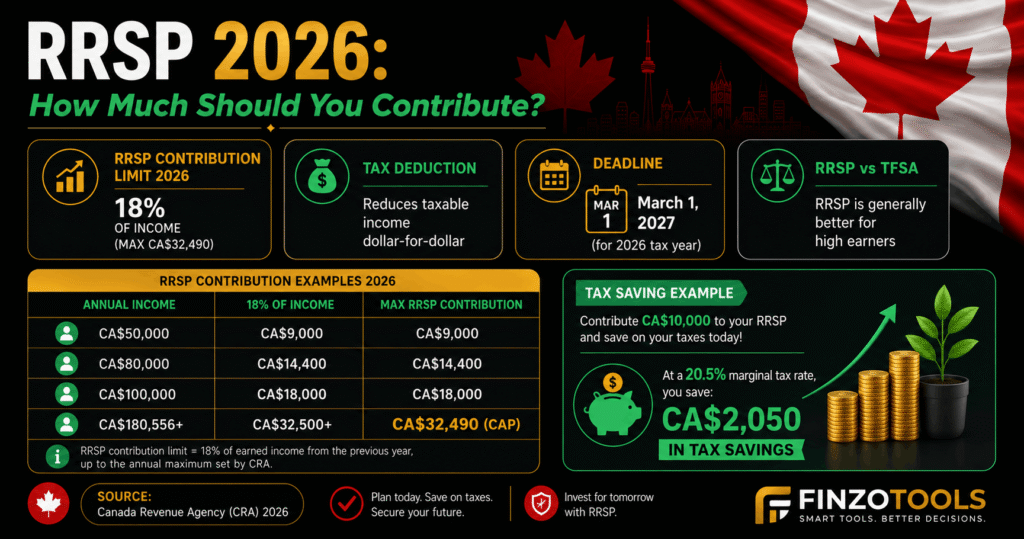
The RRSP contribution limit for 2026 is 18% of your 2025 earned income, up to a maximum of CA$32,490. Every dollar you contribute reduces your taxable income dollar-for-dollar — saving you CA$2,050–CA$5,850 in tax per CA$10,000 contributed depending on your tax bracket. The RRSP deadline for the 2026 tax year is March 1, 2027. Use our free RRSP Calculator to see your exact tax savings. Source: Canada Revenue Agency.
The RRSP (Registered Retirement Savings Plan) is Canada’s most powerful tax-reduction tool for working Canadians. Yet millions of Canadians either contribute too little, miss the deadline, or do not fully understand the tax savings they are leaving on the table.
In this guide, we cover the exact 2026 contribution limits, how much tax you actually save, the RRSP deadline, and whether RRSP or TFSA is better for your situation — using official figures from the Canada Revenue Agency.
RRSP contribution limit 2026 — the exact numbers
Your RRSP contribution limit for the 2026 tax year is 18% of your 2025 earned income, up to the annual maximum set by CRA. Any unused contribution room from previous years carries forward and can be used in 2026.
| 2025 Earned Income | RRSP Limit (18%) | Hit the Cap? |
|---|---|---|
| CA$30,000 | CA$5,400 | No |
| CA$50,000 | CA$9,000 | No |
| CA$80,000 | CA$14,400 | No |
| CA$100,000 | CA$18,000 | No |
| CA$150,000 | CA$27,000 | No |
| CA$180,556+ | CA$32,490 (MAX) | Yes — capped |
Source: Canada Revenue Agency — RRSP Contribution Limits 2026. Income of CA$180,556 or more hits the CA$32,490 annual cap.
💡 Check your exact limit: Your personal RRSP contribution limit is shown on your most recent CRA Notice of Assessment — or log in to My CRA Account to see your available room including any unused amounts carried forward from previous years.
🧮 Calculate your RRSP savings: Use our free RRSP Calculator 2026 to see exactly how much tax you save and how much your RRSP could grow by retirement.
How much tax does an RRSP contribution actually save?
This is where RRSP really shines. Every dollar you put into your RRSP reduces your taxable income by one dollar — saving you tax at your marginal rate. The higher your income, the more you save.
| Province | Income | Marginal Rate | Tax Saved per CA$10,000 |
|---|---|---|---|
| Ontario | CA$60,000 | ~29.65% | CA$2,965 |
| Ontario | CA$100,000 | ~43.41% | CA$4,341 |
| Ontario | CA$150,000 | ~49.53% | CA$4,953 |
| British Columbia | CA$100,000 | ~40.70% | CA$4,070 |
| Alberta | CA$100,000 | ~30.50% | CA$3,050 |
| Quebec | CA$100,000 | ~45.71% | CA$4,571 |
Combined federal and provincial marginal tax rates 2026. Tax saved = RRSP contribution × marginal rate. Source: Canada Revenue Agency 2026.
Real example — CA$80,000 income in Ontario
- RRSP contribution: CA$14,400 (18% of income)
- Marginal tax rate: ~31.5%
- Tax refund from CRA: ~CA$4,536
- Net cost of CA$14,400 RRSP contribution: only CA$9,864
- AND the CA$14,400 grows tax-sheltered until withdrawal
✅ The RRSP refund trick: When you get your tax refund from your RRSP contribution, invest it back into your RRSP the following year. This compounding effect — sometimes called the RRSP refund cycle — dramatically accelerates your retirement savings over 20–30 years.
RRSP deadline 2026 — do not miss it
The RRSP contribution deadline for the 2026 tax year is March 1, 2027 at 11:59 PM local time. Contributions made between January 1 and March 1, 2027 can be applied to either the 2026 or 2027 tax year — your choice.
| Tax Year | RRSP Deadline | Contribution Limit |
|---|---|---|
| 2024 | March 3, 2025 | CA$31,560 |
| 2025 | March 2, 2026 | CA$32,490 |
| 2026 | March 1, 2027 | CA$32,490 |
Source: CRA — RRSP Contribution Deadline
⚠️ Do not over-contribute: Contributing more than your RRSP limit (plus CA$2,000 lifetime buffer) results in a 1% per month penalty tax on the excess amount. Always verify your available room at My CRA Account before contributing.
RRSP growth — how much could you have at retirement?
| Monthly Contribution | Years to Retirement | Value at 6%/year | Value at 8%/year |
|---|---|---|---|
| CA$500/month | 20 years | CA$231,000 | CA$294,000 |
| CA$500/month | 30 years | CA$502,000 | CA$745,000 |
| CA$1,000/month | 20 years | CA$462,000 | CA$589,000 |
| CA$1,000/month | 30 years | CA$1,004,000 | CA$1,490,000 |
| CA$2,708/month (max) | 30 years | CA$2,720,000 | CA$4,035,000 |
Illustrative only. Past performance does not guarantee future returns. CA$2,708/month = CA$32,490 annual max contribution.
💰 See your take-home pay first: Use our Canada Salary Calculator 2026 to see your take-home pay after federal tax, provincial tax, CPP and EI — then decide how much you can afford to put in your RRSP.
RRSP vs TFSA — which is better in 2026?
This is the most common question Canadian investors ask. The honest answer is: it depends on your income level.
| Feature | RRSP | TFSA |
|---|---|---|
| Tax on contributions | Deductible (reduces income now) | Not deductible (after-tax dollars) |
| Tax on growth | Tax-deferred (not free) | Completely tax-free |
| Tax on withdrawals | Taxed as income | Tax-free always |
| Contribution room | 18% of earned income (max CA$32,490) | CA$7,000/year (2026) |
| Withdrawal room | Lost permanently | Restored next January |
| Affects GIS/OAS? | Yes — withdrawals count as income | No — withdrawals not counted |
| Best for | High earners (30%+ tax rate) | Lower earners or flexible savers |
Simple rule of thumb:
- Income above CA$60,000 → prioritise RRSP first (higher tax bracket = bigger deduction)
- Income below CA$50,000 → consider TFSA first (lower bracket means RRSP deduction worth less)
- Income between CA$50,000–CA$60,000 → split between both or prioritise employer pension match first
- Always: max your employer pension match before either RRSP or TFSA — it is free money
💡 The RRSP sweet spot: RRSP works best when you contribute at a high marginal rate (working years) and withdraw at a lower marginal rate (retirement). If your retirement income will be similar to your working income, the TFSA may be more tax-efficient.
RRSP Home Buyers Plan — withdraw CA$60,000 for your first home
The Home Buyers Plan (HBP) allows first-time home buyers to withdraw up to CA$60,000 from their RRSP tax-free to use as a down payment. This is one of the most valuable RRSP features for younger Canadians.
- Maximum withdrawal: CA$60,000 per person (CA$120,000 per couple)
- Must be a first-time home buyer (or not owned a home in the last 4 years)
- Must repay the withdrawal over 15 years (or it counts as income)
- RRSP funds must have been in the account for at least 90 days
🏠 Planning to buy in Canada? Use our Canadian Mortgage Calculator to see your monthly payments using correct Canadian semi-annual compounding rules — plus CMHC insurance costs.
RRSP Lifelong Learning Plan — withdraw for education
The Lifelong Learning Plan (LLP) allows you to withdraw up to CA$10,000 per year (maximum CA$20,000 total) from your RRSP to fund full-time education or training for yourself or your spouse — tax-free at withdrawal.
- Maximum: CA$10,000/year, CA$20,000 total
- Must enrol in a qualifying full-time program
- Must repay over 10 years (or counts as income)
5 RRSP strategies to maximise your savings in 2026
- Contribute early in the tax year: Contributing in January rather than February gives your money an extra year of tax-sheltered growth — this alone can add tens of thousands of dollars over a career.
- Set up monthly automatic contributions: Rather than scrambling for a lump sum before the March deadline, set up monthly RRSP contributions — CA$500/month is more manageable than CA$6,000 in February.
- Reinvest your tax refund: When you receive your RRSP tax refund from CRA, contribute it straight back into your RRSP. This compounding loop significantly accelerates growth.
- Check your carry-forward room: Millions of Canadians have unused RRSP room from previous years. Log into My CRA Account to see your total available contribution room — it may be much higher than this year’s limit alone.
- Spousal RRSP for income splitting: If you earn significantly more than your spouse, contribute to a Spousal RRSP — your spouse owns the account and withdraws in retirement at their lower tax rate, reducing your combined tax bill.
Calculate your RRSP & Canadian salary
Free tools — no signup required. Trusted by thousands of Canadians.📈 RRSP Calculator → 💰 Canada Salary Calculator → 🏠 Canadian Mortgage Calculator →
Frequently asked questions — RRSP 2026
What is the RRSP contribution limit for 2026?
The RRSP contribution limit for 2026 is 18% of your 2025 earned income, up to a maximum of CA$32,490. Any unused contribution room from previous years carries forward and adds to your 2026 limit. Check your exact available room on your CRA Notice of Assessment or at My CRA Account.
When is the RRSP deadline for 2026?
The RRSP contribution deadline for the 2026 tax year is March 1, 2027. Contributions made between January 1 and March 1, 2027 can be applied to either the 2026 or 2027 tax year — you choose when filing your return.
How much tax does an RRSP contribution save?
Every CA$10,000 RRSP contribution saves you tax equal to your marginal rate. In Ontario at CA$100,000 income that is approximately CA$4,341 in tax savings. In Alberta at CA$100,000 income it is approximately CA$3,050. The higher your income, the more you save per dollar contributed.
Is RRSP or TFSA better in 2026?
For high earners (above CA$60,000) the RRSP is generally better because the tax deduction is worth more at a higher marginal rate. For lower earners (below CA$50,000) the TFSA is often better as the RRSP deduction is worth less and TFSA withdrawals do not affect income-tested benefits. Always max your employer pension match before either.
Can I use my RRSP to buy a first home?
Yes. The Home Buyers Plan (HBP) lets first-time buyers withdraw up to CA$60,000 per person (CA$120,000 per couple) from their RRSP tax-free for a home purchase. You must repay the amount over 15 years or it is added to your taxable income. RRSP funds must have been deposited at least 90 days before withdrawal.
When must I convert my RRSP?
You must convert your RRSP to a RRIF (Registered Retirement Income Fund) or annuity by December 31 of the year you turn 71. After conversion you must make minimum annual withdrawals from your RRIF — the minimum percentage increases with age and all withdrawals are taxed as income.
What happens if I over-contribute to my RRSP?
There is a CA$2,000 lifetime over-contribution buffer, but anything above your limit plus CA$2,000 is subject to a 1% per month penalty tax until withdrawn. Always verify your contribution room on your CRA Notice of Assessment before contributing to avoid this penalty.
📚 Sources & references
- • Canada Revenue Agency — RRSP Contributions 2026
- • CRA — Home Buyers Plan 2026
- • CRA — Lifelong Learning Plan 2026
- • My CRA Account — Check your RRSP room
© 2026 FinzoTools — For educational purposes only. This is not financial advice. Verify all figures at canada.ca/cra before making investment decisions.