
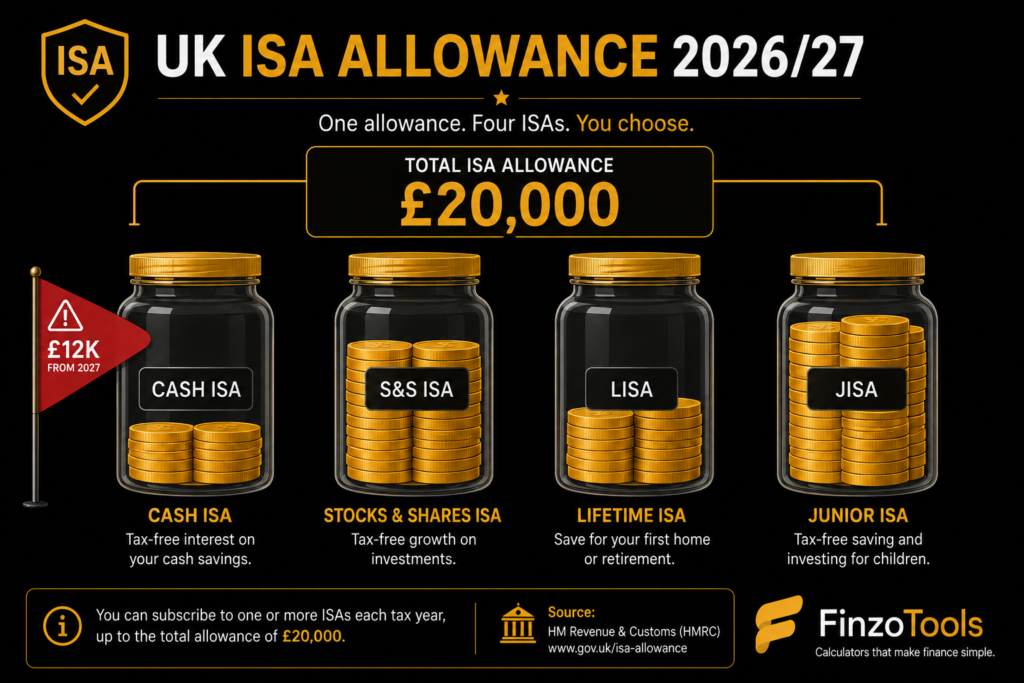
Every UK resident gets £20,000 of tax-free investment and savings space each year. Interest, dividends, and capital gains earned inside an ISA are completely free of Income Tax and Capital Gains Tax — with no limit on how large the pot grows and no requirement to declare any of it on your tax return. For the 2026/27 tax year, you can split that £20,000 across Cash ISAs, Stocks & Shares ISAs, Lifetime ISAs, and Innovative Finance ISAs however you choose.
But the landscape is changing. From April 2027, the Cash ISA allowance drops to £12,000 for anyone under 65, and new anti-circumvention rules will tax uninvested cash sitting inside Stocks & Shares ISAs. The Lifetime ISA is being replaced entirely from April 2028. This makes 2026/27 the last full tax year where the current rules apply unchanged — and the last chance to put the full £20,000 into a Cash ISA if you are under 65.
This guide compares all four ISA types, explains the allowances and rules for each, covers the April 2027 changes, and helps you decide how to split your £20,000 for maximum benefit.
ISA Allowances at a Glance — 2026/27
| ISA Type | 2026/27 Limit | From April 2027 |
|---|---|---|
| Overall ISA allowance | £20,000 | £20,000 (unchanged) |
| Cash ISA | Up to £20,000 | £12,000 (under 65s) |
| Stocks & Shares ISA | Up to £20,000 | Up to £20,000 (unchanged) |
| Lifetime ISA (LISA) | £4,000 (within £20K) | £4,000 (replacement from 2028) |
| Innovative Finance ISA | Up to £20,000 | Up to £20,000 (unchanged) |
| Junior ISA (JISA) | £9,000 (separate) | £9,000 (unchanged) |
The overall £20,000 limit is shared across all ISA types except the Junior ISA, which has its own separate £9,000 allowance. The LISA’s £4,000 counts inside the £20,000 — it is not additional. So if you contribute £4,000 to a LISA, you have £16,000 remaining for other ISAs.
Since 6 April 2024, you can pay into multiple ISAs of the same type in a single tax year — for example, two different Cash ISAs with two different providers. The only exceptions are the LISA (one per tax year) and the Junior ISA (one of each type per tax year).
Cash ISA: Simple, Safe, Shrinking
A Cash ISA works like a savings account but with one critical advantage: all interest is tax-free. Outside an ISA, savings interest above your Personal Savings Allowance (£1,000 for basic rate taxpayers, £500 for higher rate, £0 for additional rate) is taxed as income. Inside a Cash ISA, there is no limit — £100,000 earning 4% interest generates £4,000 of completely tax-free income.
Cash ISA rates in mid-2026 range from approximately 4.0% to 4.75% AER for easy-access accounts, with fixed-rate deals offering slightly more for 1-2 year terms. Your capital is protected by the FSCS up to £85,000 per institution.
A Cash ISA is best for money you cannot afford to lose: emergency funds, short-term savings goals (1-3 years), and capital you need access to at any time. It is not the best choice for long-term wealth building because returns rarely beat inflation consistently over decades.
The April 2027 change: From 6 April 2027, the Cash ISA allowance drops to £12,000 for anyone under 65. Savers aged 65 and over keep the full £20,000 Cash ISA limit. This means 2026/27 is the last tax year where under 65s can put the full £20,000 into a Cash ISA. If you have been maximising your Cash ISA, consider whether to use this final window or begin shifting towards Stocks & Shares ISAs now.
Stocks & Shares ISA: Higher Returns, More Risk
A Stocks & Shares ISA lets you invest your ISA allowance in funds, individual shares, bonds, ETFs, and investment trusts — with all dividends, interest, and capital gains completely tax-free. Over the long term, stock market returns have historically averaged 7-10% per year, significantly outperforming cash savings.
The tax advantage is particularly powerful for dividends. Outside an ISA, dividends above the £500 dividend allowance (2026/27) are taxed at 8.75% (basic rate), 33.75% (higher rate), or 39.35% (additional rate). Inside an ISA, every dividend is tax-free regardless of amount.
| Factor | Cash ISA | Stocks & Shares ISA |
|---|---|---|
| Typical annual return | 3–5% | 7–10% (long-term average) |
| Capital at risk? | No (FSCS protected) | Yes — value can fall |
| Best for | 1–3 year goals, emergency fund | 5+ year goals, retirement |
| Fees | Usually none | Platform + fund fees (0.2–1%+) |
| Access | Instant (easy-access) | Usually 1–3 business days |
| April 2027 change | Limit drops to £12K (under 65) | No change |
A Stocks & Shares ISA is the right choice for money you will not need for at least five years. Over shorter periods, market volatility means you could withdraw less than you invested. Over longer periods, the probability of positive returns increases significantly — and the tax-free compounding makes a dramatic difference to final wealth.
For a deeper dive into how Cash and Stocks & Shares ISAs compare in practice, see our Stocks & Shares ISA vs Cash ISA 2026 comparison.
Lifetime ISA: The 25% Bonus (While It Lasts)
The Lifetime ISA adds a 25% government bonus on contributions up to £4,000 per year — worth up to £1,000 of free money annually. It is designed for two purposes: saving for a first home (property up to £450,000) or retirement (accessible from age 60).
The catch is the 25% withdrawal penalty for any other purpose, which takes back the bonus plus 6.25% of your own money. This makes the LISA inflexible compared to other ISA types.
The government has announced a replacement — the First-Time Buyer ISA — launching from April 2028. The replacement will remove the withdrawal penalty but also remove the retirement savings function. Existing LISA holders can continue contributing under current rules indefinitely. For a full breakdown, see our Lifetime ISA 2026 guide.
Key LISA numbers: you must be aged 18–39 to open one, you can contribute until age 50, and the £4,000 annual limit counts within your overall £20,000 ISA allowance.
Junior ISA: £9,000 Tax-Free for Your Children
The Junior ISA (JISA) has its own separate allowance of £9,000 per tax year — it does not count towards the parent’s £20,000 adult ISA allowance. A parent or guardian opens the account, but anyone can contribute — grandparents, family friends, or the child themselves.
You can open both a Junior Cash ISA and a Junior Stocks & Shares ISA for the same child. The £9,000 limit is shared between them. The child cannot access the money until they turn 18, at which point the JISA automatically converts into an adult ISA.
For children with a long investment horizon (10+ years), a Junior Stocks & Shares ISA typically outperforms a Junior Cash ISA. Contributing £9,000 per year for 18 years at 7% average growth produces approximately £340,000 tax-free when the child turns 18 — on £162,000 of total contributions.
ISA Growth Projections: £20,000 Per Year
Here is how the full £20,000 annual ISA allowance grows over time at different return rates:
| Years | Contributed | Cash ISA (4%) | S&S ISA (7%) | Difference |
|---|---|---|---|---|
| 5 | £100,000 | £110,800 | £119,500 | +£8,700 |
| 10 | £200,000 | £245,500 | £287,200 | +£41,700 |
| 20 | £400,000 | £608,400 | £866,800 | +£258,400 |
| 30 | £600,000 | £1,101,600 | £1,968,600 | +£867,000 |
Over 30 years, the difference between Cash ISA returns (4%) and Stocks & Shares ISA returns (7%) is nearly £870,000 — all tax-free. This is the core argument for investing rather than saving, and the reason the government is pushing the April 2027 Cash ISA limit reduction.
April 2027 Changes: What You Need to Know
The Autumn Budget 2025 announced significant ISA reforms taking effect from 6 April 2027. Here is exactly what is changing:
Cash ISA limit drops to £12,000 for under 65s. The overall £20,000 ISA allowance stays the same, but no more than £12,000 can go into Cash ISAs. The remaining £8,000 must go into Stocks & Shares ISAs, IFISAs, or LISAs. Savers aged 65 and over are exempt and keep the full £20,000 Cash ISA limit.
22% tax on uninvested cash in Stocks & Shares ISAs. To prevent people from circumventing the Cash ISA limit by holding cash inside a Stocks & Shares ISA wrapper, HMRC will apply a 22% flat-rate tax on interest earned from uninvested cash held within non-Cash ISAs.
Transfers from non-Cash ISAs to Cash ISAs banned for under 65s. You will not be able to transfer money from a Stocks & Shares ISA back into a Cash ISA if you are under 65. This prevents the strategy of investing nominally to bypass the Cash ISA limit, then transferring back to cash.
These changes do not affect existing Cash ISA balances — money already saved in Cash ISAs before April 2027 remains fully protected and continues to earn tax-free interest with no limit.
How to Split Your £20,000 ISA Allowance
The optimal split depends on your time horizon, risk tolerance, and specific goals. Here are three common strategies:
Conservative saver (short-term goals): £16,000 in a Cash ISA + £4,000 in a LISA (if eligible). Maximum safety, FSCS protection, and the 25% LISA bonus. Best for those saving for a home deposit within 1–3 years.
Balanced approach (medium-term): £8,000 in a Cash ISA (emergency fund) + £12,000 in a Stocks & Shares ISA (global index funds). Provides liquidity for emergencies while growing wealth tax-free for 5+ year goals. This split also future-proofs you for the April 2027 rules.
Growth-focused (long-term): £20,000 in a Stocks & Shares ISA (diversified equity ETFs). Maximum long-term growth potential. Only appropriate if you already have an emergency fund outside the ISA and will not need the money for 5+ years.
Calculate Your ISA Growth
The FinzoTools UK ISA Calculator lets you model different contribution amounts, growth rates, and time horizons for both Cash and Stocks & Shares ISAs. See exactly how your £20,000 annual allowance could grow over 5, 10, 20, or 30 years — and compare the tax savings against a non-ISA investment.
Source: ISA allowances verified against GOV.UK ISA guidance. April 2027 changes from GOV.UK ISA Reform 2027 Factsheet, published 23 June 2026.