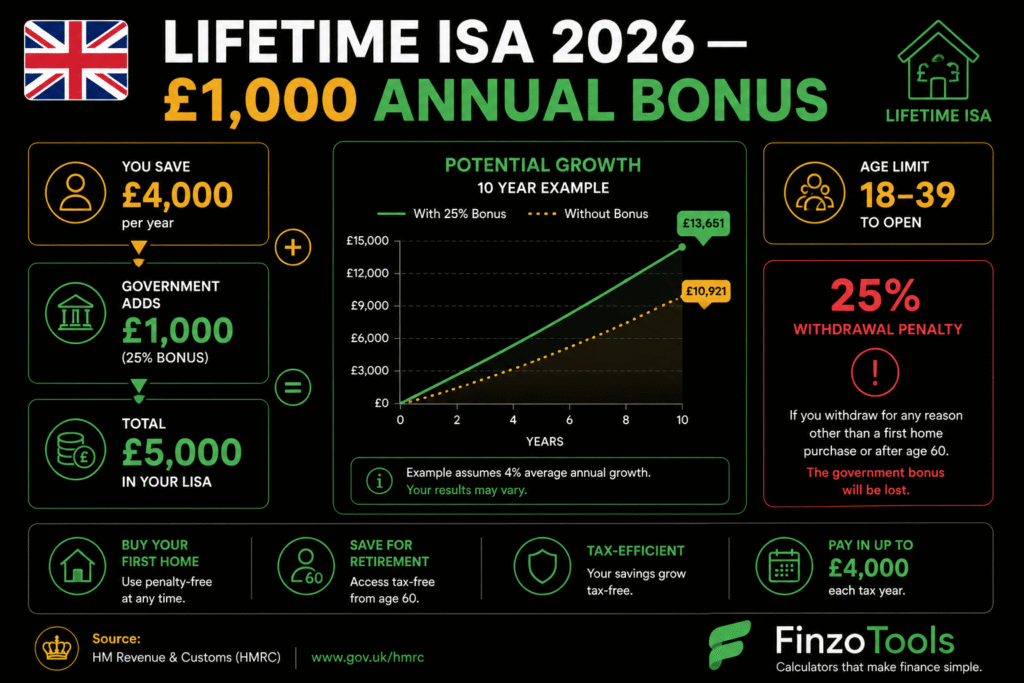
The Lifetime ISA is the most generous savings incentive the UK government offers to under-40s. Put in up to £4,000 a year and the government adds 25% on top — that is £1,000 of free money, every single tax year. Over a full savings lifetime, you could accumulate up to £160,000 in contributions and bonuses alone, before any interest or investment growth.
But there is a serious catch. If you withdraw for any reason other than buying your first home or reaching age 60, the 25% withdrawal penalty does not just take back the bonus — it takes back the bonus and 6.25% of your own money. That is the trap that has caught over 129,000 savers in a single tax year, costing them a combined £102 million.
This guide covers everything about the Lifetime ISA in the 2026/27 tax year: how the bonus works, who can open one, the penalty maths, Cash vs Stocks & Shares LISAs, and the confirmed replacement launching in April 2028.
What Is a Lifetime ISA?
A Lifetime ISA (LISA) is a tax-free savings or investment account that comes with a 25% government bonus. It was launched in April 2017 and is designed for two specific purposes: saving for your first home (costing up to £450,000) or saving for retirement (accessible from age 60). The LISA sits within the broader ISA framework, meaning all interest, dividends, and capital gains inside the account are completely tax-free.
The government bonus is paid directly into your LISA by HMRC, usually within six to eight weeks of each contribution. Unlike a pension, you do not need an employer to set one up, and unlike a Help to Buy ISA (which closed to new applicants), the bonus is paid as you save rather than at the point of purchase.
LISA Rules at a Glance — 2026/27
| Feature | Detail |
|---|---|
| Annual contribution limit | £4,000 |
| Government bonus | 25% (up to £1,000/year) |
| Overall ISA allowance | £20,000 (LISA counts towards this) |
| Age to open | 18 to 39 |
| Age to contribute until | 50 |
| Penalty-free first home use | Property up to £450,000, account open 12+ months |
| Penalty-free retirement access | From age 60 |
| Early withdrawal penalty | 25% of total amount withdrawn |
| Lifetime maximum (contributions + bonus) | £160,000 (excluding growth) |
| Replacement product | First-Time Buyer ISA from April 2028 |
How the 25% Bonus Works
Every pound you put into a LISA gets a 25% top-up from the government. Contribute £100 and you get £25. Contribute the full £4,000 annual limit and you receive the maximum £1,000 bonus. The bonus is calculated on your actual contributions, not on any interest or investment gains.
HMRC pays the bonus directly into your LISA account, typically within six to eight weeks of each contribution. This means if you have a Cash LISA, the bonus itself starts earning interest from the moment it arrives — a compounding advantage that the proposed replacement product will not offer.
If you open a LISA at age 18 and contribute the maximum £4,000 every year until age 50 (32 years of contributions), you would put in £128,000 of your own money and receive £32,000 in government bonuses. That is £160,000 before any interest or investment returns are added.
The Withdrawal Penalty: Why 25% Costs You More Than You Think
This is where most people get caught. If you withdraw from your LISA for any reason other than buying a qualifying first home or reaching age 60, HMRC imposes a 25% withdrawal charge. The critical detail is that the 25% applies to the total amount withdrawn — your contributions plus the bonus — not just the bonus.
Here is the maths that trips people up:
| Step | Amount |
|---|---|
| You contribute | £4,000 |
| Government bonus (25%) | +£1,000 |
| Total LISA balance | £5,000 |
| Withdrawal penalty (25% of £5,000) | −£1,250 |
| Amount you receive | £3,750 |
You put in £4,000 and get back £3,750. The penalty does not just claw back the £1,000 bonus — it takes an additional £250 of your own money. That £250 represents exactly 6.25% of your original contribution. You are worse off than if you had never opened the LISA at all.
This penalty cost 129,200 savers a combined £102 million in the 2024/25 tax year alone. The government temporarily reduced the penalty to 20% during COVID, which merely clawed back the bonus without touching your own money. That reduction ended, and the full 25% charge has applied since April 2021.
When Can You Withdraw Penalty-Free?
There are only three situations where you can access your LISA funds without paying the 25% charge.
Buying your first home: You must be a first-time buyer purchasing a property worth £450,000 or less using a mortgage. The LISA must have been open for at least 12 months before the purchase completes. Your LISA provider releases the funds directly to your conveyancer — you cannot withdraw the cash to your bank account and then use it for a deposit. The process typically takes around 30 days from the provider receiving the correct paperwork.
Reaching age 60: From your 60th birthday, you can withdraw any amount from your LISA for any purpose with no penalty. At this point, the LISA effectively becomes a flexible, tax-free savings pot.
Terminal illness: If you are diagnosed with a terminal illness and have less than 12 months to live, you can withdraw penalty-free at any age.
Every other withdrawal — including transferring to a different type of ISA — triggers the 25% charge.
Cash LISA vs Stocks & Shares LISA
You can hold your LISA as either a Cash LISA or a Stocks & Shares LISA. The choice depends on your time horizon and risk tolerance.
A Cash LISA works like a savings account. Your money earns a fixed or variable interest rate, and the capital is protected by the FSCS up to £85,000 per institution. After the Bank of England held the base rate at 3.75% on 30 April 2026, Cash LISA rates have stabilised — Moneybox offers 4.35% AER and Tembo offers 4.30% AER as of mid-2026. A Cash LISA is generally better if you are planning to buy a home within the next five years, because you need the certainty that your deposit will not fall in value.
A Stocks & Shares LISA invests your contributions into funds, equities, or other investments. Over the long term, stock market returns have historically outperformed cash savings, but values can fall as well as rise. A Stocks & Shares LISA is typically more suitable if you are saving for retirement (20+ years away) or have a longer time horizon before purchasing a home. Providers like AJ Bell, Hargreaves Lansdown, and Nutmeg offer Stocks & Shares LISAs with varying fund options and fee structures.
| Factor | Cash LISA | Stocks & Shares LISA |
|---|---|---|
| Risk | Capital protected (FSCS) | Value can fall below contributions |
| Typical return (2026) | 4.0%–4.35% AER | Varies — historically 7%–10% long-term |
| Best for | Buying a home in 1–5 years | Retirement or 10+ year horizon |
| Fees | Usually none | Platform + fund fees (0.25%–1%+) |
| Penalty impact | Penalty on contributions + bonus | Penalty on contributions + bonus + growth |
With a Stocks & Shares LISA, the 25% penalty applies to the entire withdrawal amount including any investment growth. If your £5,000 (£4,000 contribution + £1,000 bonus) has grown to £6,000, the penalty is 25% of £6,000 = £1,500. You get back £4,500 — still more than your £4,000 contribution in this case, but the penalty bites harder on larger gains.
The £450,000 Property Cap: The LISA’s Biggest Weakness
To use your LISA penalty-free for a first home, the property must cost £450,000 or less. This cap was set when the LISA launched in 2017 and has never been increased. In many parts of England — particularly London, the South East, and large cities — the average first-time buyer price now exceeds this limit, making the LISA unusable for its intended purpose.
If you find a property at £460,000, you cannot use your LISA at all. There is no partial penalty-free withdrawal. You would have to either pay the full 25% penalty to access the funds or find a cheaper property. This has been one of the most criticised aspects of the LISA and is a key area of the government’s 2026 consultation on the replacement product.
However, London house prices have posted seven consecutive monthly falls as of mid-2026, which has brought more properties in the capital back under the £450,000 threshold than at any point in the previous three years.
LISA vs Pension: Which Is Better for Retirement?
The LISA and workplace pensions both offer tax advantages for retirement saving, but they work very differently.
A workplace pension gives you tax relief on contributions (effectively a 25% boost for basic rate taxpayers, 66.67% for higher rate) plus mandatory employer contributions (minimum 3% of qualifying earnings under auto-enrolment). Pension contributions also reduce your taxable income. The downside is that pensions are locked until age 55 (rising to 57 from 2028), and withdrawals above the 25% tax-free lump sum are taxed as income.
A LISA gives a flat 25% bonus regardless of your tax rate, and withdrawals from age 60 are completely tax-free — no income tax on any amount. For a basic rate taxpayer, the effective bonus rate is similar to a pension. For a higher or additional rate taxpayer, the pension is significantly more generous.
The critical difference for most people is the employer match. If your employer contributes 3%–5% to your pension, that is free money you cannot get through a LISA. Financial guidance from MoneyHelper consistently recommends that you should always take the full employer pension match before considering a LISA for retirement savings.
From April 2028, the LISA’s retirement savings function will be removed entirely when the replacement First-Time Buyer ISA launches. This makes the question increasingly time-limited — the LISA retirement option has at most two more tax years of contributions remaining (2026/27 and 2027/28).
The LISA Growth Scenario: What £4,000 a Year Becomes
To understand the LISA’s real power, consider what happens when you maximise contributions over different time periods. The table below assumes a Cash LISA at 4% AER and a Stocks & Shares LISA averaging 7% annual growth, both with the £1,000 annual bonus reinvested.
| Years Saving | Your Contributions | Total Bonus | Cash LISA (4%) | S&S LISA (7%) |
|---|---|---|---|---|
| 5 years | £20,000 | £5,000 | £27,700 | £29,500 |
| 10 years | £40,000 | £10,000 | £61,600 | £71,500 |
| 20 years | £80,000 | £20,000 | £152,200 | £210,800 |
| 32 years (max) | £128,000 | £32,000 | £303,500 | £523,200 |
Over 32 years at 7% growth, a Stocks & Shares LISA could turn £128,000 of contributions into over £523,000 — all completely tax-free at age 60. Even the more conservative Cash LISA at 4% produces over £300,000. These figures illustrate why the removal of the LISA’s retirement function in 2028 is a significant loss for younger savers.
You can model your own LISA growth scenarios using the FinzoTools UK ISA Calculator, which lets you adjust contribution amounts, growth rates, and time horizons to see projected outcomes.
April 2028: The First-Time Buyer ISA Replacement
On 23 June 2026, the government launched a formal consultation on a new First-Time Buyer ISA that will replace the Lifetime ISA from April 2028. This follows the Autumn Budget 2025 announcement by Chancellor Rachel Reeves that the LISA was “not working for everyone.”
Here is what has been confirmed or strongly indicated so far:
No withdrawal penalty. The most hated feature of the LISA — the 25% charge that costs savers their own money — will be removed. If your plans change, you will be able to access your savings without losing capital.
First-time buyers only. The retirement savings function is being scrapped entirely. The new product will serve one purpose: helping people buy their first home. Self-employed savers who used the LISA as a pension supplement will lose this option.
Bonus paid at purchase. Under the current LISA, the 25% bonus is paid monthly into your account, where it earns interest or investment returns. Under the proposed FTB ISA, the bonus is expected to be paid as a lump sum at the point of house purchase. This means savers will miss out on years of compounding growth on the bonus — a meaningful difference over a five- to ten-year saving period.
Property price cap review. The £450,000 cap is a key area of the consultation. Whether it will be raised, indexed to house prices, or regionalised remains to be decided.
Existing LISA holders protected. If you already have a LISA, you can continue contributing to it indefinitely under the existing rules, even after the replacement launches. The government consultation document on GOV.UK confirms this explicitly.
What You Should Do Now
The LISA has at most two more tax years of contributions (2026/27 and 2027/28) before the replacement product arrives. Here is how different savers should approach this window.
First-time buyers planning to purchase within two years: A Cash LISA remains the best option. You get the 25% bonus immediately, earn 4%+ interest, and your capital is protected. Open one now if you have not already — the 12-month minimum period starts from the day you open the account, even if you only deposit £1.
First-time buyers uncertain about timing: Open a Cash LISA with a minimal deposit to start the 12-month clock. You can increase contributions later when your plans become clearer. The worst outcome is a small amount sitting in a savings account earning interest.
Self-employed savers using LISA for retirement: You have two more years to contribute £4,000 and receive £1,000 in bonus each year. After April 2028, this option closes. Consider maximising contributions now while the retirement function still exists. If you are under 40, this is your last chance to open a LISA for retirement purposes.
Anyone considering withdrawing early: Unless you face genuine financial hardship, avoid triggering the 25% penalty. Wait for the replacement product — if the new FTB ISA truly has no withdrawal penalty, it may be possible to transition your savings without loss. Details are still being consulted on.
Cash ISA Allowance Change from April 2027
In a related change announced in the Autumn Budget 2025, the Cash ISA annual allowance will be reduced from £20,000 to £12,000 for savers under 65 from April 2027. The overall ISA allowance remains £20,000, but no more than £12,000 can go into Cash ISAs. The remaining £8,000 must go into Stocks & Shares ISAs, Innovative Finance ISAs, or LISAs if you want to use the full allowance.
This change does not directly affect the LISA’s £4,000 contribution limit, but it reshapes the broader ISA landscape and may push more savers towards investment-based ISAs.
Common LISA Mistakes to Avoid
The most expensive mistake is withdrawing early for a non-qualifying reason — you lose the entire bonus plus 6.25% of your own savings. The second most common mistake is not opening the account early enough. The 12-month minimum period catches many first-time buyers who discover the LISA too late in their home-buying process. Even if you can only deposit £1, open the account immediately to start the clock.
Other errors include forgetting that the LISA counts towards your £20,000 ISA allowance (contributing £4,000 to a LISA leaves only £16,000 for other ISAs), trying to use a LISA for a property above £450,000 (no partial withdrawal allowed), and assuming that transferring to a different ISA type avoids the penalty (it does not — only LISA-to-LISA transfers are penalty-free).
Is It Worth Opening a LISA in 2026?
For eligible first-time buyers, the answer is almost always yes. The 25% bonus is unmatched by any other UK savings product, and the compounding interest on the bonus gives the current LISA an edge over the proposed replacement. Open one now, even with a small deposit, and start the 12-month clock.
For retirement savings, the calculation depends on whether you have maximised your workplace pension first. If you have, and you are under 40, the LISA’s two remaining years of retirement-eligible contributions represent £2,000 in government bonuses you will never be able to claim again.
The Lifetime ISA is a product on a 23-month clock. Every tax year you do not contribute is £1,000 of government money you cannot get back. Whether you are buying your first home or building a retirement nest egg, the window is closing.
Source: LISA rules verified against GOV.UK Lifetime ISA guidance. Replacement consultation published 23 June 2026 on GOV.UK. Cash LISA rates as of May 2026.