
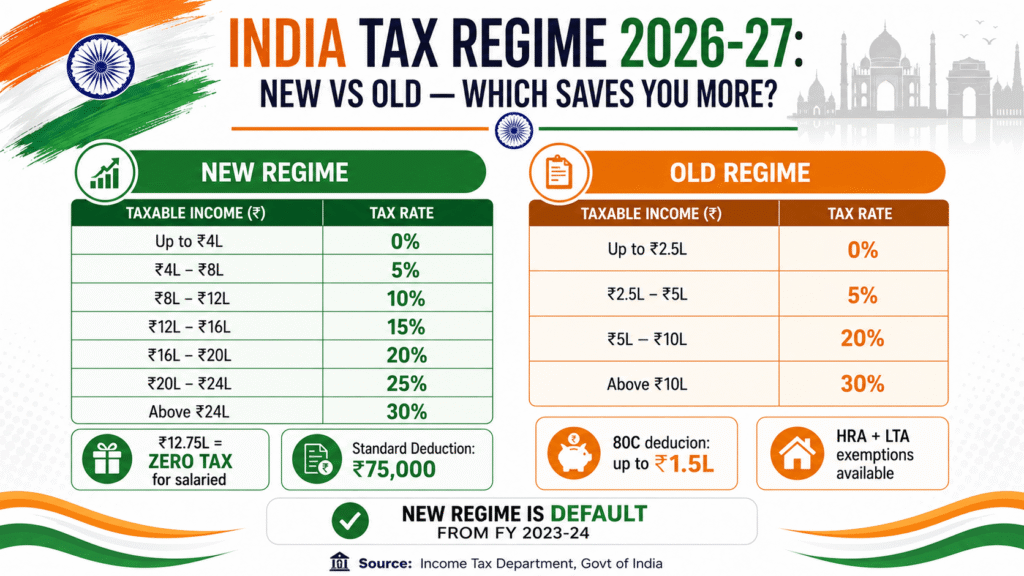
If you are a salaried employee earning up to ₹12.75 lakh in India in 2026-27, your income tax liability under the new tax regime is exactly zero — thanks to the ₹75,000 standard deduction and the Section 87A rebate of up to ₹60,000. For higher earners, the choice between the new and old regime depends on how much you invest in tax-saving instruments.
Use our free India Income Tax Calculator — updated for 2026-27 — to compare your exact tax under both regimes instantly. No signup required.
New Tax Regime Slabs 2026-27 (Default Regime)
The new tax regime has been the default regime since FY 2023-24. Budget 2026 made no changes to these slabs — they remain exactly as introduced in Budget 2025:
| Annual Income | Tax Rate | Tax Payable on This Slab |
|---|---|---|
| Up to ₹4,00,000 | 0% | Nil |
| ₹4,00,001 – ₹8,00,000 | 5% | Up to ₹20,000 |
| ₹8,00,001 – ₹12,00,000 | 10% | Up to ₹40,000 |
| ₹12,00,001 – ₹16,00,000 | 15% | Up to ₹60,000 |
| ₹16,00,001 – ₹20,00,000 | 20% | Up to ₹80,000 |
| ₹20,00,001 – ₹24,00,000 | 25% | Up to ₹1,00,000 |
| Above ₹24,00,000 | 30% | 30% on amount above ₹24L |
Key benefits of the new regime:
- Standard deduction of ₹75,000 for salaried employees — reduces gross salary before tax calculation
- Section 87A rebate up to ₹60,000 — eliminates tax entirely for income up to ₹12 lakh (after standard deduction)
- No investments required — you get lower rates without making any 80C or other investments
- Employer NPS contribution (Section 80CCD(2)) — deductible up to 14% of basic salary even under new regime
The new regime is the default for all taxpayers from FY 2023-24. If you do not actively choose the old regime, the new regime applies automatically. Source: Income Tax Department, Government of India (incometax.gov.in)
The ₹12.75 Lakh Zero Tax — Explained Simply
This is the most talked-about feature of India’s current tax system. Here is exactly how salaried employees pay zero tax on ₹12.75 lakh:
| Step | Amount |
|---|---|
| Gross salary | ₹12,75,000 |
| Less: Standard deduction | −₹75,000 |
| Taxable income | ₹12,00,000 |
| Tax on ₹12 lakh (new slabs) | ₹60,000 |
| Less: Section 87A rebate | −₹60,000 |
| Final tax payable | ₹0 |
Important: This zero-tax benefit applies only to salaried employees (who get the ₹75,000 standard deduction). For non-salaried individuals, the zero-tax limit is ₹12 lakh (not ₹12.75 lakh). Also, 4% Health and Education Cess applies on any tax payable above zero.
⚠️ Marginal relief warning: If your salary is ₹12,80,000 — just ₹5,000 above ₹12.75L — you do NOT suddenly owe full tax on ₹12,80,000. Marginal relief ensures your additional tax cannot exceed the additional income. Use our India Tax Calculator to see exactly where marginal relief applies for your salary.
Old Tax Regime Slabs 2026-27
The old tax regime remains available as an opt-in option. It has lower basic exemption bands but allows over 70 deductions and exemptions:
| Annual Income | Tax Rate (Under 60 years) |
|---|---|
| Up to ₹2,50,000 | 0% |
| ₹2,50,001 – ₹5,00,000 | 5% |
| ₹5,00,001 – ₹10,00,000 | 20% |
| Above ₹10,00,000 | 30% |
Key deductions available ONLY in old regime:
- Section 80C — up to ₹1,50,000 (PPF, ELSS, LIC, home loan principal, etc.)
- HRA exemption — house rent allowance for employees paying rent
- Section 80D — up to ₹25,000 medical insurance premium
- Home loan interest (Section 24b) — up to ₹2,00,000
- LTA — leave travel allowance exemption
- Standard deduction — ₹50,000 (less than new regime’s ₹75,000)
New Regime vs Old Regime — Direct Comparison at Every Salary Level
Here is the tax under both regimes at common salary levels, assuming maximum 80C deduction of ₹1.5 lakh in the old regime:
| Annual Salary | New Regime Tax | Old Regime Tax (with 80C ₹1.5L) | Better Option |
|---|---|---|---|
| ₹8,00,000 | ₹0 | ₹46,800 | New Regime ✅ |
| ₹10,00,000 | ₹20,800 | ₹75,400 | New Regime ✅ |
| ₹12,75,000 | ₹0 | ₹1,09,200 | New Regime ✅ |
| ₹15,00,000 | ₹1,05,300 | ₹1,04,000 | Similar — check HRA |
| ₹20,00,000 | ₹2,96,400 | ₹2,73,000 | Old Regime (if HRA) |
| ₹25,00,000 | ₹4,96,400 | ₹4,42,000 | Old Regime (if HRA + 80C) |
These figures include 4% Health & Education Cess. Old regime figures assume ₹1.5L 80C deduction only — if you also claim HRA, home loan interest, or 80D, old regime saves significantly more at higher incomes. Use our India Tax Calculator for your exact figure.
When Should You Choose the Old Regime?
The old regime is better when your total deductions exceed the “break-even” amount at your salary level. Here is the approximate break-even deduction — if your actual deductions exceed this, old regime wins:
| Annual Salary | Break-Even Deduction | Verdict |
|---|---|---|
| Up to ₹12,75,000 | Not applicable | New Regime always wins |
| ₹15,00,000 | ~₹3,75,000 | Old regime if deductions > ₹3.75L |
| ₹20,00,000 | ~₹3,75,000 | Old regime if HRA + 80C + 80D |
| ₹25,00,000+ | ~₹3,75,000 | Old regime if large HRA + home loan |
Simple rule: If your HRA + 80C + 80D + home loan interest combined exceeds ₹3.75 lakh, the old regime likely saves more at salaries above ₹15 lakh. Below ₹12.75 lakh, new regime wins always.
New Income Tax Act 2025 — What Changed from April 2026
The Income Tax Act 2025 replaced the Income Tax Act 1961 from 1 April 2026. This is India’s biggest tax law restructuring in 65 years — but for most salaried employees, the practical impact is minimal:
| What Changed | Impact on You |
|---|---|
| New concept: “Tax Year” replaces “Financial Year/Assessment Year” | Simpler language — Tax Year 2026-27 = what was FY 2026-27 / AY 2027-28 |
| Section numbers renumbered | Section 87A is now Section 157 — same rebate, different number |
| Revised return deadline extended | Can now file revised ITR up to 31 March (was 31 December) |
| TAN not required for NRI property transactions | Simplification for foreign buyers of Indian property |
| Tax slabs and rates | No change — same slabs as before |
Bottom line: The new Income Tax Act 2025 is primarily a language and structure simplification — the same tax rates, same regime choices, same deductions apply. Your tax liability for 2026-27 is unchanged compared to what it would have been under the old Act.
How to Switch Between Tax Regimes
If you are a salaried employee with no business income:
- You can switch between new and old regime every year
- Simply declare your regime choice to your employer at the start of the financial year
- If you do not declare, the new regime applies by default
- You can also change your regime when filing your ITR — the final ITR choice overrides employer TDS
If you have business or professional income:
- You can switch to old regime once — but cannot switch back to new regime again
- This restriction makes the regime choice permanent for business taxpayers
NRI Tax in India 2026-27
Non-Resident Indians (NRIs) are taxed only on income earned or received in India. Key points for NRIs in 2026-27:
- NRIs cannot claim the ₹12 lakh rebate (Section 87A) — tax applies from the first rupee
- NRIs can choose between old and new regime
- TDS on NRI bank interest: 30% (without DTAA) or reduced rate under DTAA with your country
- Property sale in India: TDS at 20% on long-term capital gains (indexed)
- NRIs with rental income in India must file ITR if rent exceeds exemption limits
India Income Tax Calculator 2026-27
Your exact tax depends on:
- Your gross salary and employer-provided allowances (HRA, LTA)
- Which tax regime you choose (new or old)
- Deductions you can claim (80C, 80D, home loan, etc.)
- Whether you are salaried or have business income
- Your age (senior citizens get higher exemption under old regime)
- Employer NPS contribution under Section 80CCD(2)
Use the free finzotools.com India Income Tax Calculator — updated for 2026-27 with both new and old regime — to see your exact tax and which regime saves you more.
👉 Calculate Your India Income Tax 2026-27 Now →
Frequently Asked Questions
Is income tax zero on ₹12 lakh salary in India 2026-27?
Yes — for salaried employees earning up to ₹12.75 lakh, the income tax is zero under the new regime in 2026-27. The ₹75,000 standard deduction reduces taxable income to ₹12 lakh. The tax on ₹12 lakh under new slabs is ₹60,000, which is fully offset by the Section 87A (Section 157 under Income Tax Act 2025) rebate of ₹60,000. The net tax payable is zero.
Which tax regime is better — new or old in 2026-27?
For most salaried employees earning up to ₹12.75 lakh, the new regime is always better — tax is zero. For those earning above ₹15 lakh, the old regime becomes better if total deductions (HRA + 80C + 80D + home loan interest) exceed approximately ₹3.75 lakh. If your deductions are below this threshold, the new regime saves more.
What is the new Income Tax Act 2025?
The Income Tax Act 2025 replaced India’s 1961 income tax law from 1 April 2026. It is primarily a language and structure simplification — making the law easier to read — without changing the actual tax rates, slabs, or regime choices. The same tax rates, deductions, and new vs old regime options continue to apply. One practical change: the revised ITR filing deadline is now 31 March (extended from 31 December).
What is the standard deduction for salaried employees in 2026-27?
The standard deduction for salaried employees in 2026-27 is ₹75,000 under the new tax regime, and ₹50,000 under the old tax regime. This deduction is automatically applied to your gross salary before tax is calculated — no receipts or investments are needed to claim it.
Can I change my tax regime every year?
Yes — salaried employees without business income can switch between the new and old tax regime every financial year. Declare your choice to your employer at the start of the year for TDS purposes. You can also change the regime when you file your ITR — the ITR choice overrides the employer’s TDS deduction. Business taxpayers can only switch to the old regime once.
Related Calculators on Finzotools
- 🇮🇳 India Income Tax Calculator — New vs old regime 2026-27, no signup
- 🇿🇦 South Africa PAYE Calculator — Take-home after SARS tax and UIF
- 🇨🇦 Canada Salary Calculator — Take-home after CRA tax, CPP and EI
- 🇦🇺 Australia Salary Calculator — Take-home after ATO tax and Medicare Levy
- 🇦🇪 UAE End of Service Calculator — Gratuity in AED, no login required
Last updated: June 2026. Tax figures based on Income Tax Act 2025, effective 1 April 2026, and Union Budget 2026-27 announced by Finance Minister Nirmala Sitharaman. Sources: Income Tax Department (incometax.gov.in), Ministry of Finance, Government of India. Always verify at incometax.gov.in or consult a registered Chartered Accountant for advice specific to your circumstances.