
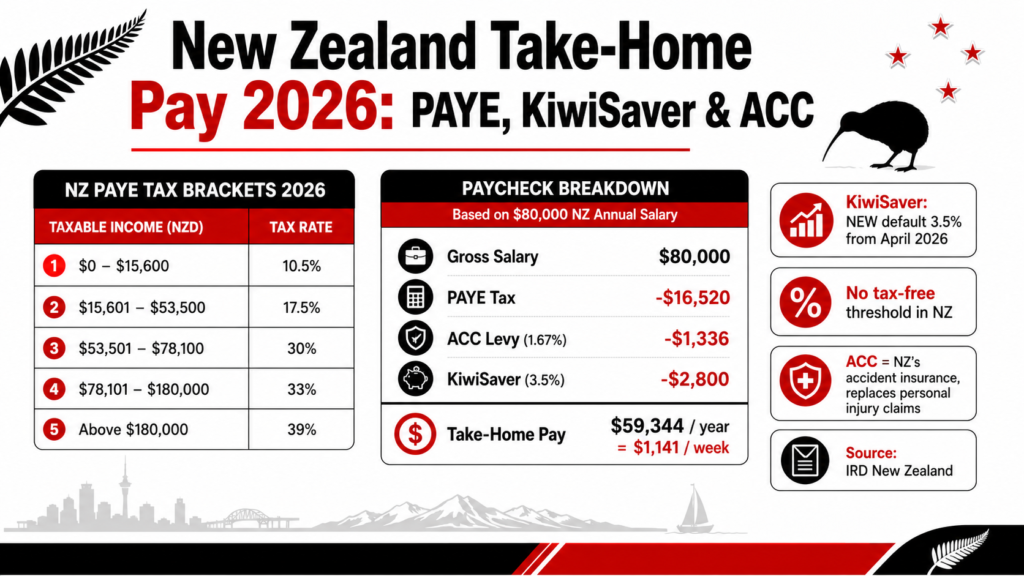
On a salary of $80,000 in New Zealand in 2026, your take-home pay is approximately $59,344 per year — or $1,141 per week after PAYE income tax, the ACC earner’s levy, and KiwiSaver at the new 3.5% default rate (changed from 3% on 1 April 2026). Unlike Australia, the UK, or Ireland, New Zealand has no tax-free threshold — income tax applies from the very first dollar you earn.
Use our free New Zealand Salary Calculator — updated with IRD 2026 rates including the new KiwiSaver default — to see your exact take-home pay. No signup required.
New Zealand PAYE Tax Brackets 2026
New Zealand uses a progressive tax system — only the income within each bracket is taxed at that rate. The IRD tax brackets for 2026 (tax year 1 April 2025 to 31 March 2026, and unchanged for 2026-27) are:
| Annual Income | PAYE Rate | Tax on This Slice |
|---|---|---|
| $0 – $15,600 | 10.5% | Up to $1,638 |
| $15,601 – $53,500 | 17.5% | Up to $6,632 |
| $53,501 – $78,100 | 30% | Up to $7,380 |
| $78,101 – $180,000 | 33% | Up to $33,627 |
| Above $180,000 | 39% | 39% on amount above $180,000 |
Important: New Zealand has no tax-free threshold. Unlike Australia ($18,200), the UK (£12,570), or Ireland (€42,000 standard rate band), NZ tax applies from the very first dollar of income. The 10.5% rate on the first $15,600 applies to everyone — even part-time workers earning $5,000/year pay 10.5% PAYE on that amount. Source: Inland Revenue Department (IRD), ird.govt.nz
New: KiwiSaver Default Changed to 3.5% from April 2026
From 1 April 2026, the default minimum KiwiSaver employee contribution rate increased from 3% to 3.5% of gross pay. This affects every new employee who does not actively choose their own KiwiSaver contribution rate.
| KiwiSaver Detail | Before April 2026 | From April 2026 |
|---|---|---|
| Default employee rate | 3% | 3.5% |
| Minimum employer contribution | 3% | 3% (unchanged) |
| Optional employee rates | 3%, 4%, 6%, 8%, 10% | 3%, 3.5%, 4%, 6%, 8%, 10% |
| On $80,000 salary — employee KiwiSaver | $2,400/year | $2,800/year (+$400) |
What this means for your paycheck: If you are already enrolled at 3% and did not change your rate, your rate stays at 3% — the 3.5% default only applies to new enrolments from 1 April 2026. However, if you want to increase your contributions to benefit from more employer contributions and government top-ups, you can change your rate at any time through your employer or IRD.
Take-Home Pay Examples — NZ Dollars (2026)
Here is exactly what New Zealanders take home at common salary levels after PAYE tax, ACC levy, and KiwiSaver at 3.5% in 2026:
| Gross Salary | PAYE Tax | ACC Levy | KiwiSaver (3.5%) | Take-Home/Year | Take-Home/Week |
|---|---|---|---|---|---|
| $50,000 | $8,020 | $835 | $1,750 | $39,395 | $757 |
| $60,000 | $11,020 | $1,002 | $2,100 | $45,878 | $882 |
| $70,000 | $14,020 | $1,169 | $2,450 | $52,361 | $1,007 |
| $80,000 | $16,520 | $1,336 | $2,800 | $59,344 | $1,141 |
| $100,000 | $23,920 | $1,670 | $3,500 | $70,910 | $1,364 |
| $120,000 | $30,520 | $2,003 | $4,200 | $83,277 | $1,601 |
| $150,000 | $40,420 | $2,552 | $5,250 | $101,778 | $1,957 |
ACC levy is capped at earnings of $152,790/year — on income above this, no additional ACC is deducted. KiwiSaver is deducted from gross pay. Use our NZ Salary Calculator to adjust KiwiSaver rate and see your exact take-home.
ACC Earner’s Levy — New Zealand’s Accident Insurance
The ACC (Accident Compensation Corporation) earner’s levy funds New Zealand’s universal accident insurance scheme — one of the most unique in the world. In exchange for this cover, New Zealanders cannot sue for personal injury in most cases.
| ACC Detail | 2026 Rate |
|---|---|
| ACC levy rate | 1.67% of gross earnings |
| Maximum liable earnings | $152,790/year |
| Maximum annual ACC levy | $2,552/year |
| What ACC covers | Injury treatment, rehabilitation, 80% of lost earnings during recovery |
| How it appears on payslip | Deducted alongside PAYE as part of total withholding |
Student Loan Repayments + PAYE
If you have a New Zealand student loan, repayments are automatically deducted through PAYE alongside your income tax:
| Student Loan Detail | 2026 Rate |
|---|---|
| Repayment rate | 12% of every dollar above threshold |
| Annual repayment threshold | $24,128/year ($464/week) |
| Tax code to use | M SL (main job with student loan) |
Example — $70,000 salary with student loan:
- Repayable earnings: $70,000 − $24,128 = $45,872
- Annual repayment: $45,872 × 12% = $5,505/year ($106/week)
- Take-home after PAYE + ACC + KiwiSaver 3.5% + student loan: approximately $46,856/year ($901/week)
NZ Tax Codes — Which One Applies to You?
New Zealand uses tax codes to determine the correct PAYE rate. Using the wrong code results in over or under-withholding:
| Tax Code | Use When |
|---|---|
| M | Main job, no student loan |
| ME | Main job + eligible for Independent Earner Tax Credit (income $24K–$48K) |
| M SL | Main job + student loan |
| S | Secondary job (total income $14K–$48K) |
| SH | Secondary job (total income $48K–$70K) |
| ST | Secondary job (total income above $70K) |
Working for Families — Extra Support for Families
If you have children, you may be eligible for Working for Families (WfF) tax credits through IRD — paid weekly or fortnightly directly to your bank account:
| Credit Type | Maximum 2026 | Eligibility |
|---|---|---|
| Family Tax Credit | $144/week | Family income under ~$110,000 |
| In-Work Tax Credit | $72.50/child/week | Working 20+ hrs/week (sole parent) or 30+ hrs/week (couples) |
| Minimum Family Tax Credit | $58/week | Income below minimum family threshold |
| Best Start | $60/week per baby | All families for first year; income-tested thereafter |
Abatement starts at $42,700 family income — WfF reduces by 20 cents per dollar above this threshold. Apply through myIR at ird.govt.nz — payments start within weeks of application.
New Zealand Salary Calculator 2026
Your exact take-home pay depends on:
- Your gross salary or hourly rate and pay frequency
- Your tax code (M, ME, M SL, etc.)
- Your KiwiSaver contribution rate (3%, 3.5%, 4%, 6%, 8%, or 10%)
- Whether you have a student loan
- Your ACC liable earnings (capped at $152,790)
- Whether you qualify for Working for Families
Use the free finzotools.com New Zealand Salary Calculator — updated with IRD 2026 rates and the new 3.5% KiwiSaver default — to get your exact weekly, fortnightly, and annual take-home pay.
👉 Calculate Your NZ Take-Home Pay Now →
Frequently Asked Questions
Does New Zealand have a tax-free threshold?
No. Unlike Australia, the UK, or Ireland, New Zealand has no tax-free threshold or personal allowance. Income tax applies from the very first dollar you earn — at 10.5% on income up to $15,600. This means even part-time workers on low incomes pay PAYE tax. However, the progressive brackets mean the effective tax rate is always lower than the marginal rate.
What is the new KiwiSaver default rate in 2026?
From 1 April 2026, the default minimum KiwiSaver employee contribution rate increased from 3% to 3.5% of gross pay. This new default applies to employees who enrol in KiwiSaver from 1 April 2026 onward without specifying their own rate. Existing members enrolled before April 2026 at 3% remain at 3% unless they choose to change. You can change your KiwiSaver rate at any time by notifying your employer.
How much take-home pay on $80,000 in New Zealand 2026?
On a gross salary of $80,000 in 2026, your take-home pay is approximately $59,344 per year ($1,141 per week) after PAYE tax of $16,520, ACC levy of $1,336, and KiwiSaver at the new 3.5% default ($2,800). If you have a student loan, an additional $6,711 in repayments would also be deducted annually.
What is the ACC levy in New Zealand 2026?
The ACC earner’s levy in 2026 is 1.67% of gross earnings, up to a maximum annual liable earning of $152,790. The maximum annual ACC levy is $2,552. The levy is deducted through PAYE and funds New Zealand’s universal accident compensation scheme — covering injury treatment, rehabilitation, and 80% of lost earnings during recovery for all New Zealand residents.
Do I need to file a tax return in New Zealand?
Most salaried employees in New Zealand do not need to file a tax return. IRD performs an automatic end-of-year income tax assessment after 31 March each year. If you overpaid PAYE, you receive a refund; if underpaid, you receive a bill. You only need to file an IR3 return if you have additional income sources such as rental income, self-employment, overseas income, or investment income not already reported to IRD.
Related Calculators on Finzotools
- 🇳🇿 New Zealand Salary Calculator — Take-home after PAYE, ACC, KiwiSaver 2026
- 🇦🇺 Australia Salary Calculator — Take-home after ATO tax and Medicare Levy
- 🇮🇳 India Income Tax Calculator — New vs old regime 2026-27
- 🇿🇦 South Africa PAYE Calculator — Take-home after SARS tax and UIF
- 🇬🇧 UK Salary Calculator — Take-home after income tax and National Insurance
Last updated: June 2026. Tax figures based on IRD confirmed rates for the 2025-26 tax year (unchanged for 2026-27). KiwiSaver 3.5% default effective from 1 April 2026. Sources: Inland Revenue Department (ird.govt.nz), ACC (acc.co.nz), IRD KiwiSaver guide. Always verify at ird.govt.nz or consult a registered tax agent for advice specific to your circumstances.