
✅ Last verified: July 2026 — Source: SARS, National Treasury Budget 2026, Pension Funds Act, Income Tax Act s.11(k)
By Abdul Basit | July 2026 | FinzoTools Blog
⚡ QUICK ANSWER
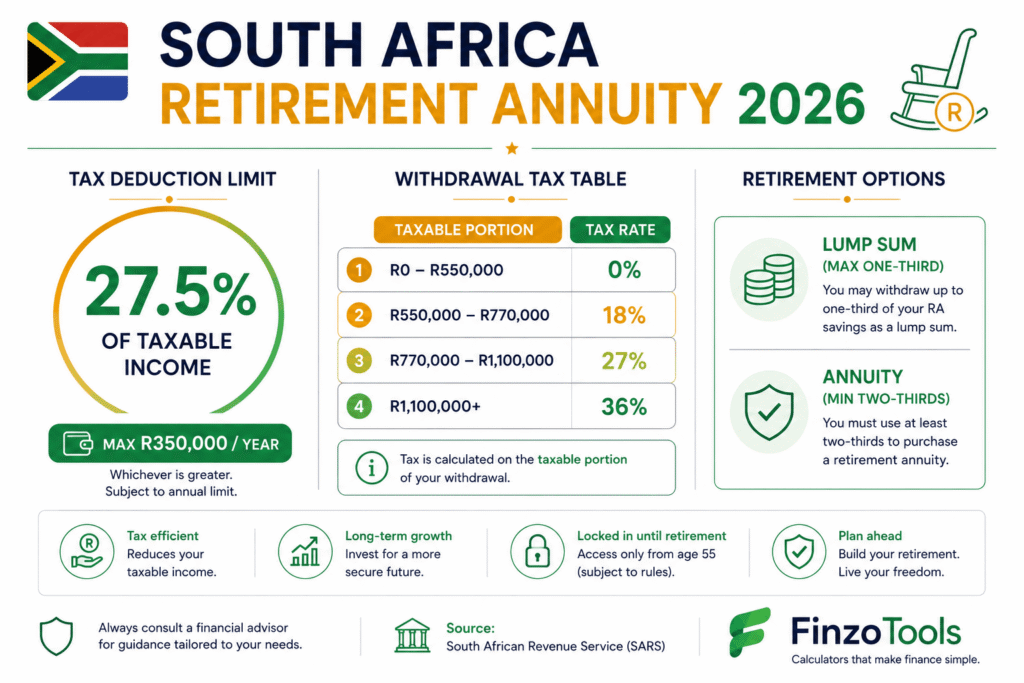
A retirement annuity (RA) in South Africa gives you a tax deduction of 27.5% of your taxable income, now capped at R430,000 per year (increased from R350,000 in Budget 2026). Growth inside the fund is completely tax-free. At retirement (from age 55), you can take up to one-third as a lump sum — the first R550,000 is tax-free — and the remaining two-thirds must go into an annuity. Since September 2024, the two-pot system splits your RA into a savings pot (one-third, accessible once per year) and a retirement pot (two-thirds, locked until 55). Use our free South Africa Retirement Calculator to estimate your fund at retirement.
Retirement annuities are the single most tax-efficient investment available to individual South Africans. For someone in the 39% or 41% marginal bracket, the deduction effectively means SARS pays R41 of every R100 you invest. No other savings product comes close.
Yet the rules are layered — contribution caps, two-pot access, withdrawal tax tables, the difference between living and life annuities, and new Budget 2026 changes. This guide covers all of it with real numbers and worked examples.
How the RA tax deduction works — 2026/27 rules
SARS allows you to deduct retirement fund contributions from your taxable income before tax is calculated. The deduction limit is:
27.5% of the greater of your remuneration or taxable income, capped at R430,000 per year.
This limit applies to your total retirement fund contributions — RA, pension fund, and provident fund combined. If your employer contributes to a pension or provident fund, those employer contributions count toward your 27.5% limit too.
| Annual Taxable Income | 27.5% of Income | Max Deductible (capped) | Tax Saved (at marginal rate) |
|---|---|---|---|
| R300,000 | R82,500 | R82,500 | R21,450 (at 26%) |
| R500,000 | R137,500 | R137,500 | R42,625 (at 31%) |
| R800,000 | R220,000 | R220,000 | R85,800 (at 39%) |
| R1,200,000 | R330,000 | R330,000 | R135,300 (at 41%) |
| R1,800,000 | R495,000 | R430,000 (cap applies) | R193,500 (at 45%) |
Source: SARS — Budget 2026 FAQ, Income Tax Act s.11(k)
The R430,000 cap is the big change from Budget 2026 — it’s the first increase since 2016 when the limit was set at R350,000. For higher earners, this opens up R80,000 of additional deductible room per year.
If you contribute more than your deductible limit, the excess isn’t lost. SARS tracks it and applies it as a deduction against retirement benefits when you eventually withdraw — preventing double taxation.
Budget 2026 changes — what’s new for retirement funds
| Item | Before Budget 2026 | From 1 March 2026 |
|---|---|---|
| Annual deduction cap | R350,000 | R430,000 |
| Annuitisation de minimis | R247,500 | R360,000 |
| Living annuity commutation threshold | R125,000 | R150,000 |
| Retirement lump sum tax table | Unchanged since 2024/25 | Unchanged (same brackets) |
| Deduction % rate | 27.5% | 27.5% (unchanged) |
The annuitisation de minimis increase to R360,000 is significant. If your total retirement fund is below this threshold, you can take the entire amount as a cash lump sum instead of being forced to buy an annuity. This protects smaller savers from losing a chunk of their fund to annuity fees.
The two-pot system — how it changed RAs from September 2024
The two-pot retirement system, effective 1 September 2024, restructured how all retirement funds work in South Africa — including RAs. Your fund is now split into three components:
- Savings pot (one-third of contributions from Sept 2024 onwards): Accessible once per tax year, minimum withdrawal R2,000. Taxed at your marginal income tax rate. Designed for emergencies.
- Retirement pot (two-thirds of contributions from Sept 2024 onwards): Locked until retirement at age 55. Withdrawals only through normal retirement rules.
- Vested pot: All contributions made before 1 September 2024 plus a seed amount of R30,000 (or the fund value if less). Subject to the old rules.
The savings pot gives you flexibility that RAs never had before. But every savings pot withdrawal is taxed at your marginal rate — so a R50,000 withdrawal could cost you R18,000 or more in tax, depending on your bracket. Most financial advisors recommend leaving the savings pot untouched unless you have a genuine emergency.
Tax on retirement lump sums — the withdrawal table
When you retire and take a lump sum from your RA, it’s taxed according to this table:
| Taxable Lump Sum | Tax Rate | Tax Payable |
|---|---|---|
| R0 – R550,000 | 0% | R0 |
| R550,001 – R770,000 | 18% of amount above R550,000 | Max R39,600 |
| R770,001 – R1,155,000 | R39,600 + 27% above R770,000 | Max R143,550 |
| Above R1,155,000 | R143,550 + 36% above R1,155,000 | No cap |
Source: SARS — Retirement Lump Sum Benefits
Critical note: These thresholds are cumulative across your lifetime. Every lump sum you’ve taken from any retirement fund since 1 October 2007 counts. If you withdrew R400,000 from a pension fund five years ago, you’ve already used R400,000 of your R550,000 tax-free threshold — leaving only R150,000 of tax-free lump sum remaining.
Worked example — RA contribution and retirement payout
Contributing: Age 35, earning R600,000/year, contributing R8,000/month
- Annual contribution: R96,000
- Deduction limit: 27.5% × R600,000 = R165,000 — your R96,000 is within the limit ✅
- Marginal tax rate: 36% (R512,801–R673,000 bracket)
- Tax saved per year: R96,000 × 36% = R34,560
- Real cost per month: R8,000 − R2,880 = R5,120 out of pocket
At retirement: Age 55, fund value R4,200,000
- Maximum lump sum: One-third = R1,400,000
- Tax on lump sum: First R550,000 tax-free. R550,001–R770,000 at 18% = R39,600. R770,001–R1,155,000 at 27% = R103,950. R1,155,001–R1,400,000 at 36% = R88,200. Total tax: R231,750
- Net lump sum received: R1,400,000 − R231,750 = R1,168,250
- Remaining fund for annuity: R2,800,000 — providing an income stream for life
Living annuity vs life annuity — your retirement income options
At retirement, the two-thirds of your fund that must go into an annuity can take two forms:
| Feature | Living Annuity | Life (Guaranteed) Annuity |
|---|---|---|
| Income level | You choose: 2.5%–17.5% of fund value per year | Fixed by insurer based on age and rates |
| Investment risk | You bear it — fund can grow or shrink | Insurer bears it — guaranteed for life |
| On death | Remaining fund passes to beneficiaries | Payments stop (unless joint-life option chosen) |
| Flexibility | High — change drawdown % annually | None — locked in at purchase |
| Risk of running out | Yes — if you draw too much or markets fall | No — guaranteed payments for life |
| Best for | Larger funds, investment-savvy retirees | Smaller funds, risk-averse retirees |
Most South Africans with larger RA pots choose living annuities for their flexibility and estate-planning benefits. But the risk of drawing down too aggressively and running out of money at 80 is real. A common approach is to blend the two: use a life annuity to cover essential expenses, and a living annuity for discretionary spending.
RA vs Tax-Free Savings Account (TFSA) — which is better?
| Feature | Retirement Annuity | Tax-Free Savings Account |
|---|---|---|
| Tax deduction on contributions | Yes — 27.5% | No |
| Tax on growth | Tax-free | Tax-free |
| Tax on withdrawal | Taxed (retirement lump sum table) | Completely tax-free |
| Annual contribution limit | 27.5% of income / R430,000 | R36,000/year |
| Lifetime limit | None | R500,000 |
| Access before retirement | Savings pot only (two-pot system) | Any time — no restrictions |
| Best for | Long-term retirement savings + tax deduction | Flexible savings — emergencies, short-to-medium goals |
The optimal approach for most South Africans: maximise your RA contributions first (to capture the tax deduction), then put additional savings into a TFSA (R36,000/year, up to R500,000 lifetime). The RA gives you the biggest upfront tax saving; the TFSA gives you flexibility and completely tax-free withdrawals.
Common retirement annuity mistakes
- Not contributing at all. Every year without RA contributions is a year of lost tax deductions and compound growth. Starting at 35 instead of 25 can halve your retirement fund.
- Contributing below your deductible limit. If you can afford 27.5% but you’re only contributing 5%, you’re paying more tax than necessary every year.
- Forgetting that employer contributions count. Your employer’s pension/provident fund contributions reduce your remaining RA deduction space. Check your total before assuming you have the full 27.5% available.
- Withdrawing from the savings pot unnecessarily. Two-pot withdrawals are taxed at your marginal rate. A R50,000 withdrawal at the 36% bracket costs R18,000 in tax — and that money is permanently gone from your retirement fund.
- Drawing too aggressively from a living annuity. Drawing 10%+ per year from a living annuity means your capital is almost certainly shrinking. At 17.5% (the maximum allowed), most funds are depleted within 8–10 years.
- Not checking cumulative lump sum thresholds. Your lifetime tax-free lump sum of R550,000 is cumulative across all retirement funds and all withdrawals since 2007. If you’ve already withdrawn, your remaining tax-free threshold is lower.
Frequently asked questions — SA retirement annuity 2026
How much can I deduct for RA contributions in 2026?
27.5% of the greater of your remuneration or taxable income, capped at R430,000 per year. This limit includes all retirement fund contributions — RA, pension, and provident combined.
What changed in Budget 2026 for retirement annuities?
The annual deduction cap increased from R350,000 to R430,000 — the first increase since 2016. The annuitisation de minimis threshold rose to R360,000, and the living annuity commutation threshold rose to R150,000.
What is the two-pot retirement system?
Effective 1 September 2024, retirement funds are split into a savings pot (one-third of new contributions, accessible once per year), a retirement pot (two-thirds, locked until age 55), and a vested pot (pre-September 2024 contributions under old rules).
How is the retirement lump sum taxed?
The first R550,000 is tax-free. R550,001–R770,000 is taxed at 18%, R770,001–R1,155,000 at 27%, and above R1,155,000 at 36%. These thresholds are cumulative across your lifetime.
Can I access my RA before age 55?
Only from the savings pot (under the two-pot system) — one withdrawal per year, minimum R2,000, taxed at your marginal rate. The retirement pot is locked until age 55, with limited exceptions for disability or financial emigration (after 3 years of non-tax residency).
What’s the difference between a living annuity and a life annuity?
A living annuity lets you choose your drawdown rate (2.5%–17.5% of fund value annually) and passes the remaining fund to beneficiaries on death. A life annuity provides a guaranteed income for life but payments stop when you die (unless a joint-life option is selected).
Should I choose an RA or a TFSA?
Both, if possible. Maximise your RA first for the tax deduction (27.5% saving at your marginal rate), then put additional savings into a TFSA (R36,000/year limit, R500,000 lifetime). The RA is better for long-term retirement savings; the TFSA is better for accessible, completely tax-free savings.
What if I contribute more than the R430,000 cap?
Excess contributions aren’t tax-deductible in the current year, but SARS tracks them. They’re carried forward and either deducted in a future year or used to reduce the taxable portion of your retirement lump sum — so you won’t be taxed twice.
What is the annuitisation de minimis threshold?
R360,000 from March 2026. If your total retirement fund is below this amount, you can take the entire value as a cash lump sum instead of being required to purchase an annuity with two-thirds.
How much do I need to retire comfortably in South Africa?
A common target is a retirement income equal to 75% of your final salary. For someone earning R600,000/year, that’s R450,000/year in retirement. Using a 4% drawdown rate from a living annuity, you’d need a fund of approximately R11.25 million. Use our SA Retirement Calculator to project your fund based on your current contributions.
Related tools and guides
- 🧮 South Africa Retirement Calculator 2026 — project your retirement fund
- 🧮 South Africa Income Tax Calculator 2026 — calculate your PAYE and take-home pay
- 📖 South Africa PAYE Tax 2026/27 — SARS Brackets Explained
- 🏠 South Africa Home Loan Calculator 2026 — estimate your bond repayments
- 🧮 Savings Goal Calculator — plan any savings target
Sources & references
- SARS — Budget 2026 Frequently Asked Questions
- SARS — Retirement Lump Sum Benefits Tax Tables
- National Treasury — Budget Review 2026
- Income Tax Act, Section 11(k) — Retirement Fund Contribution Deductions
- Pension Funds Act — Two-Pot Retirement System (effective 1 September 2024)
© 2026 FinzoTools — For educational purposes only. This is not financial, legal, or tax advice. Consult a qualified financial advisor before making retirement fund decisions.