
Inheritance Tax can feel like one of the most unfair taxes in the UK. You spend a lifetime building wealth, pay income tax on every pound you earn, and then the government takes another 40% when you die. But married couples and civil partners have a significant advantage that many families either do not know about or fail to claim properly — the transferable nil rate band.
In the 2026/27 tax year, a married couple can potentially pass up to £1,000,000 to their children completely free of inheritance tax. That is not a loophole or an aggressive tax scheme. It is a straightforward HMRC provision that simply requires proper planning and a correct claim by the executor of the second spouse’s estate.
This guide explains exactly how the transferable nil rate band works, what the residence nil rate band adds, how the spouse exemption fits in, and what critical changes are coming in April 2027 that every married couple needs to understand right now.
What Is the Nil Rate Band in 2026/27?
The nil rate band (NRB) is the amount of your estate that can be passed on without paying any inheritance tax. For the 2026/27 tax year, the NRB is £325,000 per person. This threshold has been frozen at the same level since 2009, and the government confirmed in the Autumn Budget 2025 that it will remain frozen until at least April 2031.
Anything above the nil rate band is taxed at 40%. If you leave at least 10% of your net estate to a registered charity, the rate drops to 36%.
For a single person with no spouse, the maximum IHT-free allowance is £325,000 — or £500,000 if the residence nil rate band also applies. But for married couples, the picture changes dramatically because of the transferable nil rate band.
How the Transferable Nil Rate Band Works for Married Couples
When the first spouse dies, everything they leave to the surviving spouse is completely exempt from inheritance tax. This is known as the spouse exemption, and it applies regardless of the value. A husband could leave his wife an estate worth £5 million and not a single penny of IHT would be due.
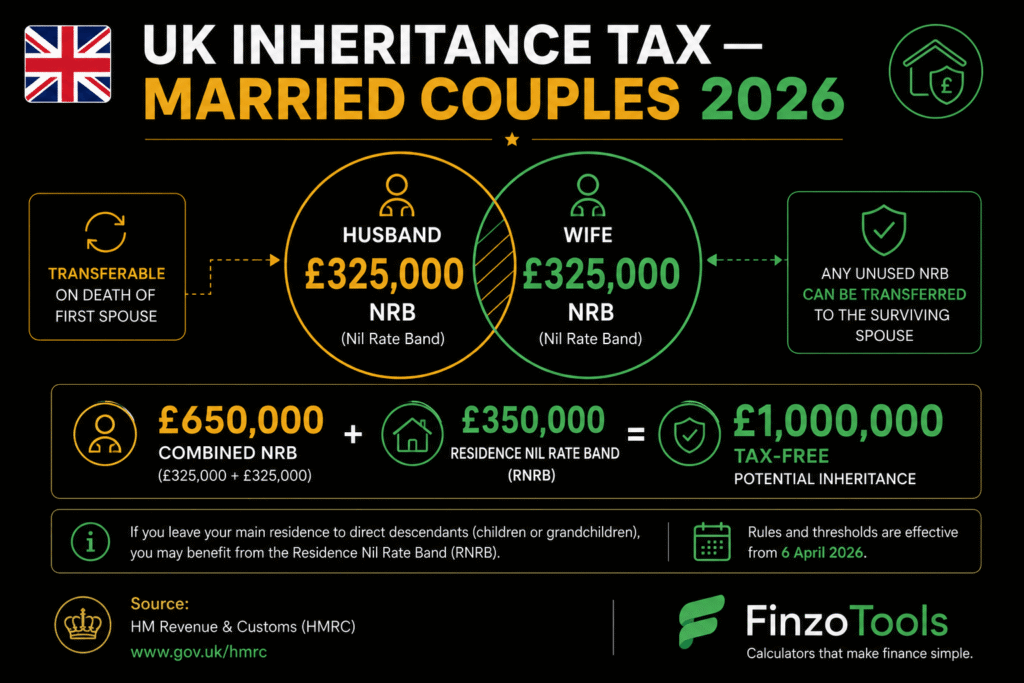
The critical point is what happens to the deceased spouse’s nil rate band. If the first spouse leaves everything to the surviving partner, their entire £325,000 NRB goes unused. Under HMRC rules, that unused allowance does not disappear — it can be transferred to the surviving spouse’s estate when they eventually die.
This means the surviving spouse effectively gets two nil rate bands — their own £325,000 plus the transferred £325,000 from their late partner. That gives a combined threshold of £650,000 before any IHT is due.
The same principle applies to the residence nil rate band. If the first spouse did not use their RNRB (because they left everything to the survivor rather than directly to children), the unused RNRB can also transfer. Two RNRBs of £175,000 each give a combined £350,000.
Add them together: £650,000 (combined NRB) + £350,000 (combined RNRB) = £1,000,000 that a married couple can pass to their direct descendants completely free of inheritance tax.
The Four Allowances That Build the £1 Million Threshold
| Allowance | Per Person | Combined (Couple) | Condition |
|---|---|---|---|
| Nil Rate Band (NRB) | £325,000 | £650,000 | Applies to all estates |
| Residence Nil Rate Band (RNRB) | £175,000 | £350,000 | Home must pass to direct descendants |
| Total per person | £500,000 | £1,000,000 | — |
The NRB applies to every estate regardless of what assets are included or who inherits them. The RNRB, however, only applies when a qualifying residential property is left to direct descendants — children, grandchildren, stepchildren, adopted children, or foster children. Nieces, nephews, siblings, and friends do not qualify.
The RNRB Taper: Estates Over £2 Million
There is an important restriction on the residence nil rate band that catches many families off guard. For estates valued above £2 million, the RNRB is reduced by £1 for every £2 over the threshold. This means the full £175,000 RNRB disappears entirely when an individual’s estate reaches £2,350,000.
For a married couple using the transferred RNRB on the second death, the combined RNRB of £350,000 is fully tapered away when the estate exceeds £2,700,000.
| Estate Value (Second Death) | RNRB Available | Total IHT-Free (NRB + RNRB) |
|---|---|---|
| Up to £2,000,000 | £350,000 (full) | £1,000,000 |
| £2,200,000 | £250,000 | £900,000 |
| £2,400,000 | £150,000 | £800,000 |
| £2,700,000+ | £0 (fully tapered) | £650,000 |
Notice that even when the RNRB is fully tapered away, the basic nil rate band of £325,000 (or £650,000 for a couple) is never tapered. It always applies regardless of estate size.
The Spouse Exemption: Why First Death Planning Matters
Most married couples assume that leaving everything to each other is the safest approach. And in terms of IHT on the first death, they are right — the spouse exemption means zero IHT is payable when assets pass between married partners or civil partners, regardless of the amount.
But this simplicity creates a planning trap. If the first spouse leaves their entire estate to the survivor, their NRB and RNRB are unused. The good news is that HMRC allows the unused percentage to be transferred. The bad news is that the executor of the second spouse’s estate must actively claim it. HMRC does not volunteer the transfer — if no claim is made, the allowance is lost.
The transfer works on a percentage basis, not a fixed amount. If the first spouse died when the NRB was £300,000 and used none of it, the unused percentage is 100%. When the surviving spouse later dies and the NRB has risen to £325,000, the transferred amount is 100% of £325,000 = £325,000. This protects families against inflation in the threshold over time.
How to Claim the Transferable Nil Rate Band
The claim is made by the personal representative (executor or administrator) of the surviving spouse’s estate. They submit HMRC form IHT402 along with the IHT return for the second estate. The form requires details of the first spouse’s death, their estate value, how much of the NRB was used, and evidence such as the death certificate and probate records.
There is no time limit for making the claim — even if the first spouse died decades ago, the unused NRB can still be transferred. However, gathering evidence becomes harder over time, so keeping clear records is important.
For the transferable RNRB, the claim is made on form IHT436. The conditions are the same: the executor must demonstrate that the first spouse’s RNRB was unused and that the second spouse’s estate includes a qualifying home passing to direct descendants.
What Counts as a “Direct Descendant” for the RNRB?
The residence nil rate band only applies when the family home passes to direct descendants. HMRC defines direct descendants as children (including stepchildren, adopted children, and foster children), grandchildren, and remoter descendants. It also includes the spouse or civil partner of a direct descendant who has died before the estate owner.
Notably, the following do not qualify: nieces and nephews, siblings, friends, unmarried partners, and charities. If a single person with no children leaves their home to a sibling, the RNRB does not apply — the maximum IHT-free amount remains at £325,000.
What Happens If You Downsize or Sell Your Home?
Many retirees downsize to a smaller property or move into residential care, which raises the question of whether the RNRB is lost. HMRC introduced downsizing provisions to address this. If you sold or downsized your home on or after 8 July 2015, and you leave assets of equivalent value to direct descendants, the RNRB can still apply. The executor must claim this using additional sections of the IHT return.
The key requirement is that the estate includes assets (of any type) that pass to direct descendants and are worth at least as much as the RNRB that would otherwise have been available. You do not need to own a property at death to qualify — the downsizing rules bridge the gap.
Practical Example: How £1 Million Passes Tax-Free
Consider James and Sarah, a married couple. James dies first in 2024 and leaves his entire estate of £400,000 to Sarah. Because of the spouse exemption, no IHT is payable. James used none of his NRB (£325,000) or RNRB (£175,000) — both are 100% unused.
Sarah dies in 2026 with a combined estate worth £950,000, including the family home valued at £350,000 which passes to their two children. Sarah’s executor claims the transferred NRB and RNRB from James’s estate.
| Component | Amount |
|---|---|
| Sarah’s estate | £950,000 |
| Sarah’s NRB | −£325,000 |
| Transferred NRB (James) | −£325,000 |
| Sarah’s RNRB | −£175,000 |
| Transferred RNRB (James) | −£175,000 |
| Taxable estate | £0 |
| IHT payable | £0 |
The full £950,000 passes to their children without any inheritance tax. If Sarah’s estate had been £1.2 million instead, the taxable amount would be £200,000, and the IHT bill would be £80,000 (40% of £200,000).
Cohabiting Couples: The £675,000 Disadvantage
The transferable nil rate band is only available to married couples and registered civil partners. Cohabiting partners — no matter how long they have lived together — cannot transfer unused allowances. They also do not benefit from the spouse exemption, meaning any assets left to an unmarried partner above the nil rate band are taxed immediately at 40%.
The practical difference is enormous. A married couple can shelter up to £1,000,000. An unmarried couple, at best, can shelter £500,000 each (£325,000 NRB + £175,000 RNRB) — but only if each person’s assets are in their own name and pass directly to their own children. There is no cross-transfer of allowances.
For couples with significant joint assets, marriage or civil partnership remains one of the most effective IHT planning tools available. It is not romantic advice — it is a tax fact worth hundreds of thousands of pounds.
Second Marriages and Blended Families
The transferable NRB becomes more complex when second marriages are involved. If the first spouse used part of their NRB on their first death — for example, by leaving assets to children from a previous marriage — only the unused percentage transfers to the surviving second spouse.
For example, if the first spouse had an NRB of £325,000 and left £162,500 to children from a previous relationship, they used 50% of their NRB. The surviving second spouse can claim the remaining 50%, which is £162,500 (50% of the current NRB at the time of the second death).
In blended families, careful will drafting is essential. Flexible life interest trusts (also known as IPDI trusts) are commonly used to ensure the surviving spouse has access to assets during their lifetime while preserving the first spouse’s NRB for the ultimate beneficiaries.
April 2027: Pensions Coming Into the IHT Net
From 6 April 2027, unused pension funds will be brought within the value of a deceased person’s estate for IHT purposes. This was legislated through the Finance Act 2026, which received Royal Assent on 18 March 2026.
Currently, most defined contribution pension funds sit outside the estate because they are paid at the trustees’ discretion. This has made pensions one of the most effective IHT planning tools — many advisers recommended spending other assets first and leaving pension pots untouched to pass tax-free to beneficiaries.
From April 2027, that strategy no longer works. Unused pension funds will be aggregated with the rest of the estate, potentially pushing many families above the nil rate band threshold. For a married couple with a combined estate of £800,000 and unused pension pots of £400,000, the total estate value jumps to £1,200,000 — creating a £200,000 taxable amount and an £80,000 IHT bill that would not have existed under the current rules.
The spouse exemption still applies to pension funds left to a surviving partner. But on the second death, those accumulated pension funds become part of the estate calculation. Beneficiaries may also face income tax on pension drawdowns, leading to a combined effective tax rate that could exceed 60% in some cases.
April 2026: Business and Agricultural Property Relief Changes
Another significant change took effect on 6 April 2026. Previously, qualifying business property and agricultural land could pass with 100% relief from IHT, meaning no tax was payable regardless of value. From April 2026, 100% relief is limited to the first £2.5 million of combined qualifying business and agricultural property per person. Above that threshold, relief drops to 50%, resulting in an effective IHT rate of 20% on the excess.
For married couples, the £2.5 million allowance is transferable between spouses, giving a combined cap of £5 million at the 100% relief rate. This is relevant for farming families and business owners whose estates include significant agricultural or trading assets alongside the family home.
Common Mistakes That Cost Families Thousands
The most expensive mistake is simply not claiming the transferable NRB. HMRC does not apply it automatically — the executor must submit form IHT402. If no claim is made, the surviving spouse’s estate is assessed against a single NRB of £325,000 rather than the combined £650,000. On a £900,000 estate, that is the difference between paying £100,000 in IHT and paying zero.
Other common errors include failing to keep records of the first spouse’s death and estate distribution, not realising that the RNRB requires the home to pass to direct descendants (not to the surviving spouse’s niece), ignoring the RNRB taper for estates above £2 million, and assuming that unmarried partners automatically qualify for the same treatment as married couples.
Perhaps the most costly emerging mistake is failing to plan for the April 2027 pension changes. Couples who have been deliberately preserving pension pots as an IHT-free inheritance vehicle need to reassess their entire estate plan before the new rules take effect.
Gifting and the Seven-Year Rule
For married couples whose combined estate exceeds the £1 million threshold, lifetime gifting combined with the seven-year rule remains the primary tool for reducing the estate below the IHT threshold. Gifts made more than seven years before death fall completely outside the estate. Gifts made within seven years are potentially exempt transfers (PETs) and are taxed on a sliding scale using taper relief — from 40% in the first three years down to 8% between six and seven years.
Each person also has an annual gift exemption of £3,000, which can be carried forward for one year if unused. Small gifts of up to £250 per recipient per year are also exempt, as are gifts from regular income that do not affect your standard of living.
How to Use the FinzoTools IHT Calculator
The FinzoTools UK Inheritance Tax Calculator lets you model your estate with both the NRB and RNRB, including the transferable allowances for married couples. Enter your total estate value, select whether the home passes to direct descendants, choose single or married status, and see exactly how much IHT would be due. You can also adjust for lifetime gifts and charitable legacies to explore different planning scenarios.
Understanding how these allowances interact is the first step to ensuring your family keeps as much of your estate as possible. The £1 million threshold is generous — but only if it is properly claimed.
Source: Tax rates and thresholds verified against HMRC Inheritance Tax guidance, June 2026. Pension changes confirmed in Finance Act 2026 (Royal Assent 18 March 2026).