
✅ Last verified: July 2026 — Source: Social Security Administration (SSA), SSA Publication 05-10035, SSA.gov
By Abdul Basit | July 2026 | FinzoTools Blog
⚡ QUICK ANSWER
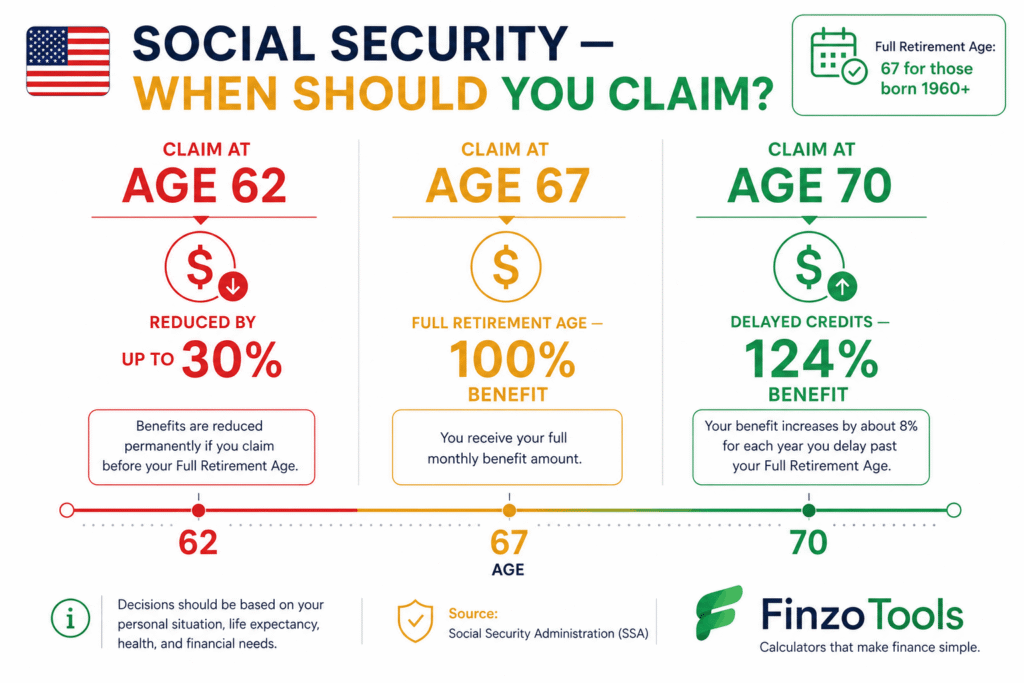
Full retirement age for Social Security is 67 for anyone born in 1960 or later. Claiming at 62 permanently reduces your benefit by 30%. Waiting until 70 increases it by 24% above the full amount through delayed retirement credits (8% per year). For a worker with a $2,000/month benefit at 67, that’s the difference between $1,400/month at 62 and $2,480/month at 70 — a 77% gap in monthly income for life. Use our free Social Security Calculator to estimate your benefit at every claiming age.
The decision of when to claim Social Security is one of the biggest financial choices most Americans will ever make. A 30% permanent cut for claiming early versus a 24% permanent bonus for waiting — on payments that last the rest of your life — can mean a six-figure difference in total lifetime income.
And yet millions of people claim at 62 without running the numbers. This guide walks through exactly how retirement age affects your benefit, what the breakeven math looks like, how spousal and survivor benefits change the calculation, and the specific 2026 numbers you need to plan around.
Full retirement age by birth year — 2026 chart
Your full retirement age (FRA) depends entirely on when you were born. For most people claiming in 2026, FRA is 67 — the final step in a phase-in that began with the 1983 Social Security Amendments.
| Birth Year | Full Retirement Age | Reduction at 62 |
|---|---|---|
| 1943–1954 | 66 | 25.0% |
| 1955 | 66 and 2 months | 25.8% |
| 1956 | 66 and 4 months | 26.7% |
| 1957 | 66 and 6 months | 27.5% |
| 1958 | 66 and 8 months | 28.3% |
| 1959 | 66 and 10 months | 29.2% |
| 1960 or later | 67 | 30.0% |
Source: SSA.gov — Retirement Age Reduction
This is the permanent FRA under current law. It won’t increase again unless Congress passes new legislation.
How claiming age changes your monthly benefit
The gap between claiming at 62 and waiting until 70 is dramatic. Here’s what it looks like for a worker with a Primary Insurance Amount (PIA) of $2,000 — the amount you’d receive at exactly your FRA:
| Claiming Age | Monthly Benefit | Annual Income | % of Full Benefit |
|---|---|---|---|
| 62 | $1,400 | $16,800 | 70% |
| 63 | $1,500 | $18,000 | 75% |
| 64 | $1,600 | $19,200 | 80% |
| 65 | $1,733 | $20,800 | 86.7% |
| 66 | $1,867 | $22,400 | 93.3% |
| 67 (FRA) | $2,000 | $24,000 | 100% |
| 68 | $2,160 | $25,920 | 108% |
| 69 | $2,320 | $27,840 | 116% |
| 70 | $2,480 | $29,760 | 124% |
The difference between $1,400 at 62 and $2,480 at 70 is $1,080 every month — $12,960 per year — for the rest of your life. And these amounts grow with the annual COLA (2.8% in 2026), so the dollar gap widens over time.
Maximum Social Security benefits in 2026
For workers who earned at or above the taxable maximum ($184,500 in 2026) for 35 years, the SSA publishes these maximum benefit amounts:
| Claiming Age | Maximum Monthly Benefit 2026 | Maximum Annual Income |
|---|---|---|
| 62 | $2,969 | $35,628 |
| 67 (FRA) | $4,207 | $50,484 |
| 70 | $5,181 | $62,172 |
The average retired worker receives approximately $2,070 per month in 2026 — well below the maximum, since few people earn the taxable maximum for a full 35 years.
The breakeven calculation — when does waiting pay off?
The most common argument for claiming at 62 is: “I’ll collect for more years.” And that’s true — you get 60 extra monthly payments before a 67-claimer receives anything. The question is how long it takes for the higher monthly amount to catch up.
Using a $2,000 PIA:
- Claiming at 62 vs 67: You collect $1,400/month for 60 months = $84,000 head start. At 67, the other claimant gets $600 more per month. Breakeven: $84,000 ÷ $600 = 140 months ≈ age 78.7
- Claiming at 62 vs 70: You collect $1,400/month for 96 months = $134,400 head start. At 70, the other claimant gets $1,080 more per month. Breakeven: $134,400 ÷ $1,080 = 124 months ≈ age 80.3
- Claiming at 67 vs 70: You collect $2,000/month for 36 months = $72,000 head start. At 70, the other claimant gets $480 more per month. Breakeven: $72,000 ÷ $480 = 150 months ≈ age 82.5
If you live past the breakeven age, waiting produces more total lifetime income. The average 62-year-old American can expect to live to approximately 83–85, which puts most people past the breakeven point. But individual health, financial needs, and family history all factor in.
These calculations also don’t account for COLA increases, which compound over time and benefit the higher payment more. With COLA included, the breakeven ages shift roughly 1–2 years earlier.
Spousal benefits — up to 50% of the worker’s amount
A spouse who didn’t work or earned significantly less can claim a spousal benefit worth up to 50% of the higher-earning spouse’s FRA benefit. The worker must have already filed for benefits before the spouse can claim on their record.
| Spouse Claims At | % of Worker’s FRA Benefit | Example (Worker PIA $2,000) |
|---|---|---|
| 62 | 32.5% | $650/month |
| 65 | 41.7% | $834/month |
| 67 (FRA) | 50% | $1,000/month |
Unlike retirement benefits, spousal benefits do not earn delayed retirement credits. There’s no advantage to waiting past FRA to claim a spousal benefit — the maximum is 50% at FRA.
A spouse receives whichever is higher: their own benefit based on their earnings record, or the spousal benefit. SSA doesn’t pay both — you get the higher of the two.
Survivor benefits — why the higher earner’s decision matters most
When one spouse dies, the surviving spouse can receive up to 100% of the deceased worker’s benefit — including any delayed retirement credits the worker earned by waiting past FRA.
This is the single most important planning consideration for married couples. If the higher earner delays to 70 and then dies, the surviving spouse inherits that larger payment — potentially for decades. If the higher earner claimed at 62, the survivor is locked into the reduced amount.
For couples where one spouse earned significantly more, the higher earner delaying to 70 functions as a form of life insurance for the surviving spouse.
The earnings test — working while collecting benefits
If you claim Social Security before FRA and continue working, the earnings test may temporarily reduce your benefits:
| Situation | 2026 Earnings Limit | Withholding |
|---|---|---|
| Under FRA all year | $24,480 | $1 withheld per $2 earned above limit |
| Year you reach FRA (months before FRA) | $65,160 | $1 withheld per $3 earned above limit |
| At FRA and beyond | No limit | No withholding — earn any amount |
Source: SSA.gov — Receiving Benefits While Working
Withheld benefits aren’t lost permanently. At FRA, SSA recalculates your benefit to credit the months where payments were withheld. But the recalculation doesn’t guarantee full recovery — it depends on how long you live after FRA.
Key Social Security numbers for 2026
| Item | 2026 Amount |
|---|---|
| COLA increase | 2.8% |
| Average retired worker benefit | ~$2,070/month |
| Taxable wage base | $184,500 |
| Credits needed to qualify | 40 credits (~10 years) |
| Earnings per credit | $1,890 |
| Maximum credits per year | 4 |
| Delayed retirement credit (per year past FRA) | 8% |
| Early claiming reduction (at 62, FRA=67) | 30% |
When to claim at 62, 67, or 70 — a practical framework
Claiming at 62 may make sense if:
- You’ve stopped working and have no other income source to bridge the gap
- You have a serious health condition that shortens your life expectancy below 78
- You’re the lower earner in a married couple and your spouse will delay their larger benefit
- You need the income to avoid going into debt or withdrawing from retirement accounts at a loss
Waiting until 67 (FRA) makes sense if:
- You can bridge the gap with savings, a pension, or part-time work
- You’re in average health and expect to live past 79
- You want to avoid the earnings test while still working
- You want the simplicity of receiving 100% of your calculated benefit
Delaying until 70 is strongest when:
- You’re the higher earner in a married couple — delaying protects your spouse’s survivor benefit
- You have other income sources to cover ages 62–70
- You’re in good health with family history of longevity
- You want to maximize the guaranteed, inflation-adjusted income stream for life
There’s no benefit to waiting past 70. Delayed retirement credits stop accruing at that point.
Common Social Security mistakes
- Claiming at 62 “because the system might run out.” The Social Security Trust Fund faces a shortfall around 2035, but even in the worst case, the system can still pay roughly 80% of scheduled benefits from ongoing payroll taxes. A 20% benefit cut is bad, but it doesn’t justify voluntarily taking a 30% permanent reduction today.
- Ignoring spousal and survivor implications. For married couples, the higher earner’s claiming decision affects both spouses — potentially for decades after one of them dies.
- Not checking your earnings record for errors. SSA calculates benefits from your highest 35 years of earnings. If any years are missing or incorrect, your benefit will be lower. Review your statement at my.ssa.gov.
- Forgetting that claiming reductions are permanent. If you claim at 62, your benefit is permanently 30% lower. It doesn’t “reset” to the full amount when you reach 67.
- Not factoring in taxes on benefits. Up to 85% of Social Security benefits can be subject to federal income tax, depending on your combined income. This affects the real value of early vs delayed claiming.
Frequently asked questions — Social Security retirement age 2026
What is the full retirement age for Social Security in 2026?
67 for anyone born in 1960 or later. This is the permanent FRA under current law. For those born 1955–1959, FRA ranges from 66 and 2 months to 66 and 10 months.
How much is Social Security reduced if I claim at 62?
If your FRA is 67, claiming at 62 permanently reduces your benefit by 30%. A $2,000/month benefit at FRA becomes $1,400/month at 62.
How much more do I get by waiting until 70?
24% more than your FRA benefit. Delayed retirement credits add 8% per year for each year past FRA until age 70. A $2,000 FRA benefit becomes $2,480 at age 70.
What is the average Social Security benefit in 2026?
Approximately $2,070 per month for a retired worker, after the 2.8% COLA increase applied in January 2026.
What is the maximum Social Security benefit in 2026?
$2,969/month at age 62, $4,207/month at FRA (67), and $5,181/month at age 70. These maximums apply to workers who earned at or above the taxable maximum for 35 years.
Can I work and collect Social Security at the same time?
Yes, but if you’re under FRA and earn above $24,480 in 2026, SSA withholds $1 in benefits for every $2 over the limit. At FRA, the earnings test disappears and your benefit is recalculated to credit withheld months.
What is the breakeven age for delaying Social Security?
Roughly age 78–81, depending on whether you compare 62 vs 67, 62 vs 70, or 67 vs 70. If you live past the breakeven age, waiting produces more total lifetime income. COLA adjustments shift breakeven roughly 1–2 years earlier.
How do spousal benefits work?
A spouse can receive up to 50% of the higher earner’s FRA benefit. The worker must have filed first. Claiming spousal benefits before FRA reduces the amount. There are no delayed retirement credits on spousal benefits — the maximum is 50% at FRA.
What happens to Social Security when my spouse dies?
The surviving spouse can receive up to 100% of the deceased worker’s benefit, including any delayed retirement credits. This is why the higher earner’s claiming decision is critical — delaying creates a larger survivor benefit that could last decades.
What is the 2026 COLA increase for Social Security?
2.8%, applied to all benefit payments starting January 2026. The COLA is based on the Consumer Price Index for Urban Wage Earners and Clerical Workers (CPI-W) and adjusts benefits annually for inflation.
Related tools and guides
- 🧮 Social Security Benefits Calculator 2026 — estimate your benefit at every claiming age
- 📖 Social Security Benefits 2026 — How Much Will You Get?
- 🧮 401(k) Calculator 2026 — project your retirement savings
- 🧮 Retirement Calculator — estimate your total retirement income
- 🧮 FIRE Calculator — calculate your path to financial independence
- 🧮 US Income Tax Calculator 2026 — see your federal tax breakdown
Sources & references
- Social Security Administration — Retirement Benefits 2026 (Publication 05-10035)
- SSA.gov — Benefit Reduction for Early Retirement
- SSA.gov — Receiving Benefits While Working
- SSA.gov — Delayed Retirement Credits
- SSA — 2026 COLA Adjustment: 2.8%
© 2026 FinzoTools — For educational purposes only. This is not financial, legal, or tax advice. Consult a qualified financial advisor before making Social Security claiming decisions.