
UK Inheritance Tax 2026
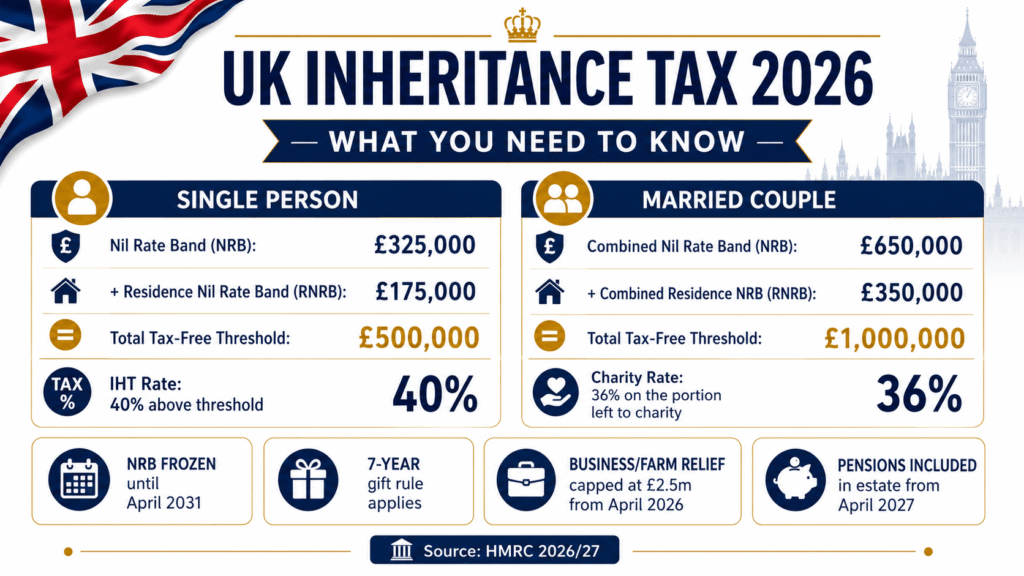
The UK inheritance tax threshold for 2026/27 is £325,000 per person — frozen at this level since 2009 and now confirmed frozen until April 2031 following Rachel Reeves’s November 2025 Budget. With the residence nil rate band (£175,000 for a family home passed to children or grandchildren), a single person can pass up to £500,000 tax-free. Married couples combining both allowances can shelter up to £1,000,000 from inheritance tax entirely.
Use our free UK Inheritance Tax Calculator to estimate your estate’s IHT liability in 60 seconds — updated for 2026/27 HMRC thresholds, no signup required.
UK Inheritance Tax Thresholds 2026/27 — At a Glance
| Threshold | Amount | Who Gets It | Condition |
|---|---|---|---|
| Nil Rate Band (NRB) | £325,000 | Everyone | No conditions |
| Residence NRB (RNRB) | £175,000 | Homeowners | Home passed to direct descendants |
| Single person total | £500,000 | Homeowners with children | NRB + RNRB combined |
| Married couple total | £1,000,000 | Married/civil partners | Both sets of allowances combined |
| IHT Rate | 40% | All estates above threshold | On amount above threshold only |
| Charity Rate | 36% | Charitable estates | 10%+ of net estate left to charity |
All thresholds confirmed frozen until April 2031 by the November 2025 Autumn Budget. Source: HMRC, GOV.UK, Finance Act 2026.
How UK Inheritance Tax Works — Step by Step
Inheritance tax is calculated on your net estate — everything you own at death (property, savings, investments, personal possessions) minus any debts, mortgages and reasonable funeral costs. Here is exactly how HMRC calculates it:
- Calculate gross estate: Total value of all assets at death
- Deduct debts: Mortgages, loans, outstanding bills, funeral costs
- Apply exemptions: Spouse/charity transfers are fully exempt
- Subtract nil rate bands: NRB (£325,000) + RNRB if eligible (£175,000)
- Apply IHT rate: 40% on remaining taxable estate
- Add 7-year gifts: Gifts made within 7 years are added back
Example: £800,000 Estate (Single Person, Family Home)
| Calculation Step | Amount |
|---|---|
| Gross estate value | £800,000 |
| Less: mortgage/debts | −£50,000 |
| Net estate | £750,000 |
| Less: Nil Rate Band | −£325,000 |
| Less: Residence NRB | −£175,000 |
| Taxable estate | £250,000 |
| IHT at 40% | £100,000 |
| Heirs receive | £650,000 |
IHT by Estate Value — How Much Will Your Heirs Pay?
Here is the inheritance tax due at different estate values for a single person passing a family home to children (NRB £325,000 + RNRB £175,000 = £500,000 total threshold):
| Estate Value | IHT Due at 40% | Heirs Receive | Effective Rate |
|---|---|---|---|
| £400,000 | £0 | £400,000 | 0% |
| £600,000 | £40,000 | £560,000 | 6.7% |
| £800,000 | £120,000 | £680,000 | 15% |
| £1,000,000 | £200,000 | £800,000 | 20% |
| £1,500,000 | £400,000 | £1,100,000 | 26.7% |
| £2,000,000 | £600,000 | £1,400,000 | 30% |
Use our free UK IHT Calculator to calculate the exact tax on your estate including spouse allowances, gifts, and charity donations.
What Changed in UK Inheritance Tax for 2026?
The November 2025 Autumn Budget introduced two significant changes that take effect in the 2026/27 tax year:
1. Business and Agricultural Property Relief Capped from April 2026
Previously, qualifying business assets and agricultural land received 100% IHT relief with no cap — meaning a family farm worth £10 million could pass completely free of inheritance tax. From 6 April 2026, a combined cap of £2.5 million applies to Business Property Relief (BPR) and Agricultural Property Relief (APR) combined at the 100% rate. Value above £2.5 million receives only 50% relief — an effective IHT rate of 20% on the excess.
2. NRB Freeze Extended to April 2031
The nil rate band (£325,000), residence nil rate band (£175,000), and the £2 million RNRB taper threshold were due to begin rising with inflation from 2028. The November 2025 Budget nailed them down until April 2031 — meaning more estates will be dragged into IHT liability each year as property prices and asset values rise while the threshold stays fixed. This “fiscal drag” is a silent tax increase affecting millions of families.
3. Pensions Included in Estates from April 2027
From 6 April 2027, most unused pension funds and death benefits will be included in your taxable estate for IHT purposes. Currently, pension pots are one of the most IHT-efficient assets to leave to heirs — sitting outside the estate entirely. Anyone who has been using a pension as a quiet way to pass wealth down should review that plan well before the date, because the maths changes.
The 7-Year Gift Rule — How It Works in Practice
One of the most powerful IHT planning tools is making gifts more than 7 years before death. These are called Potentially Exempt Transfers (PETs) — they leave your estate completely once the 7-year clock runs.
| Years Between Gift and Death | IHT Rate on Gift | Taper Relief |
|---|---|---|
| 0 – 3 years | 40% | None |
| 3 – 4 years | 32% | 20% relief |
| 4 – 5 years | 24% | 40% relief |
| 5 – 6 years | 16% | 60% relief |
| 6 – 7 years | 8% | 80% relief |
| 7+ years | 0% | Fully exempt |
Important: Taper relief only applies once the total value of gifts exceeds the £325,000 nil rate band. On gifts below £325,000, there is no IHT anyway — so taper relief gives no additional benefit in those cases. Also, giving away your home and continuing to live in it rent-free is a “gift with reservation of benefit” — HMRC treats it as still in your estate regardless of who is on the deeds.
Annual Gift Exemptions — IHT-Free From Day One
Unlike PETs, these gifts are immediately outside your estate with no 7-year requirement:
- Annual gift exemption: £3,000 per year (can carry forward one year if unused)
- Small gifts: £250 per person per year to any number of people
- Wedding gifts: £5,000 to a child, £2,500 to a grandchild, £1,000 to anyone else
- Regular gifts from income: Any amount — provided they come from surplus income and don’t reduce your standard of living
- Gifts to charity: Always fully exempt, no limit
How to Reduce UK Inheritance Tax Legally — 6 Strategies
1. Write a Will — And Review It Regularly
Dying without a will (intestate) means your estate is distributed under fixed legal rules — potentially missing the RNRB, wasting the transferable NRB, or leaving assets to people you didn’t intend. A well-written will is the foundation of all IHT planning.
2. Start Gifting Early
The 7-year clock starts the day you make a gift — not the day you plan to. Every year you delay is a year the clock isn’t running. Start systematic gifting in your 60s rather than your 80s to maximise the chance of gifts clearing the 7-year window.
3. Leave 10% to Charity
If you leave at least 10% of your net estate to a UK registered charity, the IHT rate on the rest drops from 40% to 36%. Depending on your estate size, this can actually result in your heirs receiving more money after tax — while also supporting a cause you care about.
4. Put Life Insurance in Trust
A life insurance policy held outside a trust forms part of your estate and may face IHT. Placing it in a discretionary trust means the payout goes directly to your beneficiaries without IHT and without waiting for probate — sometimes critical for covering the IHT bill itself.
5. Use Business Property Relief While It Lasts
Qualifying business assets and AIM-listed shares still receive significant IHT relief in 2026 — though the April 2026 cap limits the 100% relief to £2.5 million combined. If you own a trading business, shares in an AIM company, or agricultural land, specialist structuring advice is essential.
6. Review Your Pension Arrangements Before April 2027
Currently, pension funds sit completely outside your estate for IHT. From April 2027, they will be included. If you have been treating your pension as an inheritance vehicle — drawing income from other assets while preserving the pension for heirs — this strategy needs urgent review before the rules change.
UK Inheritance Tax Calculator 2026
Estimate your estate’s IHT liability in 60 seconds — includes nil rate band, residence nil rate band, spouse allowances, charity reduction, and gifts:
👉 Free UK IHT Calculator 2026/27 — No Signup Required →
Frequently Asked Questions
What is the UK inheritance tax threshold in 2026?
The UK inheritance tax threshold (nil rate band) for 2026/27 is £325,000 per person — frozen since 2009 and now confirmed frozen until April 2031. With the residence nil rate band (£175,000 when a family home passes to direct descendants), a single person can pass up to £500,000 tax-free. Married couples can pass up to £1,000,000 by combining both allowances. Source: HMRC 2026/27.
How much is inheritance tax in the UK in 2026?
UK inheritance tax is charged at 40% on the net value of your estate above the nil rate band. The rate reduces to 36% if you leave at least 10% of your net estate to a UK registered charity. Transfers between spouses or civil partners are completely exempt with no limit. Source: HMRC.
What is the 7-year gift rule for inheritance tax?
Gifts made more than 7 years before death are completely exempt from IHT (Potentially Exempt Transfers). If you die within 7 years, taper relief reduces IHT: 0–3 years: 40%; 3–4 years: 32%; 4–5 years: 24%; 5–6 years: 16%; 6–7 years: 8%. Taper only applies once cumulative gifts exceed the £325,000 nil rate band.
Do spouses pay inheritance tax on each other’s estates?
No. Transfers between spouses or civil partners are fully IHT-exempt with no limit. The surviving spouse also inherits any unused nil rate band and residence nil rate band — effectively doubling their own threshold. A couple can pass up to £1,000,000 tax-free. The unused allowances must be claimed by the executor when the second spouse dies.
What changed in UK inheritance tax in 2026?
Two major changes from April 2026: (1) Business Property Relief and Agricultural Property Relief now share a £2.5 million cap at 100% relief — value above this gets only 50% relief. (2) NRB, RNRB and taper threshold frozen until April 2031 by the November 2025 Budget. From April 2027: pension funds will be included in taxable estates.
When must inheritance tax be paid?
IHT must normally be paid by the end of the 6th month after the person’s death. HMRC charges interest on late payments. The executor pays IHT from the estate before probate is granted. For property that takes time to sell, HMRC allows instalments over 10 years on qualifying assets.
Related Calculators
- 🇬🇧 UK Inheritance Tax Calculator 2026 — IHT estimate in 60 seconds
- 🇬🇧 UK Salary Calculator 2026 — Take-home after income tax and NI
- 🇬🇧 ISA Calculator 2026 — Tax-free savings and investment growth
- 🇬🇧 UK Pension Calculator — Estimate your pension pot at retirement
- 🇬🇧 Stamp Duty Calculator — SDLT on UK property purchases
Last updated: July 2026. Based on HMRC 2026/27 IHT rates and thresholds, Finance Act 2026, and HM Treasury Autumn Budget 2025. Sources: GOV.UK (gov.uk/inheritance-tax), HMRC Inheritance Tax Manual, House of Commons Library Research Briefing April 2026. This article is for informational purposes only — always consult a qualified solicitor or chartered financial planner for personalised estate planning advice.