
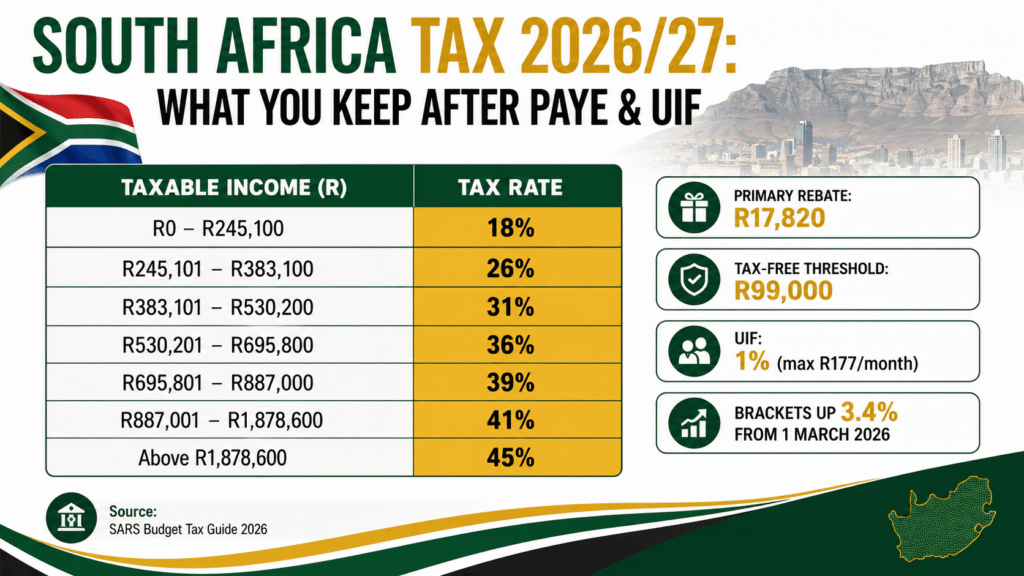
On a salary of R30,000 per month in South Africa, your take-home pay after PAYE income tax and UIF is approximately R25,142 per month in 2026/27. The South African Revenue Service (SARS) raised all income tax brackets by 3.4% from 1 March 2026 — the first inflation-linked adjustment since 2023/24 — giving most workers a modest reduction in their effective tax rate.
Use our free South Africa PAYE Tax Calculator — updated with SARS 2026/27 confirmed rates — to see your exact take-home pay. No email signup or registration required.
SARS Income Tax Brackets 2026/27 (Confirmed)
South Africa uses a progressive tax system — you only pay the higher rate on the portion of income within that bracket, never on your full salary. The confirmed SARS tax brackets for the 2026/27 tax year (1 March 2026 to 28 February 2027) are:
| Taxable Income (R) | Tax Rate | Tax Formula |
|---|---|---|
| R1 – R245,100 | 18% | 18% of taxable income |
| R245,101 – R383,100 | 26% | R44,118 + 26% above R245,100 |
| R383,101 – R530,200 | 31% | R79,998 + 31% above R383,100 |
| R530,201 – R695,800 | 36% | R125,599 + 36% above R530,200 |
| R695,801 – R887,000 | 39% | R185,215 + 39% above R695,800 |
| R887,001 – R1,878,600 | 41% | R259,783 + 41% above R887,000 |
| Above R1,878,600 | 45% | R666,339 + 45% above R1,878,600 |
These brackets apply to income earned from 1 March 2026 to 28 February 2027. Source: SARS Budget Tax Guide 2026, National Treasury, published 25 February 2026. Brackets were increased by 3.4% from the 2025/26 year.
SARS Rebates 2026/27 — How They Reduce Your Tax
A tax rebate reduces your tax liability directly (not your income). SARS applies three age-based rebates that are subtracted from your calculated tax — effectively making a portion of your income completely tax-free:
| Rebate Type | Who Qualifies | 2026/27 Amount | Tax-Free Threshold |
|---|---|---|---|
| Primary Rebate | All taxpayers under 65 | R17,820 | R99,000/year |
| Secondary Rebate | Age 65–74 (additional) | R9,765 | R153,250/year |
| Tertiary Rebate | Age 75+ (additional) | R3,249 | R171,300/year |
How the threshold works: The R99,000 tax-free threshold for under-65s is not a deduction from income — it is the income level at which the 18% bracket tax exactly equals the primary rebate (R99,000 × 18% = R17,820). If you earn below R99,000 per year (R8,250/month), you pay zero income tax.
Take-Home Pay Examples — Real Rand Amounts (2026/27)
Here is exactly what South Africans take home at common monthly salary levels after PAYE tax and UIF in 2026/27 (under 65, standard deductions only):
| Monthly Salary | Annual Income | Annual PAYE Tax | UIF/Month | Take-Home/Month | Effective Rate |
|---|---|---|---|---|---|
| R8,000 | R96,000 | R0 | R80 | R7,920 | 1.0% |
| R10,000 | R120,000 | R1,530 | R100 | R9,773 | 2.3% |
| R15,000 | R180,000 | R12,330 | R150 | R13,328 | 11.2% |
| R20,000 | R240,000 | R25,326 | R177 | R17,629 | 11.9% |
| R30,000 | R360,000 | R56,502 | R177 | R25,142 | 15.7% |
| R45,000 | R540,000 | R111,312 | R177 | R35,547 | 20.6% |
| R50,000 | R600,000 | R132,912 | R177 | R38,747 | 22.2% |
| R80,000 | R960,000 | R267,624 | R177 | R57,661 | 27.9% |
These figures are for employees under 65 with no additional deductions (no retirement annuity, no medical aid credits). Use our South Africa PAYE Calculator to add your specific deductions for a personalised figure. No signup required.
UIF (Unemployment Insurance Fund) 2026/27
UIF is a mandatory contribution that funds temporary income support during job loss, illness, maternity leave, and adoption leave. Both you and your employer each contribute 1% of your salary:
| UIF Detail | 2026/27 Amount |
|---|---|
| Employee contribution rate | 1% of monthly salary |
| Employer contribution rate | 1% of monthly salary (does not affect your take-home) |
| Maximum monthly earnings ceiling | R17,712/month |
| Maximum UIF deduction per month | R177.12/month |
If your salary is above R17,712 per month, your UIF contribution is capped at R177.12 regardless of how much you earn. This explains why employees earning R30,000, R50,000, or R100,000 per month all pay the same R177.12 in UIF.
Bracket Creep in 2026/27 — The Silent Tax Increase
SARS raised tax brackets by 3.4% from 1 March 2026. However, most South African workers received salary increases of 5–6% in 2026. The gap between your salary increase and the bracket adjustment creates what economists call “bracket creep” — a silent, effective tax increase.
| Scenario | 2025/26 Salary | 2026/27 Salary (6% raise) | Effect |
|---|---|---|---|
| Salary growth: 6% | R400,000/year | R424,000/year | Extra R24,000 partially in higher bracket |
| Bracket growth: 3.4% | — | Brackets up 3.4% only | Gap = 2.6% of income taxed at higher rate |
The 3.4% bracket adjustment partially offsets inflation but does not fully protect workers whose salaries grew faster than inflation. The primary rebate increased from R17,235 to R17,820 — saving workers approximately R585 per year compared to the previous year.
Medical Aid Tax Credits 2026/27
If you contribute to a registered medical aid scheme, you can reduce your PAYE liability through the Medical Scheme Fees Tax Credit (MSFTC). These credits are deducted directly from your tax owed — not from your income:
| Medical Aid Member | Monthly Credit (2026/27) | Annual Tax Saving |
|---|---|---|
| Main member | R376/month | R4,512/year |
| First dependant | R376/month | R4,512/year |
| Each additional dependant | R254/month | R3,048/year |
Example: A worker with a spouse and one child on medical aid claims: R376 + R376 + R254 = R1,006 per month in tax credits, saving R12,072 per year in PAYE — simply for being on a medical aid scheme.
Retirement Annuity Deductions 2026/27
Contributions to a pension fund, provident fund, or retirement annuity (RA) are tax-deductible under Section 11F of the Income Tax Act:
| RA Deduction Rule | 2026/27 Limit |
|---|---|
| Maximum deductible rate | 27.5% of greater of remuneration or taxable income |
| Annual cap | R430,000/year (increased from R350,000 in 2025/26) |
Example tax saving: On a R50,000 monthly salary (R600,000/year), contributing 15% to an RA (R90,000/year) reduces your taxable income to R510,000 — saving approximately R27,900 in PAYE at the 31% marginal rate.
New in 2026: CARF Crypto Reporting
From 2 March 2026, South Africa implemented the Crypto-Asset Reporting Framework (CARF) — an internationally aligned system requiring crypto-asset service providers (exchanges, wallets) to report user transaction data directly to SARS.
This means if you bought, sold, or earned cryptocurrency through a South African platform in 2026, SARS may already have a record of those transactions. Key implications:
- Crypto gains are taxable as either income tax or capital gains tax depending on trading frequency
- SARS can now cross-reference crypto activity against your tax return
- Voluntary disclosure before SARS contacts you avoids penalties
- The CARF data sharing integrates with international AEOI (Automatic Exchange of Information) — foreign crypto activity may also be reported to SARS
South Africa PAYE Tax Calculator 2026/27
Your exact take-home pay depends on:
- Your gross monthly salary
- Your age (under 65, 65–74, or 75+)
- Medical aid contributions and number of dependants
- Retirement annuity or pension fund contributions
- Travel allowance (80% is taxable)
- Any other SARS-approved deductions
Use the free finzotools.com South Africa PAYE Calculator — updated with confirmed SARS 2026/27 brackets, rebates, and UIF rates. No email signup or registration required.
👉 Calculate Your 2026/27 South Africa Take-Home Pay Now →
Frequently Asked Questions
What are the SARS income tax brackets for 2026/27?
The SARS 2026/27 tax brackets are: 18% on income up to R245,100; 26% on R245,101–R383,100; 31% on R383,101–R530,200; 36% on R530,201–R695,800; 39% on R695,801–R887,000; 41% on R887,001–R1,878,600; and 45% above R1,878,600. Brackets were raised 3.4% from 1 March 2026 — the first inflation adjustment since 2023/24.
How much tax do I pay on R30,000 per month in South Africa?
On a gross salary of R30,000 per month (R360,000 per year) in 2026/27, a South African taxpayer under 65 pays approximately R56,502 in annual PAYE tax, plus R177.12/month in UIF. This leaves a take-home pay of approximately R25,142 per month — an effective tax rate of 15.7%.
What is the tax-free threshold in South Africa for 2026/27?
The tax-free threshold for 2026/27 is R99,000 per year (R8,250 per month) for taxpayers under 65. This means if you earn below this amount, you pay zero income tax. The threshold is R153,250 for those aged 65–74, and R171,300 for those aged 75 and older.
What is the primary rebate in South Africa for 2026/27?
The primary rebate for 2026/27 is R17,820 — an increase from R17,235 in 2025/26. This rebate is subtracted directly from your calculated tax liability (not your income), saving all taxpayers under 65 approximately R585 per year compared to the previous year.
How much UIF do I pay in South Africa 2026?
UIF is deducted at 1% of your monthly salary, up to a maximum of R177.12 per month (based on a monthly earnings ceiling of R17,712). If you earn more than R17,712 per month, you pay the flat maximum of R177.12 regardless of your actual salary. Your employer also contributes 1% separately — this does not reduce your take-home pay.
What changed in South Africa tax for 2026/27?
Key changes from 1 March 2026 include: all seven tax brackets increased by 3.4% (first inflation adjustment since 2023/24); the primary rebate increased from R17,235 to R17,820; tax-free threshold raised from R95,750 to R99,000; medical aid tax credits increased to R376/month per person (from R364); retirement annuity deduction cap raised to R430,000 (from R350,000); and CARF crypto-asset reporting implemented from 2 March 2026.
Related Calculators on Finzotools
- 🇿🇦 South Africa PAYE Calculator — Take-home pay after SARS tax and UIF 2026/27
- 🇦🇺 Australia Salary Calculator — Take-home after ATO tax and Medicare Levy
- 🇨🇦 Canada Salary Calculator — Take-home after CRA tax, CPP and EI
- 🇦🇪 UAE End of Service Calculator — Exact gratuity in AED, no login required
- 🇬🇧 UK Salary Calculator — Take-home after income tax and National Insurance
Last updated: June 2026. Tax figures based on SARS Budget Tax Guide 2026, published by National Treasury on 25 February 2026. Tax year runs 1 March 2026 to 28 February 2027. Sources: South African Revenue Service (sars.gov.za), National Treasury Budget Review 2026. Always verify at sars.gov.za or consult a registered tax practitioner for advice specific to your circumstances.