
Published: June 2026 · Last reviewed: October 2026 · Figures: ATO 2026-27 resident rates.
🧮 Get your exact number: use our free Australia Salary Calculator (2026-27 ATO rates) — or see a worked $40,000 salary example.
Your gross annual salary before tax
Employer super contribution (12% for 2026-27)
Additional salary sacrifice to super
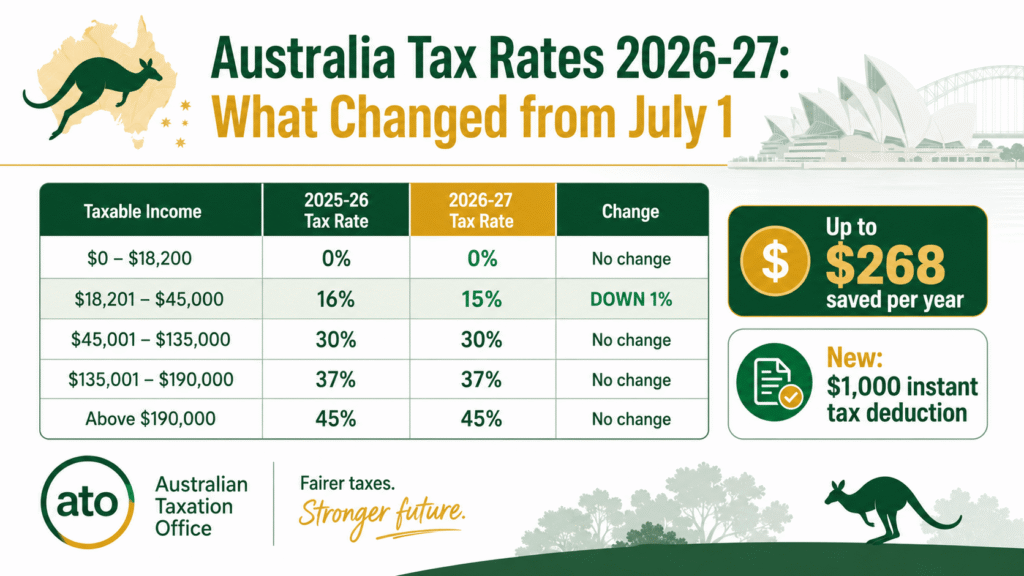
From 1 July 2026, every Australian taxpayer received a tax cut — the marginal rate on income between $18,201 and $45,000 dropped from 16% to 15%, saving up to $268 per year. A new $1,000 instant tax deduction for work-related expenses also applies from the 2026-27 financial year, giving 6.2 million workers an average additional saving of $205.
Use our free Australia Salary Calculator — updated with the confirmed 2026-27 ATO rates — to see your exact take-home pay and tax for the new financial year.
Australia Income Tax Brackets 2026-27 (ATO Confirmed)
Australia uses a progressive tax system — you only pay the higher rate on income within that bracket, not on your entire income. Here are the confirmed resident tax rates for 2026-27, effective from 1 July 2026:
| Taxable Income | 2025-26 Rate | 2026-27 Rate | Change |
|---|---|---|---|
| $0 – $18,200 | 0% | 0% | No change |
| $18,201 – $45,000 | 16% | 15% | ↓ 1 pp |
| $45,001 – $135,000 | 30% | 30% | No change |
| $135,001 – $190,000 | 37% | 37% | No change |
| Above $190,000 | 45% | 45% | No change |
These rates do not include the 2% Medicare Levy, which applies on top for most residents. Source: Australian Taxation Office (ato.gov.au) — confirmed for the 2026-27 income year (1 July 2026 – 30 June 2027).
What You Actually Save — Real Dollar Figures
The 1 percentage point cut applies to income between $18,201 and $45,000 — a range of $26,800. For anyone earning above $45,000, the maximum saving is the same: $268 per year ($22.33 per month).
| Annual Salary | 2025-26 Tax | 2026-27 Tax | Annual Saving | Monthly Saving |
|---|---|---|---|---|
| $30,000 | $1,888 | $1,768 | $120 | $10 |
| $40,000 | $3,488 | $3,288 | $200 | $17 |
| $45,000+ | Varies | Varies | $268 (max) | $22 |
| $60,000 | $9,388 | $9,120 | $268 | $22 |
| $80,000 | $15,388 | $15,120 | $268 | $22 |
| $100,000 | $21,388 | $21,120 | $268 | $22 |
| $150,000 | $40,888 | $40,620 | $268 | $22 |
These figures are before Medicare Levy (2%) and do not include the Low Income Tax Offset (LITO) or other offsets. Use our Australia Salary Calculator to get your complete take-home pay figure including all offsets and levies.
New: $1,000 Instant Tax Deduction (2026-27)
Alongside the bracket rate cut, the Australian Government introduced a $1,000 instant tax deduction for work-related expenses, effective from the 2026-27 financial year.
| Feature | Detail |
|---|---|
| Deduction amount | Up to $1,000 of work-related expenses |
| Receipts required? | No — no receipts needed for the first $1,000 |
| Who benefits? | Workers with under $1,000 in work expenses — 6.2 million Australians |
| Average tax saving | $205 per person (average benefit) |
| When does it apply? | When lodging your 2026-27 tax return (from July 2027) |
| Workers with $1,000+ expenses | Continue claiming actual expenses as before — unaffected |
Combined saving example: A worker earning $80,000 with under $1,000 in work expenses will save $268 from the bracket cut + $205 from the instant deduction = $473 more per year compared to 2025-26 rates.
Full Take-Home Pay at Different Salary Levels — 2026-27
Here is what Australians at different income levels actually take home after income tax and Medicare Levy in 2026-27:
| Gross Salary | Income Tax | Medicare Levy (2%) | Total Deductions | Take-Home Pay | Effective Rate |
|---|---|---|---|---|---|
| $50,000 | $5,620 | $1,000 | $6,620 | $43,380 | 13.2% |
| $60,000 | $9,120 | $1,200 | $10,320 | $49,680 | 17.2% |
| $70,000 | $12,120 | $1,400 | $13,520 | $56,480 | 19.3% |
| $80,000 | $15,120 | $1,600 | $16,720 | $63,280 | 20.9% |
| $100,000 | $21,120 | $2,000 | $23,120 | $76,880 | 23.1% |
| $120,000 | $27,120 | $2,400 | $29,520 | $90,480 | 24.6% |
| $150,000 | $40,620 | $3,000 | $43,620 | $106,380 | 29.1% |
| $200,000 | $59,120 | $4,000 | $63,120 | $136,880 | 31.6% |
These figures include income tax and Medicare Levy only. They do not include HECS-HELP repayments, Medicare Levy Surcharge (for those without private health cover earning above $93,000), or the Low Income Tax Offset (LITO). Use our Australia Salary Calculator for a complete personalised breakdown.
Medicare Levy 2026-27
The Medicare Levy remains at 2% of taxable income for most residents in 2026-27. However, the low-income thresholds increased from 1 July 2025:
| Category | Full Exemption Below | Phase-In Range |
|---|---|---|
| Singles | $27,222 | $27,222 – $34,027 |
| Families | $45,907 + $4,216 per child | Phased in above threshold |
| Seniors (SAPTO eligible) | $43,020 | $43,020 – $53,775 |
The Medicare Levy Surcharge (MLS) is an additional 1% to 1.5% charge for higher-income earners who do not have appropriate private hospital cover. The MLS applies above $93,000 (singles) or $186,000 (families) in 2026-27.
Superannuation 2026-27 — Super Guarantee Rate
The Super Guarantee (SG) rate — the mandatory employer super contribution — remains at 12% of ordinary time earnings in 2026-27, having reached its legislated cap in the 2025-26 year.
| Year | Super Guarantee Rate |
|---|---|
| 2024-25 | 11.5% |
| 2025-26 | 12% |
| 2026-27 (current) | 12% (no change) |
Super on high balances: From 1 July 2026, earnings tax on super balances between $3 million and $10 million rises to 30%, and above $10 million to 40%. This applies only to the wealthiest super accounts and does not affect most Australians.
HECS-HELP Repayments 2026-27
HECS-HELP (student loan) repayments are separate from income tax and are based on your repayment income, not taxable income. The minimum repayment threshold for 2026-27 is $69,528 (indexed from $67,000 in 2025-26). Repayments are marginal: 15c per $1 from $69,528 to $129,717, then $9,028 plus 17c per $1 to $186,050, then 10% of total repayment income (whichever is lower) — never a flat percentage of your whole income.
HECS-HELP repayments are deducted through the PAYG system alongside income tax, but they reduce your take-home pay independently of the tax cut. If you have a HECS-HELP debt, use our Australia Salary Calculator to see your complete after-tax, after-HECS take-home figure.
Low Income Tax Offset (LITO) 2026-27
The Low Income Tax Offset (LITO) reduces the income tax payable for lower earners. In 2026-27:
| Income Range | LITO Benefit |
|---|---|
| Below $37,500 | Maximum offset: $700 |
| $37,500 – $45,000 | Reduces by 5 cents per dollar above $37,500 |
| $45,001 – $66,667 | Reduces by 1.5 cents per dollar above $45,000 |
| Above $66,667 | No LITO benefit |
The LITO is applied automatically when the ATO processes your tax return — it reduces the tax you owe, not the tax withheld during the year. If your employer withheld too much (which is common for lower earners), you will receive a refund when you lodge your return.
What Changed From 2025-26 to 2026-27 — Full Summary
| Item | 2025-26 | 2026-27 | Change |
|---|---|---|---|
| Tax-free threshold | $18,200 | $18,200 | No change |
| $18,201–$45,000 bracket rate | 16% | 15% | ↓ 1 pp |
| All other brackets | 30% / 37% / 45% | 30% / 37% / 45% | No change |
| Medicare Levy | 2% | 2% | No change |
| Super Guarantee | 12% | 12% | No change |
| Instant tax deduction | Not available | $1,000 (new!) | New |
| LITO (maximum) | $700 | $700 | No change |
Australia Salary Calculator 2026-27
Your exact take-home pay in 2026-27 depends on:
- Your gross salary and pay frequency (weekly, fortnightly, monthly)
- Whether you have a HECS-HELP debt
- Whether you have private hospital cover (affects Medicare Levy Surcharge)
- Your employer’s super contribution (12% standard)
- Any salary sacrifice or pre-tax deductions
- Tax offsets you qualify for (LITO, SAPTO for seniors)
Use the free finzotools.com Australia Salary Calculator — updated with confirmed 2026-27 ATO rates — for your exact monthly and annual take-home pay.
👉 Calculate Your 2026-27 Australia Take-Home Pay Now →
How Australian Tax Compares Internationally
Australia’s top marginal rate of 45% (plus 2% Medicare levy) sits below the UK’s 45% additional rate but above the US federal top rate of 37% (before state taxes). Australia’s $18,200 tax-free threshold is more generous than the UK’s £12,570 personal allowance at current exchange rates, while the 2026-27 cut to a 15% second bracket keeps middle incomes competitive.
6 Tips to Reduce Your Australian Tax Bill in 2026-27
- Use the $1,000 instant deduction: new for 2026-27 — claim up to $1,000 in work-related expenses without receipts.
- Salary-sacrifice into super: pre-tax contributions are taxed at 15% instead of your marginal rate (up to the $30,000 concessional cap).
- Time your deductions: bring forward work expenses into this financial year if you expect lower income next year.
- Check private hospital cover: without it, high earners pay the Medicare Levy Surcharge of 1–1.5% on top of everything else.
- Claim the LITO automatically: no action needed, but know it phases out above $66,667 — plan overtime and bonuses accordingly.
- Keep records all year: logbook, receipts, and donation records make tax time a refund instead of a chore.
Frequently Asked Questions
What are the Australian income tax rates for 2026-27?
The 2026-27 Australian income tax rates for residents are: 0% on income up to $18,200 (tax-free threshold), 15% on $18,201–$45,000 (down from 16%), 30% on $45,001–$135,000, 37% on $135,001–$190,000, and 45% on income above $190,000. The 2% Medicare Levy applies on top for most residents. These rates are confirmed by the ATO and effective from 1 July 2026.
How much does the 2026 Australian tax cut save me?
The 2026-27 tax cut reduces the rate on income between $18,201 and $45,000 from 16% to 15%. For anyone earning above $45,000, this saves exactly $268 per year (or $22.33 per month). Lower earners save proportionally less — someone on $30,000 saves $120 per year. The saving applies automatically through your employer’s updated PAYG withholding from 1 July 2026.
What is the $1,000 instant tax deduction in Australia 2026-27?
The $1,000 instant tax deduction allows workers to reduce their taxable income by $1,000 for work-related expenses without needing to keep receipts. It applies from the 2026-27 financial year (lodged in 2027). It benefits 6.2 million Australians with an average saving of $205. Workers who already claim more than $1,000 in work expenses continue claiming their actual amounts as before.
Has the Medicare Levy changed for 2026-27?
No. The Medicare Levy remains at 2% of taxable income for most Australian residents in 2026-27. The Medicare Levy Surcharge (1%–1.5%) continues to apply to higher-income earners without private hospital cover. The low-income exemption thresholds were updated from 1 July 2025.
What is the super rate for 2026-27?
The Superannuation Guarantee (SG) rate is 12% for 2026-27 — unchanged from 2025-26, where it reached its legislated maximum. Your employer must contribute 12% of your ordinary time earnings to your super fund. Note that from 1 July 2026, earnings tax on super balances above $3 million will increase to 30%–40%, affecting only the wealthiest super accounts.
When do I see the 2026-27 tax cut in my pay?
You should see the benefit from your first pay run in July 2026, provided your employer has updated their payroll software to the new ATO PAYG withholding tables effective 1 July 2026. If your employer has not updated by August, the difference will still come back to you when you lodge your 2026-27 tax return. For most workers using Xero, MYOB, or QuickBooks, the update is automatic.
Related Calculators on Finzotools
- 🇦🇺 Australia Salary Calculator — Take-home pay after tax, Medicare Levy and super 2026-27
- 🇬🇧 UK Salary Calculator — Take-home after income tax and NI
- 🇮🇪 Ireland Salary Calculator — Take-home after PAYE, USC and PRSI
- 🇸🇬 Singapore Income Tax Calculator — YA 2026 progressive rates
- 🇵🇰 Pakistan FBR Tax Calculator — Updated FY2026-27 slabs
Last updated: June 2026. Tax rates and figures based on confirmed ATO legislation for the 2026-27 income year (1 July 2026 – 30 June 2027). Sources: Australian Taxation Office (ato.gov.au), Australian Budget 2026-27, PwC Australia Federal Budget Analysis. The $1,000 instant tax deduction applies when lodging the 2026-27 tax return in 2027. Always verify at ato.gov.au or consult a registered tax agent for advice specific to your circumstances.