
Singapore Income Tax 2026: How Much Do You Actually Pay?
On a $50,000 salary in Singapore, you pay just $3,350 in income tax per year — an effective rate of only 6.7%. Singapore has one of the lowest personal income tax rates in the world, making it an attractive destination for professionals and expatriates globally.
Use our free Singapore Income Tax Calculator to get your exact tax amount for Year of Assessment (YA) 2026.
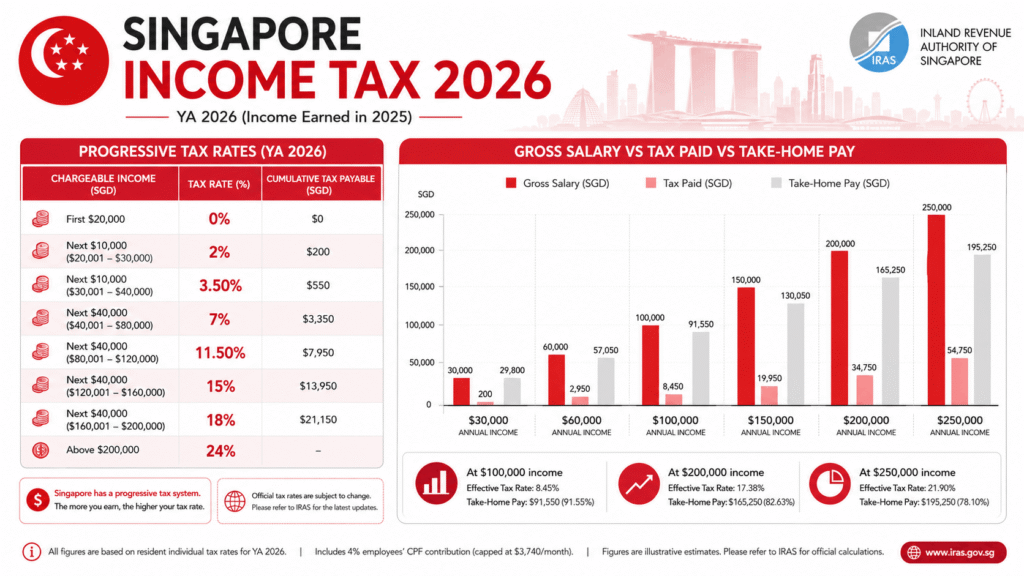
Singapore Income Tax Rates 2026 (YA 2026)
Singapore uses a progressive tax system — meaning higher income is taxed at higher rates, but only on that specific portion of income. The rates for Year of Assessment 2026 are:
| Chargeable Income | Tax Rate | Tax Amount |
|---|---|---|
| First $20,000 | 0% | $0 |
| Next $10,000 ($20,001–$30,000) | 2% | $200 |
| Next $10,000 ($30,001–$40,000) | 3.5% | $350 |
| Next $40,000 ($40,001–$80,000) | 7% | $2,800 |
| Next $40,000 ($80,001–$120,000) | 11.5% | $4,600 |
| Next $40,000 ($120,001–$160,000) | 15% | $6,000 |
| Next $40,000 ($160,001–$200,000) | 18% | $7,200 |
| Next $40,000 ($200,001–$240,000) | 19% | $7,600 |
| Next $40,000 ($240,001–$280,000) | 19.5% | $7,800 |
| Next $40,000 ($280,001–$320,000) | 20% | $8,000 |
| Above $320,000 | 22% | — |
Singapore’s top marginal rate of 22% is one of the lowest among developed economies. Compare: UK top rate is 45%, Ireland is 40%, Australia is 45%, US federal is 37%.
How Much Tax Do You Pay at Each Salary Level?
Here is the exact income tax for common salary levels in Singapore for YA 2026. These figures assume you are a tax resident with the standard earned income relief only:
| Annual Salary | Income Tax | Effective Rate | Monthly Tax |
|---|---|---|---|
| $30,000 | $200 | 0.7% | $17 |
| $40,000 | $550 | 1.4% | $46 |
| $50,000 | $1,150 | 2.3% | $96 |
| $60,000 | $1,850 | 3.1% | $154 |
| $80,000 | $3,350 | 4.2% | $279 |
| $100,000 | $5,650 | 5.7% | $471 |
| $120,000 | $8,250 | 6.9% | $688 |
| $150,000 | $13,950 | 9.3% | $1,163 |
| $200,000 | $21,150 | 10.6% | $1,763 |
| $300,000 | $40,150 | 13.4% | $3,346 |
| $500,000 | $79,150 | 15.8% | $6,596 |
Even at $500,000 — Singapore’s effective tax rate is just 15.8%. Use our Singapore Income Tax Calculator to calculate your exact figure including all personal reliefs.
Singapore Tax Reliefs You Can Claim in 2026
Singapore’s tax system is generous with personal reliefs that reduce your chargeable income before tax is calculated. Here are the main reliefs available in YA 2026:
| Relief Type | Maximum Amount | Who Qualifies |
|---|---|---|
| Earned Income Relief | Up to $3,000 | All working residents |
| CPF Relief | Up to $37,740 | Singapore citizens/PRs |
| NSman Relief | $1,500–$5,000 | NS servicemen |
| Spouse Relief | $2,000 | Supporting non-working spouse |
| Child Relief | $4,000 per child | Parents of qualifying children |
| Parent Relief | $5,500–$9,000 | Supporting parents/grandparents |
| SRS Relief | Up to $15,300 | SRS account contributors |
| Course Fees Relief | Up to $5,500 | Job-related education |
| Life Insurance Relief | Up to $5,000 | Policy holders |
| Rental Relief | Actual amount | Landlords with rental income |
Example — Tax saving from reliefs on $80,000 salary:
- Without reliefs: Tax = $3,350
- With Earned Income + CPF Relief ($40,740 total): Chargeable income reduces to $39,260
- Tax on $39,260 = $875 — saving of $2,475/year
Singapore vs Other Countries — Tax Comparison
Why do so many professionals choose Singapore? The tax advantage is significant compared to other major economies:
| Country | Tax on $100,000 Salary | Effective Rate |
|---|---|---|
| 🇸🇬 Singapore | $5,650 | 5.7% |
| 🇦🇺 Australia | $24,497 | 24.5% |
| 🇬🇧 UK (£100k) | $27,460 | 27.5% |
| 🇮🇪 Ireland (€100k) | $37,680 | 37.7% |
| 🇺🇸 US (federal only) | $17,400 | 17.4% |
| 🇨🇦 Canada | $20,840 | 20.8% |
Singapore’s 5.7% effective rate on $100,000 is dramatically lower than almost every comparable developed economy. This is before factoring in Singapore’s zero capital gains tax and zero inheritance tax.
Am I a Singapore Tax Resident?
Your tax rate depends on whether IRAS classifies you as a tax resident or non-resident. The rules for YA 2026:
Tax Resident — you qualify if:
- You are a Singapore citizen or Permanent Resident
- You are a foreigner who stayed or worked in Singapore for 183 days or more in the previous calendar year
- You are a foreigner who worked in Singapore for a continuous period spanning 3 consecutive years
Non-Resident — flat tax rates apply:
- Employment income: 15% or progressive rates, whichever is higher
- Director fees: 24%
- Other income: 24%
Tax residents get the benefit of progressive rates AND all personal reliefs. Non-residents cannot claim reliefs.
When Do You File Taxes in Singapore?
Singapore’s tax year and filing timeline for YA 2026:
| Event | Date |
|---|---|
| Income year | 1 January – 31 December 2025 |
| Year of Assessment | YA 2026 |
| Filing opens | 1 March 2026 |
| Filing deadline (paper) | 15 April 2026 |
| Filing deadline (online) | 18 April 2026 |
| Tax bill issued | May–September 2026 |
| Payment due | 1 month from tax bill |
Most Singapore employees on the Auto-Inclusion Scheme (AIS) do not need to file — their employer reports income directly to IRAS. You only need to file if you have additional income sources like rental, freelance, or overseas income.
How to Reduce Your Singapore Tax Bill Legally
1. Maximize SRS contributions The Supplementary Retirement Scheme (SRS) lets Singapore citizens and PRs contribute up to $15,300 per year — fully tax deductible. Foreigners can contribute up to $35,700. Every dollar contributed reduces your chargeable income by one dollar.
2. Top up CPF voluntarily Voluntary CPF top-ups to your Retirement Account or Special Account are tax deductible up to $8,000 per year for yourself, plus another $8,000 for family members.
3. Claim all eligible reliefs Many Singapore residents leave money on the table by not claiming Parent Relief, Course Fees Relief, or Life Insurance Relief. Check your IRAS MyTax Portal to see all reliefs you qualify for.
4. Time your income If you expect lower income in one year, consider deferring bonuses or freelance income to that year to stay in a lower tax bracket.
Singapore Income Tax Calculator 2026
Every person’s tax situation is different. Your actual tax depends on:
- Your chargeable income (salary minus reliefs)
- Your tax residency status
- CPF contributions (for citizens and PRs)
- Personal reliefs you are eligible to claim
- Whether you have additional income sources
Use the free finzotools.com Singapore Income Tax Calculator to enter your salary and reliefs for an instant, accurate YA 2026 tax calculation in SGD.
👉 Calculate Your Singapore Income Tax Now →
Frequently Asked Questions
How much income tax do I pay on a $50,000 salary in Singapore?
On a $50,000 annual salary in Singapore in YA 2026, you pay approximately $1,150 in income tax — an effective rate of just 2.3%. This makes Singapore one of the most tax-efficient countries in the world for middle-income earners.
What is the top income tax rate in Singapore in 2026?
The top marginal income tax rate in Singapore for YA 2026 is 22%, applied to chargeable income above $320,000. However, the effective rate (total tax as a percentage of total income) is always lower than the marginal rate due to Singapore’s progressive system.
Do foreigners pay the same tax rate as Singaporeans?
Foreigners who qualify as tax residents (working in Singapore for 183 days or more in the prior year) pay the same progressive rates as citizens. Non-resident foreigners pay a flat 15% on employment income or the progressive rate, whichever is higher, and cannot claim personal reliefs.
Does Singapore have capital gains tax?
No. Singapore does not have capital gains tax, inheritance tax, or wealth tax. Gains from the sale of shares, property (with some exceptions for traders), and other investments are not taxed. This makes Singapore extremely attractive for investors.
What is the difference between YA 2026 and income year 2025 in Singapore?
In Singapore, the Year of Assessment (YA) 2026 refers to tax filed in 2026 on income earned in the previous calendar year — 2025. So if you earned income from January to December 2025, you file and pay tax on that income in YA 2026 (between March and April 2026).
How do I file my Singapore income tax return?
Most Singapore employees do not need to file manually — employers submit income data directly to IRAS under the Auto-Inclusion Scheme (AIS). If you need to file, log in to myTax Portal at mytax.iras.gov.sg using your Singpass. The online deadline for YA 2026 is 18 April 2026.
Related Calculators on Finzotools
- 🏦 CPF Calculator Singapore — CPF OA growth at 2.5% guaranteed
- 🏠 Singapore Home Loan Calculator — Monthly repayments in SGD
- 👴Singapore Retirement Calculator — Estimate savings at 65 in SGD
- 💶 Ireland vs UK Tax Calculator — Compare take-home pay
- 💷 UK Salary Calculator — Take-home after tax and NI
Last updated: June 2026. Tax figures based on IRAS confirmed YA 2026 rates. Personal relief amounts subject to change — always verify at iras.gov.sg for the latest official rates.