
✅ Last verified: July 2026 — Source: Canada Revenue Agency (CRA), Government of Canada 2026
By Abdul Basit | July 23, 2026 | FinzoTools Blog
⚡ QUICK ANSWER
RRSP is better if you earn a high income now and expect lower income in retirement — you get a tax deduction today. TFSA is better if you want flexibility, are in a low tax bracket, or need tax-free withdrawals anytime. The RRSP limit for 2026 is $32,490 and the TFSA limit is $7,000. Most Canadians benefit from using both. Use our free RRSP Calculator and Canada Salary Calculator to plan your contributions.
The RRSP vs TFSA debate is one of the most common financial questions Canadians face every year — especially as the March RRSP deadline approaches. Both accounts offer powerful tax advantages, but they work in fundamentally different ways and suit different financial situations.
In this guide, we compare RRSP and TFSA head-to-head using 2026 limits, real income examples, and clear rules on when each account wins — so you can make the right choice for your situation.
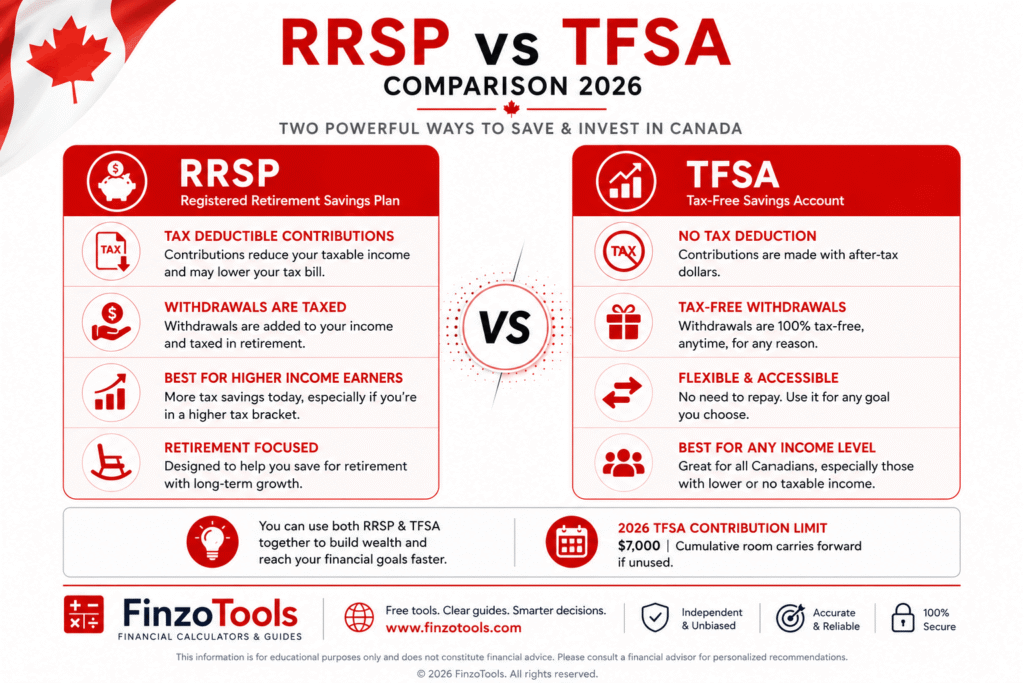
RRSP vs TFSA — complete comparison 2026
| Feature | RRSP | TFSA |
|---|---|---|
| 2026 Contribution Limit | $32,490 (or 18% of income) | $7,000 |
| Cumulative Room (since start) | Based on income history | $102,000 (since 2009) |
| Tax deduction on contribution | ✅ Yes — reduces taxable income | ❌ No deduction |
| Tax on withdrawals | ✅ Fully taxed as income | ❌ Completely tax-free |
| Withdrawal flexibility | Anytime but taxed + room lost | Anytime, tax-free, room restored |
| Contribution deadline | March 2, 2026 (for 2025 taxes) | December 31, 2026 |
| Age limit | Must convert to RRIF at 71 | No age limit |
| Affects OAS/GIS benefits? | Yes — withdrawals count as income | No — withdrawals not counted |
| Best for | High income earners, retirement | Flexibility, low income, any goal |
| Investments allowed | Stocks, ETFs, GICs, bonds, mutual funds | Stocks, ETFs, GICs, bonds, mutual funds |
Source: Canada Revenue Agency (CRA) — RRSP and TFSA rules 2026
RRSP in 2026 — how it works
An RRSP (Registered Retirement Savings Plan) lets you contribute pre-tax dollars — every dollar you put in reduces your taxable income by the same amount. The money grows tax-free inside the account, and you pay tax only when you withdraw, ideally in retirement when your income (and tax rate) is lower.
RRSP contribution limits 2026
| 2025 Earned Income | 18% of Income | 2026 RRSP Limit | Actual Limit (lower of two) |
|---|---|---|---|
| $50,000 | $9,000 | $32,490 | $9,000 |
| $80,000 | $14,400 | $32,490 | $14,400 |
| $120,000 | $21,600 | $32,490 | $21,600 |
| $180,000+ | $32,400+ | $32,490 | $32,490 (max) |
Source: CRA — RRSP deduction limit 2026. Pension adjustments may reduce your room.
Who should prioritise RRSP?
- Earning $80,000+ per year — the tax deduction is worth more at higher brackets
- Expect to be in a lower tax bracket in retirement than you are today
- Saving specifically for retirement and won’t need the money before then
- Want to use the Home Buyers’ Plan (withdraw up to $35,000 tax-free for first home)
- Want to use the Lifelong Learning Plan (withdraw up to $10,000/year for education)
TFSA in 2026 — how it works
A TFSA (Tax-Free Savings Account) is funded with after-tax dollars — you get no deduction upfront. But all growth, dividends, and withdrawals are completely tax-free forever. There is no age limit, no mandatory conversion, and withdrawals never affect your income-tested benefits.
TFSA cumulative contribution room 2026
| Year Eligible Since | Cumulative Room (2026) | Annual Limit 2026 |
|---|---|---|
| 2009 (18+ in 2009) | $102,000 | $7,000 |
| 2015 (turned 18 in 2015) | $54,500 | $7,000 |
| 2020 (turned 18 in 2020) | $32,000 | $7,000 |
| 2026 (turning 18 in 2026) | $7,000 | $7,000 |
Source: CRA — TFSA dollar limits and contribution room 2026
Who should prioritise TFSA?
- Earning under $50,000 — lower tax bracket means RRSP deduction is worth less
- Need flexibility — may need to access money before retirement
- Receiving OAS, GIS or other income-tested benefits — TFSA withdrawals don’t count as income
- Already maximised your RRSP — TFSA is the next best option
- Saving for any goal — not just retirement (car, travel, home renovation)
Real example — RRSP vs TFSA on $100,000 salary in Ontario 2026
| Scenario | RRSP ($10,000 contribution) | TFSA ($10,000 contribution) |
|---|---|---|
| Tax deduction today | ~$4,341 tax refund (43.41% marginal rate) | $0 refund |
| Growth over 20 years (7%) | $38,697 (tax-free inside) | $38,697 (tax-free inside) |
| Tax on withdrawal (retirement, 20% rate) | ~$7,739 tax paid | $0 tax paid |
| Net benefit | $4,341 refund − $7,739 tax = net ahead if lower bracket in retirement | $38,697 fully tax-free |
Ontario marginal tax rate at $100,000 income = 43.41%. Retirement withdrawal assumed at 20% marginal rate.
The RRSP wins if your retirement tax rate is significantly lower than your working tax rate. The TFSA wins if your rates stay similar — or if flexibility matters more than the upfront deduction.
Can you use both RRSP and TFSA?
Yes — and this is the smartest strategy for most Canadians. A common approach:
- Contribute to RRSP first if you are in the 40%+ tax bracket — maximise the deduction
- Put the tax refund you receive straight into your TFSA
- Use TFSA for short-term goals or emergency fund
- Use RRSP for long-term retirement savings
6 tips to maximise RRSP and TFSA in 2026
- Check your contribution room on CRA My Account — your exact RRSP room and TFSA room are listed there. Never guess — over-contributing triggers a 1%/month penalty.
- Invest your RRSP tax refund in your TFSA — a $10,000 RRSP contribution on a $100,000 Ontario salary generates a ~$4,341 refund. Put that straight into your TFSA.
- Never over-contribute to TFSA — the CRA penalty is 1% per month on excess amounts. Wait until January 1 before re-contributing withdrawn amounts.
- Hold growth investments in TFSA, fixed income in RRSP — tax-free compounding of high-growth assets in TFSA is more powerful over time.
- Use the RRSP Home Buyers’ Plan if buying your first home — withdraw up to $35,000 tax-free, repay over 15 years.
- Convert RRSP to RRIF before age 71 — mandatory. Plan your RRIF withdrawal strategy early to minimise OAS clawbacks in retirement.
Frequently asked questions — RRSP vs TFSA 2026
Is RRSP or TFSA better in 2026?
RRSP is better if you earn a high income now and expect lower income in retirement — you get a tax deduction today and pay less tax on withdrawals later. TFSA is better if you are in a low tax bracket, need flexibility, or want tax-free withdrawals at any time without affecting government benefits.
What is the RRSP contribution limit for 2026?
The RRSP contribution limit for 2026 is 18% of your 2025 earned income, up to a maximum of $32,490. Unused contribution room from previous years carries forward and can be used in 2026. Check your exact room on CRA My Account.
What is the TFSA contribution limit for 2026?
The TFSA contribution limit for 2026 is $7,000. The cumulative lifetime TFSA room for someone eligible since 2009 is $102,000 as of 2026. Unused room carries forward and withdrawals are added back to your room the following January 1.
Can I have both an RRSP and a TFSA?
Yes — using both is often the best strategy. Contribute to RRSP first if you are in a high tax bracket to get the deduction, then put remaining savings in your TFSA for flexible tax-free growth. Both accounts can hold the same investments.
What happens when I withdraw from my RRSP?
RRSP withdrawals are fully taxed as income in the year you withdraw. The bank withholds tax at source — 10% on amounts up to $5,000, 20% on $5,001–$15,000, and 30% on amounts over $15,000. You must convert your RRSP to a RRIF by December 31 of the year you turn 71.
Are TFSA withdrawals taxable?
No. TFSA withdrawals are completely tax-free at any time for any reason. They do not count as income, do not affect OAS or GIS benefits, and do not trigger clawbacks. The withdrawn amount is added back to your TFSA room the following January 1.
What is the RRSP deadline for 2026?
The RRSP contribution deadline for the 2025 tax year is March 2, 2026. Contributions made by this date can be deducted on your 2025 tax return. For the 2026 tax year, the deadline is March 1, 2027.
Related tools and guides
- 🇨🇦 RRSP Calculator 2026 — calculate your RRSP contributions and tax savings
- 💰 Canada Salary Calculator 2026 — see your take-home pay by province
- 🏠 Canadian Mortgage Calculator 2026 — calculate your monthly payments
- 📖 RRSP 2026 — Complete Guide — everything about RRSP rules and limits
- 🇬🇧 UK ISA vs RRSP Comparison — tax-free savings across countries
- 🇮🇪 Irish Pension Calculator 2026 — estimate your State Pension
Sources & references
- Canada Revenue Agency — RRSP rules and limits 2026
- Canada Revenue Agency — TFSA rules and contribution room 2026
- Government of Canada — TFSA dollar limit history
© 2026 FinzoTools — For educational purposes only. Verify all figures at canada.ca before making financial decisions.