
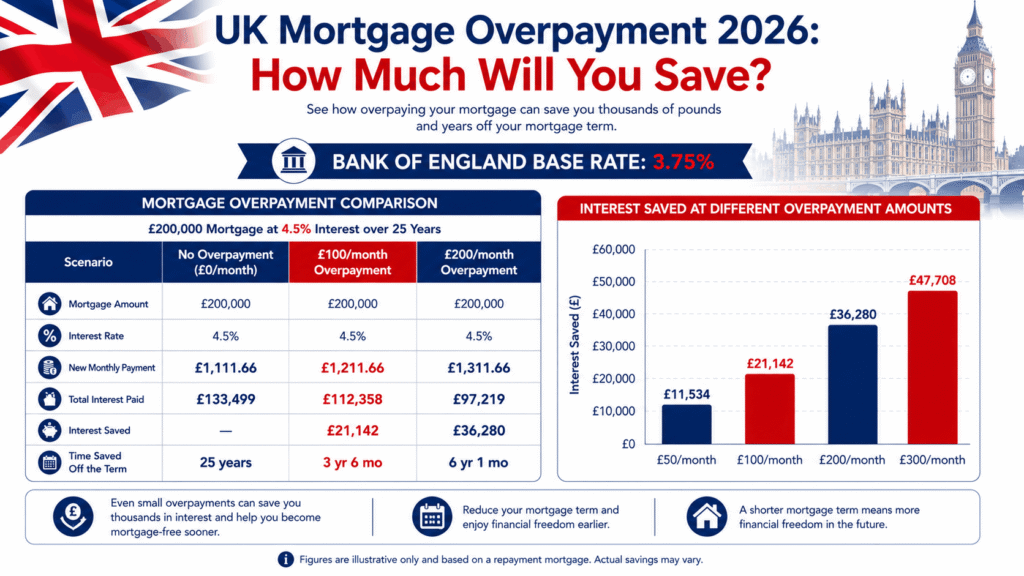
UK Mortgage Overpayment 2026: How Much Will You Actually Save?
Overpaying your mortgage by just £100 per month on a typical £200,000 mortgage can save you over £21,000 in interest and cut roughly 3 years and 6 months off your term. With the Bank of England base rate at 3.75% and average mortgage rates still well above pre-2022 levels, overpaying remains one of the most effective ways UK homeowners can reduce their long-term costs in 2026.
Use our free UK Mortgage Overpayment Calculator to see your exact savings based on your own mortgage balance, rate, and overpayment amount.
🔶 Bank of England Decision — June 18, 2026
The Bank of England’s Monetary Policy Committee met on June 18, 2026 and voted 8-1 to hold the base rate at 3.75% — the fourth consecutive hold. One member voted for a rise to 4.00%. The decision was widely expected, with inflation at 2.8% and ongoing pressure from Middle East-driven energy prices. The next MPC decision is due July 30, 2026.
| Mortgage Type | June 18 Outcome | Impact on £200k Tracker | What This Means for Overpaying |
|---|---|---|---|
| Tracker | Held at 3.75% | No change to monthly payment | Continue your existing overpayment plan unchanged |
| Standard Variable Rate | Tracks base rate | No immediate change | SVR borrowers see no shift this cycle |
| Fixed-rate | Unaffected by this decision | No change | Continue overpaying within your annual allowance as planned |
Regardless of the outcome, the principles of mortgage overpayment below remain valid — overpaying reduces your principal balance, which reduces the interest charged on that balance for the remainder of your term, whatever the prevailing rate.
How Mortgage Overpayments Work
When you make an overpayment, the extra amount goes directly toward reducing your outstanding principal balance — not future scheduled payments. Because mortgage interest is calculated on your outstanding balance, a lower balance means less interest accrues for every month going forward.
This creates a compounding effect: every overpayment reduces the balance, which reduces the interest on that balance, which means more of your future regular payments go toward principal rather than interest — accelerating the snowball.
How Much Does Overpaying Actually Save? (£200,000 Mortgage Example)
Here is a real example for a £200,000 mortgage at 4.5% over 25 years — a typical rate for a fixed-rate deal in 2026:
| Overpayment | New Monthly Payment | Total Interest Paid | Interest Saved | Time Saved |
|---|---|---|---|---|
| £0 (none) | £1,112 | £133,600 | — | — |
| £50/month | £1,162 | £119,300 | £14,300 | ~1 yr 8 mo |
| £100/month | £1,212 | £108,100 | £25,500 | ~3 yr 1 mo |
| £200/month | £1,312 | £91,200 | £42,400 | ~5 yr 6 mo |
| £300/month | £1,412 | £79,400 | £54,200 | ~7 yr 9 mo |
A £200/month overpayment more than doubles your monthly outlay’s impact on interest — saving £42,400 over the life of the mortgage while cutting more than 5 years off your term. Use our UK Mortgage Calculator to enter your own balance, rate, and overpayment amount.
The 10% Overpayment Rule
Most UK lenders allow you to overpay up to 10% of your outstanding mortgage balance per year without triggering an Early Repayment Charge (ERC) — but this varies by lender and product, so always check your mortgage terms.
| Mortgage Balance | 10% Annual Limit | Max Monthly Equivalent |
|---|---|---|
| £150,000 | £15,000/year | £1,250/month |
| £200,000 | £20,000/year | £1,666/month |
| £300,000 | £30,000/year | £2,500/month |
If you exceed this limit while on a fixed-rate or discounted deal, you may face an Early Repayment Charge — typically 1% to 5% of the amount overpaid above the limit, depending on how far into your deal you are.
Should You Overpay or Save the Money Instead?
This depends on the relationship between your mortgage rate and the best savings rate available:
| Your Situation | Better Option | Why |
|---|---|---|
| Mortgage rate > savings rate | Overpay | e.g. 5.63% mortgage vs ~4% Cash ISA — overpaying gives a guaranteed “return” equal to your mortgage rate |
| No emergency fund yet | Save first | Build 3-6 months of expenses before overpaying — you can’t easily withdraw overpayments |
| Higher-rate taxpayer with pension allowance left | Pension first | 40% tax relief often beats mortgage interest savings |
| Fixed deal ending soon | Overpay before remortgaging | Reducing your balance now improves your Loan-to-Value (LTV) for a better rate on your next deal |
How LTV Improvements From Overpaying Can Get You a Better Rate
Lenders offer their best rates to borrowers with lower Loan-to-Value (LTV) ratios. Overpaying before you remortgage can push you into a better LTV band:
| LTV Band | Typical Rate Difference vs 90% LTV |
|---|---|
| 90% LTV | Baseline (highest rates) |
| 85% LTV | ~0.1-0.2% lower |
| 75% LTV | ~0.3-0.5% lower |
| 60% LTV | ~0.5-0.7% lower (best rates) |
On a £200,000 mortgage, moving from 85% to 75% LTV through overpayments could unlock a rate roughly 0.3-0.5% lower at your next remortgage — saving hundreds of pounds per year on top of the direct interest savings from overpaying.
UK Mortgage Overpayment Calculator
Your exact savings depend on:
- Your current mortgage balance
- Your interest rate (fixed, tracker, or SVR)
- Your remaining term
- How much extra you overpay each month
- Whether you’re within your lender’s penalty-free overpayment limit
Use the free finzotools.com UK Mortgage Overpayment Calculator to enter your own figures and see your exact interest saved and time cut from your mortgage term.
👉 Calculate Your Overpayment Savings Now →
Frequently Asked Questions
How much does overpaying my mortgage by £100/month save?
On a typical £200,000 mortgage at 4.5% over 25 years, overpaying by £100/month saves approximately £25,500 in total interest and cuts about 3 years 1 month off your mortgage term. The exact figure depends on your specific balance, rate, and remaining term.
What is the 10% overpayment rule on UK mortgages?
Most UK lenders allow you to overpay up to 10% of your outstanding mortgage balance each year without triggering an Early Repayment Charge. For a £200,000 balance, that’s up to £20,000 per year, or roughly £1,666 per month. Limits vary by lender and product, so always check your specific mortgage terms.
Will the Bank of England rate decision affect my overpayment strategy?
If you have a fixed-rate mortgage, a Bank of England base rate change has no immediate effect on your payments — your rate is locked for the duration of your deal. If you have a tracker mortgage, your rate moves directly with the base rate. Either way, the core principle of overpaying — reducing your balance to cut future interest — remains beneficial regardless of rate movements.
Should I overpay my mortgage or put the money in a savings account?
If your mortgage rate is higher than the best available savings rate, overpaying typically gives a better guaranteed return. For example, if your mortgage rate is 5.63% and the best Cash ISA pays around 4%, overpaying effectively earns you 5.63% risk-free. However, ensure you have an emergency fund first, since overpayments are generally not easily accessible.
Can overpaying help me get a better rate when I remortgage?
Yes. Overpaying reduces your outstanding balance relative to your property’s value, improving your Loan-to-Value (LTV) ratio. Lenders offer progressively better rates at lower LTV bands — moving from 85% to 75% LTV could unlock a rate around 0.3-0.5% lower on your next deal.
What happens if I exceed my overpayment limit?
If you overpay beyond your lender’s penalty-free limit (commonly 10% of the balance per year) while on a fixed or discounted deal, you may be charged an Early Repayment Charge (ERC) — typically 1% to 5% of the excess amount, depending on how far through your current deal you are.
Related Calculators on Finzotools
- 🏠 UK Mortgage Calculator — Monthly repayments and overpayment savings
- 🏷️ Stamp Duty Calculator — SDLT on England & Wales property
- 📈 ISA Calculator — Tax-free savings growth
- 🧓 UK Pension Calculator — Estimate your pension pot at retirement
- 💷 UK Salary Calculator — Take-home after tax and NI
Last updated: June 2026. Mortgage examples based on a typical £200,000 loan at 4.5% over 25 years. Bank of England base rate figures current as of the publication date. Always check your specific mortgage terms for overpayment limits and Early Repayment Charges, and speak to a qualified mortgage adviser for personal advice.