
✅ Last verified: August 2026 — Source: Revenue Commissioners, HMRC, GOV.UK, Citizens Information, House of Commons Library
By Abdul Basit | Updated August 2026 | FinzoTools Blog
⚡ QUICK ANSWER
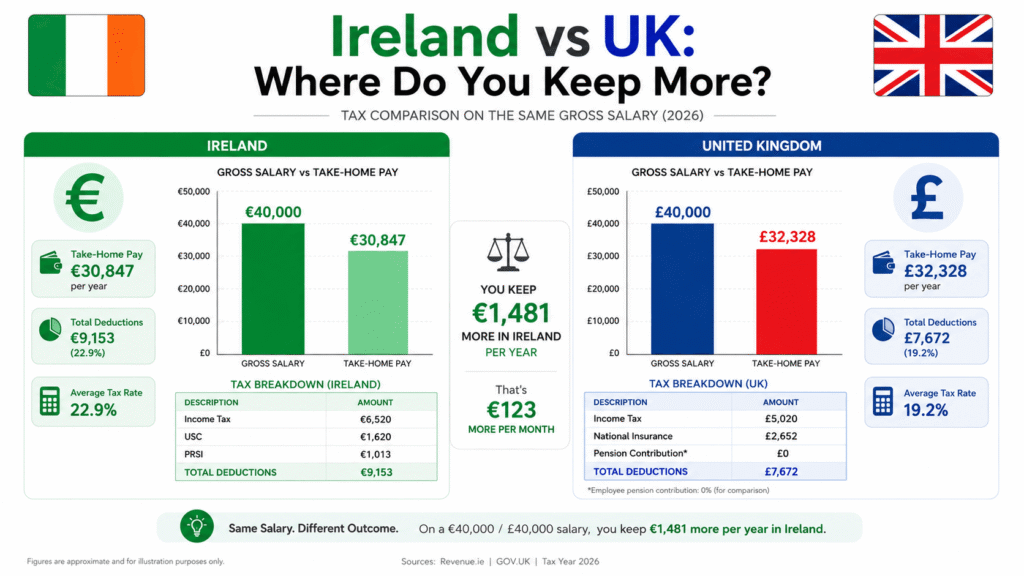
On the same salary, UK workers generally take home more than Irish workers — especially between €40,000 and €80,000. The UK’s higher basic rate band (£50,270 vs Ireland’s €42,000) and larger personal allowance (£12,570 vs Ireland’s credit-based system) mean less income hits the higher rate. However, Ireland is slightly better for lower salaries (under €35,000) due to USC exemptions. Above €100,000, the UK’s personal allowance taper narrows the gap. Use our Ireland vs UK Tax Calculator to compare your exact take-home in both countries.
Comparing taxes across Ireland and the UK isn’t as simple as looking at headline rates. Ireland charges three separate deductions (PAYE, USC, PRSI) while the UK has two (income tax, National Insurance). Ireland has no personal allowance — it uses tax credits instead. And the standard rate bands sit at different levels, fundamentally changing who pays the higher rate and when.
Whether you’re considering a cross-border move, negotiating a relocation package, or simply curious about how the two systems compare, this guide gives you the full picture with real take-home figures at every salary level.
Ireland vs UK — tax system comparison 2026
| Tax Feature | Ireland 2026 | UK 2026/27 |
|---|---|---|
| Income tax rates | 20% and 40% | 20%, 40%, 45% |
| Higher rate threshold (single) | €42,000 | £50,270 (~€59,000) |
| Tax-free mechanism | Tax credits worth €3,750 in savings | Personal Allowance £12,570 (~€14,700) |
| Social insurance (employee) | PRSI 4% (no upper cap) | NI 8% (to £50,270), 2% above |
| Additional charge | USC 0.5%–8% | None |
| Top combined marginal rate | 52% (40% + 8% USC + 4% PRSI) | 47% (45% + 2% NI) |
| Hidden high-rate trap | None | 60% effective rate on £100K–£125,140 |
| Corporation tax | 12.5% (15% large multinationals) | 25% (19% small profits under £50K) |
| Capital gains tax | 33% | 18% (basic) / 24% (higher) |
| VAT standard rate | 23% | 20% |
| State pension (full, weekly) | €277.30/week | £230.25/week (~€269) |
| Property tax | LPT: ~€200–€600/year | Council tax: £1,200–£3,000/year |
The systems look similar on paper — two income tax rates, a social insurance charge, and progressive bands. But the devil is in the thresholds. Ireland’s 40% rate starts at €42,000 while the UK’s starts at approximately €59,000 (£50,270). That €17,000 gap means a huge chunk of mid-range Irish earners pay 40% tax on income that would be taxed at just 20% in the UK.
Take-home pay comparison — same salary, Ireland vs UK
What you’d actually keep on identical gross salaries in each country (single person, no pension or student loan, England/Wales/NI rates):
| Gross Salary | Ireland Take-Home | Ireland Rate | UK Take-Home (€ equiv) | UK Rate | Winner |
|---|---|---|---|---|---|
| €25,000 | €22,160 | 11.4% | €21,780 | 12.9% | Ireland +€380 |
| €30,000 | €25,920 | 13.6% | €25,390 | 15.4% | Ireland +€530 |
| €35,000 | €29,490 | 15.7% | €29,540 | 15.6% | Roughly equal |
| €45,000 | €36,013 | 20.0% | €37,080 | 17.6% | UK +€1,067 |
| €50,000 | €38,576 | 22.8% | €40,110 | 19.8% | UK +€1,534 |
| €60,000 | €43,496 | 27.5% | €46,080 | 23.2% | UK +€2,584 |
| €70,000 | €48,416 | 30.8% | €51,200 | 26.9% | UK +€2,784 |
| €80,000 | €53,216 | 33.5% | €55,760 | 30.3% | UK +€2,544 |
| €100,000 | €62,536 | 37.5% | €64,350 | 35.7% | UK +€1,814 |
| €125,000 | €74,536 | 40.4% | €74,100 | 40.7% | Ireland +€436 |
UK figures converted at £1 = €1.17. Exchange rates fluctuate — use our Ireland vs UK Tax Calculator for exact comparison.
The pattern is clear: Ireland wins below €35,000, the UK wins between €35,000 and €110,000, and Ireland pulls back at very high salaries because the UK’s personal allowance taper creates a 60% effective marginal rate between £100,000 and £125,140.
The maximum advantage to the UK is around €60,000–€70,000, where the gap reaches nearly €2,800 per year. That’s roughly €230/month more take-home — enough to notice.
Why Ireland feels more expensive despite similar headline tax rates
The income tax comparison alone doesn’t capture the full cost difference. Several non-tax factors significantly affect real disposable income:
- Healthcare: The UK has the NHS — free at point of use for virtually all services. Ireland has no equivalent. Private health insurance runs €1,000–€3,000 per year per person, and public hospital waiting lists are notoriously long. Many Irish workers consider health insurance a necessity, not a luxury.
- Childcare: Irish childcare costs are among the highest in Europe — €800–€1,200/month per child in Dublin. The UK now offers 30 hours of free childcare for children aged 9 months to school age (rolled out through 2024-2025), dramatically reducing costs for working parents.
- VAT: Ireland charges 23% versus the UK’s 20%. On €30,000 of annual consumer spending, that’s roughly €750 more going to VAT in Ireland.
- Housing: Dublin rents are comparable to London zones 2-3. Outside Dublin, Ireland is generally cheaper than southeast England but more expensive than northern England, Wales, or Scotland.
- Property tax: Ireland’s Local Property Tax (typically €200–€600/year) is a fraction of UK council tax (£1,200–£3,000/year). This is one area where Ireland is genuinely cheaper.
- Motor costs: Irish motor insurance, VRT (vehicle registration tax), and fuel prices are all higher than UK equivalents. Running a car costs roughly €500–€1,000 more per year in Ireland.
When you factor in healthcare, childcare, and higher consumer prices, the effective cost-of-living gap between Ireland and the UK is wider than the income tax comparison alone suggests — particularly for families.
Where Ireland wins over the UK
- Corporation tax: At 12.5% versus 25%, Ireland is dramatically more competitive for business owners operating through a company. This is why Ireland attracts disproportionate FDI and tech headquarters.
- Low earners: If your income is under €13,000, you’re fully exempt from USC. The UK has no equivalent NI exemption at that level — NI kicks in once you earn above £12,570/year.
- State Pension: Ireland’s full Contributory Pension (€277.30/week, ~€14,420/year) is slightly higher than the UK’s full new State Pension (£230.25/week, ~€14,000/year).
- Council tax / property tax: Ireland’s LPT is typically €200–€600/year compared to UK council tax of £1,200–£3,000+. A clear Irish advantage.
- Pension tax relief (older workers): Ireland’s age-based pension contribution limits become very generous at older ages — 40% of €115,000 at age 60+. The UK has a flat £60,000 annual allowance for all ages, which is higher at younger ages but lower at 55+.
- Child benefit: Ireland pays €140/month per child universally with no clawback. The UK pays less (£25.60/week first child) and claws it back for earners above £60,000.
Where the UK wins over Ireland
- Mid-range salaries (€40K–€80K): The UK’s higher basic rate threshold means significantly more income is taxed at 20% instead of 40%.
- Capital gains tax: UK CGT at 18%/24% is far lower than Ireland’s flat 33%. Investors and property sellers save substantially.
- NHS: Free healthcare at point of use — no insurance premiums, no GP visit fees (Irish GP visits cost €50–€65 without a medical card).
- Childcare support: 30 hours free childcare from 9 months is a massive financial benefit for working parents. Ireland’s National Childcare Scheme subsidises costs but doesn’t match the UK’s generosity.
- ISAs: UK residents can save £20,000/year in ISAs with zero tax on interest, dividends, or capital gains — forever. Ireland has no equivalent (TFSA doesn’t exist in Ireland).
- Dividend tax: UK offers a £500 dividend allowance and lower dividend tax rates. Ireland taxes dividends as income at up to 52%.
Self-employed and business owners — which country is better?
For self-employed people and small business owners, the answer depends on your business structure:
- Operating through a company: Ireland wins convincingly. The 12.5% corporation tax rate means your company retains significantly more profit than a UK company paying 25%. Extracting profits through salary and dividends is still taxed personally, but the ability to retain and reinvest at 12.5% is a powerful advantage.
- Sole trader: UK is slightly better for most income levels because of the higher personal allowance and basic rate band. Irish sole traders also pay an additional 3% USC surcharge on income above €100,000 if less than 80% of their income is subject to PAYE — bringing their top rate to 55%.
- Selling a business: UK entrepreneurs selling a qualifying business can use Business Asset Disposal Relief (formerly Entrepreneurs’ Relief) — CGT at just 10% on the first £1 million of lifetime gains. Ireland’s revised CGT entrepreneur relief offers 10% on the first €1 million, broadly matching the UK.
Pensions — comparing the tax relief
Both countries offer generous pension tax relief at the marginal rate (20% or 40%). The differences are in the contribution limits and structures:
| Feature | Ireland | UK |
|---|---|---|
| Tax relief rate | 20% or 40% (marginal) | 20% or 40% (marginal) |
| Annual contribution limit | Age-based: 15%–40% of €115,000 | £60,000 flat (all ages) |
| Max for age 35 | €23,000 (20% × €115K) | £60,000 (~€70,200) |
| Max for age 55 | €40,250 (35% × €115K) | £60,000 (~€70,200) |
| Tax-free lump sum at retirement | 25% of fund (first €200K tax-free) | 25% of fund (max £268,275 tax-free) |
| USC/NI on contributions | USC still applies (not relieved) | NI saved via salary sacrifice |
For younger workers, the UK is more generous — a 30-year-old can contribute up to £60,000/year versus Ireland’s €23,000 limit. For older workers (55+), the gap narrows as Ireland’s limits increase with age. The UK’s salary sacrifice option, which saves NI on top of income tax, gives it a further edge in terms of total tax efficiency.
Read our full guides: PRSA Pension Ireland 2026 | UK ISA Guide 2026
Frequently asked questions — Ireland vs UK tax 2026
Is tax higher in Ireland or the UK?
For most mid-to-high earners (€40K–€80K), Ireland is higher — mainly because Ireland’s 40% rate starts at €42,000 while the UK’s starts at ~€59,000. At lower incomes (under €35K), Ireland can be slightly better. At very high incomes (€125K+), Ireland often comes out ahead because the UK’s personal allowance taper creates a 60% effective rate.
What is the highest tax rate in Ireland vs UK?
Ireland’s top combined rate is 52% (40% income tax + 8% USC + 4% PRSI). The UK’s top combined rate is 47% (45% income tax + 2% NI). However, UK taxpayers earning £100K–£125K face an effective 60% rate due to personal allowance taper — higher than Ireland’s 52% in that specific band.
Which country has better pension tax relief?
Both offer up to 40% relief. The UK has a higher flat annual allowance (£60,000) that suits younger savers. Ireland’s age-based limits are more generous at older ages. The UK’s salary sacrifice option also saves NI, which Ireland doesn’t match.
Is capital gains tax lower in the UK?
Yes, significantly. UK CGT is 18% (basic rate) or 24% (higher rate). Ireland charges a flat 33%. Investors and property sellers pay substantially less CGT in the UK.
Which country is better for self-employed people?
It depends on structure. Ireland’s 12.5% corporation tax makes operating through a company very attractive. The UK’s 25% corporation tax is higher, but UK sole traders benefit from higher personal allowance and basic rate thresholds.
Is there council tax in Ireland?
Ireland has Local Property Tax (LPT) — typically €200–€600/year depending on property value. UK council tax ranges from £1,200–£3,000+/year, making Ireland significantly cheaper.
Which country has a better State Pension?
Similar. Ireland’s full Contributory Pension is €277.30/week (~€14,420/year). UK’s full new State Pension is £230.25/week (~€14,000/year). Ireland is slightly higher, and Ireland also doesn’t tax the State Pension as aggressively as the UK.
Is healthcare really free in the UK?
Yes — the NHS provides free GP visits, hospital treatment, A&E, and prescriptions (in Scotland, Wales, and NI; England charges a flat £9.90 per item). Ireland has no equivalent. Irish GP visits cost €50–€65 without a medical card, and private health insurance is €1,000–€3,000/year.
At what salary does the UK advantage disappear?
Above approximately €110,000–€125,000. The UK’s personal allowance taper (which creates a 60% effective rate between £100K and £125,140) narrows the gap, and above €125K Ireland’s straightforward 52% rate can actually be lower than the UK’s blended rate including the taper zone.
Which country is cheaper overall to live in?
Outside major cities, Ireland and the UK are broadly comparable. Dublin vs London is roughly equal for rent. But Ireland’s higher VAT (23% vs 20%), healthcare costs, childcare costs, and motor insurance make the overall cost of living slightly higher in Ireland for families. Singles without children may find the difference marginal.
Related tools
- 🧮 Ireland vs UK Tax Calculator — side-by-side salary comparison
- 🧮 Ireland Salary & PAYE Calculator 2026
- 🧮 UK Salary & Tax Calculator 2026
- 📖 Ireland Take-Home Pay 2026 — Full Guide
- 📖 UK £40K Salary — Take-Home Pay After Tax & NI
- 📖 PRSA Pension Ireland 2026
- 📖 Ireland Stamp Duty Rates 2026
- 📖 Stocks & Shares ISA vs Cash ISA 2026
Sources & references
- Revenue Commissioners — Tax Relief Charts 2026
- HMRC / GOV.UK — Income Tax Rates 2026/27
- House of Commons Library — Direct Taxes 2026/27
- Citizens Information — How Your Tax Is Calculated
- Scottish Government — Scottish Income Tax 2026/27
© 2026 FinzoTools — For educational purposes only. This is not tax advice. Verify rates with Revenue.ie and GOV.UK or consult a qualified tax adviser.