
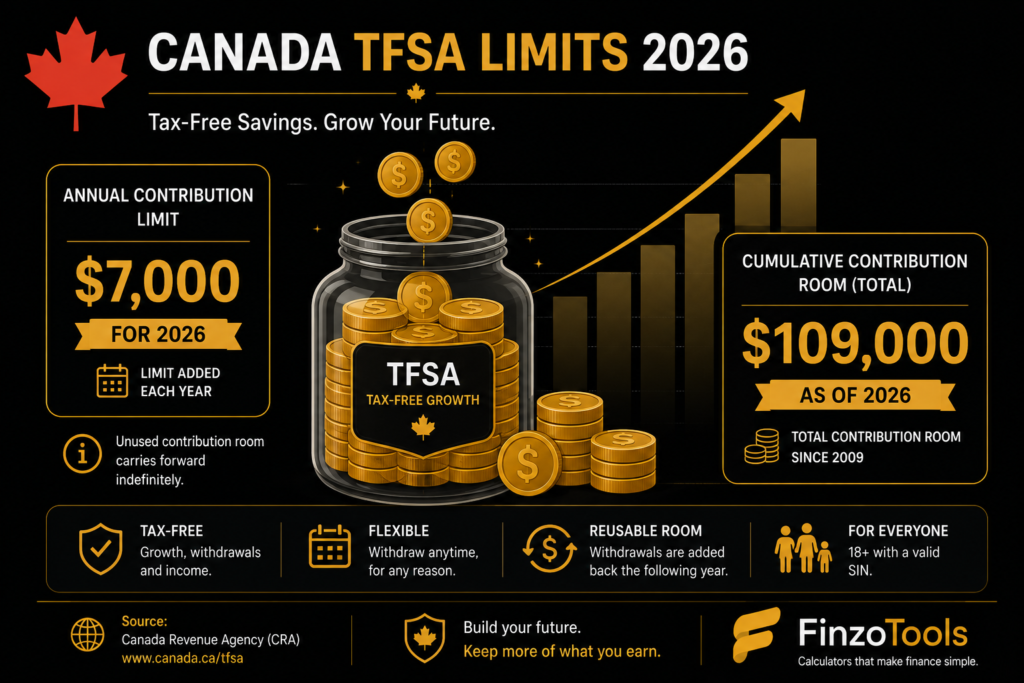
The Tax-Free Savings Account is the single most flexible savings vehicle available to Canadians. Every dollar of interest, dividends, and capital gains earned inside a TFSA is completely tax-free — not tax-deferred like an RRSP, but genuinely untaxed, both while it grows and when you withdraw it. For 2026, the CRA has confirmed the annual contribution limit at $7,000, unchanged from 2024 and 2025, bringing total cumulative room to $109,000 for anyone eligible since the TFSA launched in 2009.
Yet many Canadians either underuse their TFSA or make costly mistakes with it — contributing too much and triggering the 1% monthly penalty, withdrawing and re-contributing in the same year, or treating it as a simple savings account when it could be growing their wealth tax-free for decades. This guide covers the full contribution rules, the year-by-year room table, how withdrawals work, what you can hold inside a TFSA, growth projections at common contribution levels, and the strategic comparison with the RRSP.
TFSA Contribution Limit 2026
The annual TFSA dollar limit for 2026 is $7,000. This is the third consecutive year at $7,000 — the CRA indexes the limit to inflation in $500 increments, and cumulative inflation has not yet triggered the next increase. Your annual room is added automatically on January 1 of each year, whether or not you have opened a TFSA.
To be eligible for TFSA contribution room, you must be a Canadian resident with a valid Social Insurance Number (SIN) and at least 18 years of age (19 in some provinces for account opening purposes, though room still accumulates from 18). There is no upper age limit — unlike the RRSP, which must be converted to a RRIF by December 31 of the year you turn 71, the TFSA has no mandatory conversion and no age cap on contributions.
Cumulative TFSA Contribution Room: 2009–2026
If you have never contributed to a TFSA and were eligible since 2009, your total available room in 2026 is $109,000. You can contribute this full amount at any time — there is no requirement to spread it over multiple years.
| Year | Annual Limit | Cumulative Room |
|---|---|---|
| 2009 | $5,000 | $5,000 |
| 2010 | $5,000 | $10,000 |
| 2011 | $5,000 | $15,000 |
| 2012 | $5,000 | $20,000 |
| 2013 | $5,500 | $25,500 |
| 2014 | $5,500 | $31,000 |
| 2015 | $10,000 | $41,000 |
| 2016 | $5,500 | $46,500 |
| 2017 | $5,500 | $52,000 |
| 2018 | $5,500 | $57,500 |
| 2019 | $6,000 | $63,500 |
| 2020 | $6,000 | $69,500 |
| 2021 | $6,000 | $75,500 |
| 2022 | $6,000 | $81,500 |
| 2023 | $6,500 | $88,000 |
| 2024 | $7,000 | $95,000 |
| 2025 | $7,000 | $102,000 |
| 2026 | $7,000 | $109,000 |
The 2015 spike to $10,000 was a one-time increase by the Harper government, reversed the following year. If you turned 18 after 2009, your cumulative room starts from the year you became eligible — not from 2009.
How TFSA Withdrawals Work
One of the TFSA’s most powerful features is the withdrawal-and-recontribution mechanic. When you withdraw money from a TFSA, that amount is added back to your contribution room — but not immediately. The restored room appears on January 1 of the following year.
This timing rule is the single most common source of TFSA over-contributions. If you withdraw $10,000 in March 2026 and re-contribute $10,000 in September 2026, you have over-contributed by $10,000 because the restored room does not appear until January 1, 2027. The CRA will charge you a 1% monthly penalty on the excess amount for every month it remains in the account.
Withdrawals themselves are completely tax-free regardless of the amount. Whether you withdraw $500 or $50,000, there is no tax, no reporting requirement, and no impact on any government benefits. This is unlike the RRSP, where every withdrawal is added to your taxable income and can affect your OAS, GIS, or other income-tested benefits.
The Over-Contribution Penalty
If you exceed your available TFSA contribution room, the CRA charges a penalty of 1% per month on the highest excess amount during each month the over-contribution exists. There is no grace period and no minimum threshold — even a $100 over-contribution triggers the penalty.
The most reliable way to check your current contribution room is through CRA My Account at canada.ca. The CRA updates TFSA records annually, with 2025 records processed by April 2026. Always cross-reference the CRA figure with your own records if you contribute at multiple institutions, as the CRA figure can lag by several months.
What Can You Hold Inside a TFSA?
Despite the name “savings account,” a TFSA can hold far more than cash. The CRA permits a wide range of qualified investments inside a TFSA, and choosing the right investments can dramatically increase the tax-free growth over time.
| Investment Type | Allowed in TFSA? | Best For |
|---|---|---|
| High-interest savings account | ✓ | Emergency fund, short-term savings |
| GICs (Guaranteed Investment Certificates) | ✓ | Guaranteed returns, capital protection |
| Canadian and US stocks | ✓ | Long-term growth, dividends |
| ETFs (Exchange-Traded Funds) | ✓ | Diversification, low-cost investing |
| Mutual funds | ✓ | Managed portfolios |
| Bonds and government securities | ✓ | Fixed income, stability |
| Cryptocurrency, real estate, private companies | ✗ | Not qualified investments |
The most common mistake Canadians make is keeping their entire TFSA in a basic savings account earning 1–3% when it could be invested in diversified ETFs averaging 7–10% annually. On $109,000 over 20 years, the difference between 2% and 7% growth is more than $150,000 in tax-free wealth — all because of the investment choice inside the account.
TFSA Growth Projections: Interest and Investment Returns
The power of the TFSA lies in compounding tax-free returns. Here is how a $7,000 annual contribution grows at different return rates over time:
| Years | Contributions | At 3% (HISA/GIC) | At 5% (Balanced) | At 7% (Equity ETFs) |
|---|---|---|---|---|
| 5 | $35,000 | $37,900 | $39,800 | $41,800 |
| 10 | $70,000 | $82,200 | $90,700 | $100,500 |
| 20 | $140,000 | $192,200 | $238,800 | $303,200 |
| 30 | $210,000 | $340,800 | $476,200 | $688,600 |
At 7% over 30 years, $210,000 in contributions becomes nearly $689,000 — and every dollar of that $479,000 growth is completely tax-free. In a non-registered account at a 30% marginal tax rate, you would owe approximately $40,000 in tax on that growth. The TFSA saves you that entire amount.
Model your own TFSA growth scenarios using the FinzoTools TFSA Calculator, which lets you adjust contributions, growth rates, and time horizons.
TFSA vs RRSP: Which Should You Use First?
This is the most common personal finance question in Canada, and the answer depends on your current and expected future tax bracket.
| Factor | TFSA | RRSP |
|---|---|---|
| Tax on contributions | After-tax dollars (no deduction) | Tax-deductible (reduces taxable income) |
| Tax on growth | Tax-free forever | Tax-deferred (taxed on withdrawal) |
| Tax on withdrawal | None | Taxed as income |
| Impact on government benefits | No impact on OAS/GIS | Withdrawals can trigger OAS clawback |
| Age limit | No limit | Must convert to RRIF at 71 |
| Withdrawal flexibility | Anytime, room restored next year | Room permanently lost |
| Best for | Low-to-middle income, retirees, flexibility | High income now, lower income in retirement |
The general rule: if your marginal tax rate today is higher than what you expect in retirement, the RRSP wins because the tax deduction now is worth more than the tax you will pay later. If your tax rate is similar or lower now, the TFSA wins because withdrawals are completely tax-free and do not affect income-tested benefits like OAS.
For most Canadians earning under $55,000, the TFSA is typically the better first choice. For those earning above $100,000, the RRSP deduction provides more immediate value. For a detailed comparison specific to your situation, see our RRSP vs TFSA 2026 comparison guide.
TFSA Savings Strategies
Max out early each year. Contributing your full $7,000 on January 1 rather than spreading it across 12 months gives your money an extra 11 months of tax-free growth. Over 30 years, this timing difference alone can add thousands of dollars to your final balance.
Use the TFSA for your highest-growth investments. Since all growth is permanently tax-free, the TFSA gives you the most benefit when it holds investments with the highest expected returns — typically equity ETFs. Put your lower-growth, interest-bearing investments (GICs, bonds) in your RRSP or non-registered accounts instead.
Use your TFSA as an emergency fund first, then an investment account. If you do not yet have three to six months of expenses saved, a TFSA high-interest savings account serves double duty as an emergency fund and a tax shelter. Once your emergency fund is established, shift to growth investments for the long term.
Track your room carefully. The CRA’s records can lag by several months. Maintain your own spreadsheet of contributions and withdrawals, and reconcile with CRA My Account annually. One accidental over-contribution can trigger months of 1% penalties before you even realise it.
How to Check Your TFSA Contribution Room
The most reliable method is logging into CRA My Account at canada.ca and checking your TFSA contribution room directly. The CRA also provides this information through the Tax Information Phone Service (TIPS) at 1-800-267-6999 and on your most recent Notice of Assessment.
Keep in mind that the CRA figure may not reflect contributions made in the current calendar year if your financial institution has not yet reported them. Always cross-reference the CRA figure with your own records, especially if you have TFSAs at multiple institutions.
Calculate Your TFSA Growth
The FinzoTools TFSA Calculator lets you model different contribution amounts, growth rates, and time horizons to see how your TFSA balance could grow tax-free over time. For a broader view of Canadian retirement planning, see our guides on RRSP contribution limits and Canadian take-home pay after CPP and EI.
Source: TFSA contribution limits and rules verified against CRA Tax-Free Savings Account guidance, August 2026.