
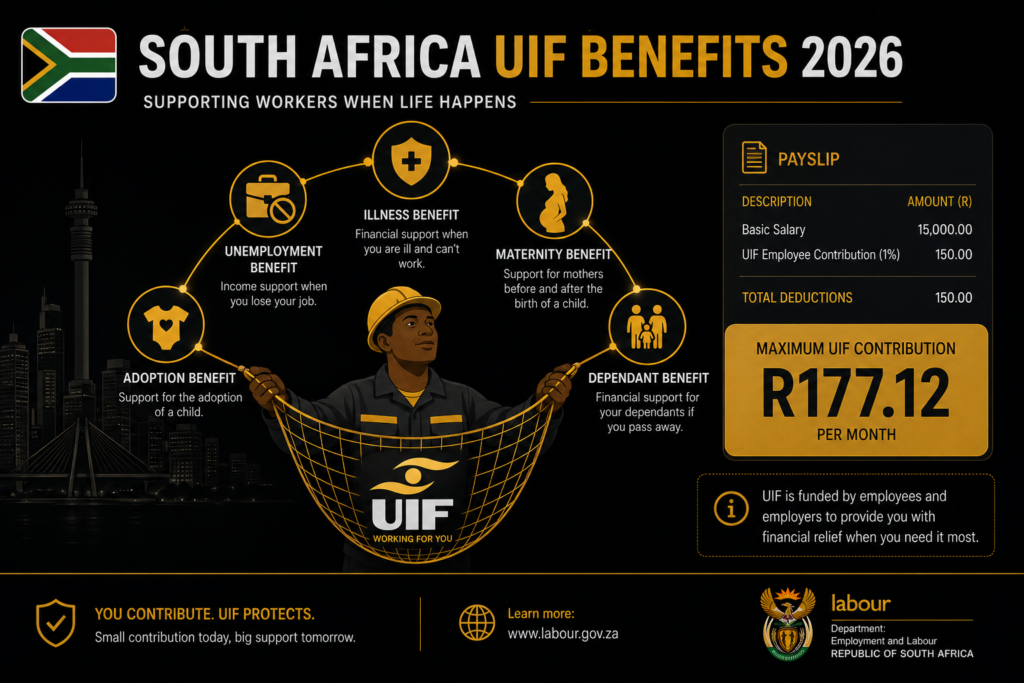
Every month, 1% of your salary disappears into the Unemployment Insurance Fund. Your employer matches it with another 1%. It is a small deduction — capped at R177.12 per month — but when you lose your job, fall ill, or go on maternity leave, that fund becomes the difference between financial survival and crisis. Yet 27,000 South Africans search for “how to claim UIF” every month, and many delay their application beyond the six-month deadline, losing thousands in benefits they have already paid for.
The UIF provides up to 12 months of income replacement for retrenched workers, 121 days of maternity pay at 66% of earnings, and illness benefits for workers unable to work for more than 14 days. All UIF payouts are completely tax-free. This guide covers everything: the contribution mechanics, all five benefit types, the payout formula, and a step-by-step walkthrough of the claim process.
UIF Contribution Rates 2026
The UIF is funded by matched contributions from employees and employers. The rates and ceiling have been unchanged since 1 June 2021 and remain the same for the 2026/27 tax year.
| Component | Rate / Amount |
|---|---|
| Employee contribution | 1% of remuneration |
| Employer contribution | 1% of remuneration |
| Combined total | 2% of remuneration |
| Monthly remuneration ceiling | R17,712 |
| Annual remuneration ceiling | R212,544 |
| Maximum employee deduction | R177.12/month |
| Maximum combined deduction | R354.24/month |
If you earn R25,000 per month, your UIF deduction is not R250. Because the ceiling is R17,712, the maximum deduction is R177.12 regardless of how much more you earn. Your employer similarly caps at R177.12. Importantly, this ceiling also limits your benefit payout — if you earn above R17,712, your UIF benefits will be calculated on R17,712, not your full salary.
Employers pay both contributions (their 1% plus the 1% deducted from employees) to SARS by the 7th of each month via the EMP201 return, alongside PAYE and SDL. Domestic employers — those employing a gardener, cleaner, or nanny for 24+ hours per month — must also register and contribute.
The Five Types of UIF Benefits
The UIF provides five distinct benefit types, each with its own eligibility rules and payout formula.
1. Unemployment Benefits
This is the most commonly claimed benefit. If you are retrenched, dismissed (not for misconduct), or your fixed-term contract expires, you can claim unemployment benefits. You cannot claim if you resigned voluntarily.
The payout is based on a sliding scale called the Income Replacement Rate (IRR). Lower earners receive a higher percentage of their income — up to 60% — while higher earners receive a lower percentage, down to approximately 38%. The exact formula is:
IRR = 29.2 + 7,173.92 ÷ (232.92 + daily income)
Your daily income is calculated as: (capped monthly salary × 12) ÷ 365.
You accumulate 1 credit day for every 4 days worked while contributing. The maximum is 365 credit days, accrued over the previous four years of contributions. The first 238 days of unemployment are paid at your IRR. Any days beyond 238 are paid at a reduced flat rate of 20%.
2. Illness Benefits
If you are unable to work for more than 14 consecutive days due to illness or injury that is not covered by COIDA (the Compensation for Occupational Injuries and Diseases Act), you can claim illness benefits. The payout uses the same IRR sliding scale as unemployment benefits.
3. Maternity Benefits
Female employees can claim maternity benefits for up to 121 days (approximately 17 weeks). The payout rate is a flat 66% of daily income — not the sliding IRR scale. This is more generous than the unemployment rate for most earners. If your employer pays you during maternity leave, the UIF benefit is reduced so that your total income does not exceed 100% of your normal salary.
4. Adoption Benefits
When adopting a child under the age of 2, one of the adopting parents can claim adoption benefits for up to 121 days. The application must be submitted within 6 months of the court issuing the adoption order. The benefit rate matches the maternity rate.
5. Dependant Benefits
If a UIF contributor passes away, their surviving spouse, life partner, or dependants can claim dependant benefits. The application must be submitted within 18 months of the contributor’s date of death.
How Much Will You Actually Receive?
Here are estimated monthly unemployment payouts at common salary levels, assuming maximum credit days have been accumulated:
| Monthly Salary | IRR % | Est. Monthly Payout | Max Duration |
|---|---|---|---|
| R5,000 | ~58% | ~R2,900 | Up to 365 days |
| R10,000 | ~50% | ~R5,000 | Up to 365 days |
| R15,000 | ~44% | ~R6,600 | Up to 365 days |
| R17,712 (ceiling) | ~42% | ~R7,440 | Up to 365 days |
| R30,000+ | ~42% (capped) | ~R7,440 (same as ceiling) | Up to 365 days |
The ceiling effect is stark. Whether you earn R17,712 or R80,000, your maximum UIF payout is the same — approximately R7,440 per month. For higher earners, this represents a dramatic drop in living standard, which is why financial advisers recommend building an emergency fund of three to six months’ expenses alongside your UIF entitlement.
All UIF benefits are tax-free. You do not need to declare them on your income tax return.
How to Claim UIF: Step-by-Step
You can claim UIF either online through uFiling or in person at your nearest Department of Employment and Labour office. The online process is faster but requires prior registration.
Online via uFiling (www.ufiling.labour.gov.za):
Register on the uFiling portal if you have not already. You will need your South African ID number, contact details, and banking information. Once registered, log in and select the type of benefit you are claiming. Upload the required documents (listed below) and submit your application. Track your claim status through the portal.
In person at a Labour Centre:
Visit your nearest Department of Employment and Labour office. Arrive early — queues can be long, especially in the first week of each month. Bring all required documents in original plus certified copies.
Required documents for unemployment claims:
| Document | What It Is |
|---|---|
| UI-19 form | Completed by your employer — confirms your employment dates, salary, and reason for separation |
| UI-2.8 form | Registration as a work seeker — you complete this yourself |
| Certified copy of ID | South African identity document or smart card |
| Last payslip | Confirms your most recent salary for benefit calculation |
| Banking details | Bank statement or confirmation letter for direct deposit |
| Dismissal/retrenchment letter | Proof of employment termination |
The most critical document is the UI-19 form. Your employer is legally required to provide this, and without it, your claim cannot be processed. If your employer refuses or delays providing the UI-19, you can report them to the Department of Employment and Labour. You must submit your claim within six months of losing your job. After six months, your claim may be rejected.
Common Reasons Claims Are Rejected
The most common reason is voluntary resignation — if you left your job by choice, you are not eligible for unemployment benefits. Other common rejection reasons include the employer failing to submit the UI-19 form or not having updated your contribution record on uFiling, incomplete or incorrect documents, and having already exhausted your credit days from a previous claim within the four-year cycle.
If your claim is rejected, you can appeal within 30 days by submitting a UI-2.11 form. For dismissal-related disputes, escalate to the CCMA. For UIF administrative issues, contact the Public Protector.
Who Is Excluded from UIF?
Not everyone in South Africa contributes to or benefits from UIF. The following workers are excluded: employees working fewer than 24 hours per month for a single employer, certain national and provincial government employees (who have their own schemes), workers receiving a government pension, learners under learnership agreements, and foreigners working on contract who are not ordinarily resident in South Africa.
Self-employed individuals are not required to contribute to UIF, though they may do so voluntarily if they employ other workers and register themselves as both employer and employee.
UIF and Your Overall Tax Picture
UIF is just one component of your total payroll deductions. For a complete view of how PAYE, UIF, and other deductions affect your take-home pay, use the FinzoTools South Africa Income Tax Calculator. For a full breakdown of the 2026/27 SARS tax brackets and how they interact with UIF, medical credits, and retirement deductions, see our tax brackets guide.
Source: UIF contribution rates and benefit rules verified against the Unemployment Insurance Act 63 of 2001 and Department of Employment and Labour uFiling portal, July 2026.