
✅ Last verified: July 2026 — Source: Revenue Commissioners, Pensions Authority, Finance Act 2024, Automatic Enrolment Retirement Savings System Act 2024
By Abdul Basit | July 2026 | FinzoTools Blog
⚡ QUICK ANSWER
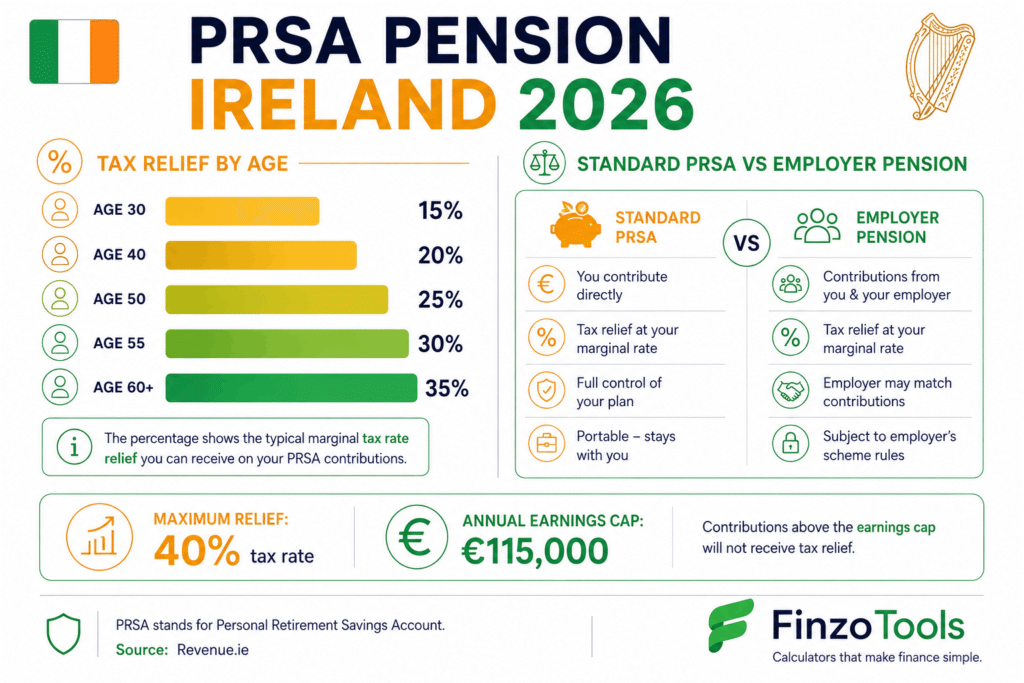
A PRSA (Personal Retirement Savings Account) is a portable, flexible pension available to every worker in Ireland — employed, self-employed, or not working at all. You get income tax relief at your marginal rate (20% or 40%) on contributions up to age-based limits, capped at €115,000 of earnings. For a 40% taxpayer, every €100 contributed costs just €60 out of pocket. The limits rise with age: 15% under 30, 20% at 30–39, 25% at 40–49, 30% at 50–54, 35% at 55–59, and 40% at 60+. Since January 2026, Ireland’s new auto-enrolment scheme (My Future Fund) means workers without a pension are now enrolled automatically — but a PRSA remains the better option for most people who want tax relief and investment flexibility. Use our free Irish Pension Calculator to estimate your retirement fund.
If you’re working in Ireland and don’t have an employer pension — or if you do but want to save more — a PRSA is almost certainly the most tax-efficient way to build your retirement fund. The tax relief alone makes it hard to beat: the government effectively pays 40% of your contributions if you’re a higher-rate taxpayer.
Yet roughly half of Irish workers still have no private pension. Some don’t know the rules. Others assume their employer’s scheme is enough. And since auto-enrolment launched in January 2026, there’s fresh confusion about how My Future Fund interacts with existing PRSAs.
This guide covers how PRSAs work, what the contribution limits are, how tax relief is calculated, and how PRSAs compare to both employer pensions and the new auto-enrolment system.
What is a PRSA?
A Personal Retirement Savings Account is a long-term savings and investment contract between you and an authorised PRSA provider (typically a life insurance company, bank, or investment firm). It was introduced in 2002 to give all workers — especially those without access to employer pensions — a way to save for retirement with tax advantages.
Key characteristics:
- Available to everyone — employees, self-employed, homemakers, and unemployed
- Fully portable — if you change jobs, the PRSA goes with you. No transfer needed.
- Tax relief — contributions reduce your income tax at your marginal rate (20% or 40%)
- Investment growth is tax-free — no income tax, CGT, or DIRT on fund growth inside a PRSA
- Two types — Standard PRSA (max 1% annual management charge, default fund required) and Non-Standard PRSA (wider investment choice, potentially higher charges)
- Accessible from age 60 — or earlier in some circumstances (e.g., ill health, leaving employment at 50+)
Every employer in Ireland must provide access to at least a Standard PRSA if they don’t offer an occupational pension scheme — though this obligation has been partly overtaken by the new auto-enrolment system.
PRSA contribution limits and tax relief 2026 — by age
Revenue sets the maximum personal pension contribution that qualifies for income tax relief as a percentage of your net relevant earnings, capped at €115,000. The percentage increases with age, recognising that older workers have less time to build a fund.
| Your Age | Max % of Earnings | Max Annual Contribution (at €115K cap) | Cost at 40% Tax Rate |
|---|---|---|---|
| Under 30 | 15% | €17,250 | €10,350 |
| 30–39 | 20% | €23,000 | €13,800 |
| 40–49 | 25% | €28,750 | €17,250 |
| 50–54 | 30% | €34,500 | €20,700 |
| 55–59 | 35% | €40,250 | €24,150 |
| 60 and over | 40% | €46,000 | €27,600 |
Source: Revenue — Tax Relief on Pension Contributions
The “cost at 40% tax rate” column is the real number that matters. A 55-year-old earning €115,000+ can put €40,250 into their PRSA but it only costs them €24,150 out of pocket. Revenue picks up the other €16,100.
Important: the €115,000 cap applies regardless of your actual salary. If you earn €200,000, Revenue still calculates your limit based on €115,000. A 45-year-old earning €200,000 can claim relief on 25% × €115,000 = €28,750 — not 25% of €200,000.
How PRSA tax relief works — step by step
PRSA tax relief reduces your income tax only. It does not reduce USC or PRSI. Here’s how to calculate your actual saving:
Example: Age 35, earning €65,000, contributing €500/month (€6,000/year)
- Check the limit: Age 35 = 20% band. 20% × €65,000 = €13,000 maximum. Your €6,000 is within the limit. ✅
- Tax relief: You’re a higher-rate taxpayer (income above €44,000 standard rate band). Relief at 40%: €6,000 × 40% = €2,400 back in tax relief.
- Actual cost: €6,000 − €2,400 = €3,600 per year (€300/month out of pocket)
- What goes into your fund: The full €6,000 — Revenue’s €2,400 contribution goes in alongside your €3,600.
Example: Age 52, self-employed, earning €90,000, maximising contributions
- Check the limit: Age 52 = 30% band. 30% × €90,000 = €27,000 maximum.
- Tax relief: Higher-rate taxpayer. €27,000 × 40% = €10,800 relief.
- Actual cost: €27,000 − €10,800 = €16,200 per year
- Real return before any investment growth: 66.7% — you put in €16,200 and immediately have €27,000 in your fund.
That guaranteed 66.7% return from tax relief alone is why financial advisors call pension contributions the best investment available in Ireland.
Standard PRSA vs Non-Standard PRSA
| Feature | Standard PRSA | Non-Standard PRSA |
|---|---|---|
| Annual management charge | Max 1% | No cap — can be higher |
| Contribution charge | Max 5% | Varies by provider |
| Investment options | Limited — must include default fund | Wider range — individual funds, ETFs, property |
| Tax relief | Same | Same |
| Best for | Most workers — low cost, simple | Experienced investors wanting more control |
For most people, a Standard PRSA with its capped charges is the better option. The 1% management charge cap means more of your money stays invested over time. Non-Standard PRSAs only make sense if you want specific investment funds that Standard products don’t offer — and even then, watch the charges.
PRSA vs auto-enrolment (My Future Fund) — what’s the difference?
Ireland’s new auto-enrolment system, My Future Fund, launched on 1 January 2026. It automatically enrols workers aged 23–60 earning over €20,000 who aren’t already in a workplace pension. The natural question is: should you stick with the default My Future Fund, or set up a PRSA instead?
| Feature | PRSA | My Future Fund (Auto-Enrolment) |
|---|---|---|
| Tax relief on contributions | Yes — 20% or 40% | No tax relief — State contributes instead |
| State contribution | None | €1 for every €3 contributed (≈ 33% boost) |
| Employer contribution | Optional (not mandatory) | Mandatory — matches employee (starts at 1.5%) |
| Starting contribution rate | You choose | 1.5% — rising to 6% over 10 years |
| Earnings cap | €115,000 | €80,000 |
| Investment choice | Wide — you choose provider and funds | Limited — managed by NAERSA |
| Portability | Fully portable | Central fund — follows you automatically |
| Best for | Higher-rate taxpayers (40% relief beats 33% state top-up) | Standard-rate taxpayers without employer pension |
The critical difference is tax treatment. A 40% taxpayer gets €40 back from Revenue for every €100 contributed to a PRSA. In My Future Fund, the State contributes €1 for every €3 the employee contributes — equivalent to a 33% boost. For higher-rate taxpayers, PRSA tax relief is more valuable. For standard-rate taxpayers (20%), the My Future Fund’s 33% State contribution actually beats the 20% PRSA tax relief.
The best approach for many workers earning above €44,000 is to have their employer set up a PRSA (which exempts them from auto-enrolment) and maximise their own contributions to capture the 40% tax relief.
Retirement options — what happens when you access your PRSA
At retirement (from age 60, or earlier in specific circumstances), you have several options for drawing down your PRSA fund:
- Tax-free lump sum: Up to 25% of the fund value. The first €200,000 is completely tax-free. Between €200,000 and €500,000 is taxed at 20%. Above €500,000 is taxed at 40%.
- Annuity: Convert the remaining fund into a guaranteed income for life — the rate depends on age, interest rates, and provider.
- Approved Retirement Fund (ARF): Keep the fund invested and draw down income as needed. The minimum drawdown is 4% per year from age 61 (5% from age 71).
- Taxable cash: Withdraw the balance as a lump sum (taxed at your marginal rate).
Most people with larger PRSA pots choose the tax-free lump sum plus an ARF — this combination gives you a cash boost at retirement while keeping the rest invested for ongoing income.
Standard Fund Threshold — the ceiling on tax-relieved pensions
The Standard Fund Threshold (SFT) is the maximum total value of all tax-relieved pension benefits you can draw in your lifetime. From January 2026, the SFT is being increased by €200,000 per year, reaching €2.8 million by 2029.
If your combined pension funds — occupational, PRSA, RACs, everything — exceed the SFT at the point of drawing benefits, a 40% chargeable excess tax applies on the amount above the threshold.
For most workers this won’t be an issue. But higher earners who’ve been contributing to pensions for 30+ years, particularly those with defined benefit schemes, should check their total projected fund against the SFT.
Common PRSA mistakes
- Not contributing at all. The biggest mistake. Even €200/month at age 30, with 40% tax relief and 5% annual growth, projects to approximately €350,000+ by age 65.
- Contributing below your age-based limit. If you can afford to contribute 20% of earnings at age 35 but you’re only contributing 5%, you’re leaving tax relief on the table.
- Ignoring charges. A 1% annual management charge versus a 1.5% charge doesn’t sound like much — but over 30 years it can reduce your final fund by 15% or more.
- Assuming auto-enrolment is enough. My Future Fund starts at just 1.5% of salary. At maximum (6%, reached after 10 years), it builds a useful supplement — but it’s unlikely to fund a comfortable retirement on its own.
- Not backdating contributions. You can make a lump sum contribution before 31 October and elect to have it treated as a contribution for the previous tax year. This is valuable if you didn’t use your full allowance last year.
- Forgetting that USC and PRSI aren’t relieved. Tax relief applies to income tax only. Your PRSA contribution still incurs USC (up to 8%) and PRSI (4%) on the gross amount. The real effective relief is closer to 30–32% for higher-rate taxpayers, not the headline 40%.
Frequently asked questions — PRSA pension Ireland 2026
What is a PRSA pension in Ireland?
A Personal Retirement Savings Account — a portable, flexible pension contract available to all workers in Ireland. Contributions qualify for income tax relief at your marginal rate (20% or 40%), and the fund grows tax-free until retirement.
How much can I contribute to a PRSA in 2026?
Up to an age-based percentage of your earnings, capped at €115,000. Under 30: 15%, 30–39: 20%, 40–49: 25%, 50–54: 30%, 55–59: 35%, 60+: 40%. The maximum annual contribution qualifying for tax relief is €46,000 (40% of €115,000 for those aged 60+).
How does PRSA tax relief work?
Your PRSA contribution is deducted from your income before income tax is calculated. If you pay tax at 40%, every €100 you contribute costs €60 out of pocket — Revenue refunds the other €40. Relief applies to income tax only, not USC or PRSI.
Is a PRSA better than My Future Fund (auto-enrolment)?
For higher-rate taxpayers (40%), yes — PRSA tax relief of 40% beats the auto-enrolment State contribution of approximately 33%. For standard-rate taxpayers (20%), My Future Fund’s State top-up is actually more generous than the 20% PRSA tax relief. Either way, taking the employer match from auto-enrolment first, then topping up with a PRSA, is the optimal approach for many workers.
Can I have both a PRSA and an employer pension?
Yes. You can contribute to a PRSA alongside an occupational pension scheme. The combined contributions must stay within your age-based limit for tax relief purposes. Additional Voluntary Contributions (AVCs) to your employer scheme count toward the same limit.
What is the difference between a Standard and Non-Standard PRSA?
A Standard PRSA has a maximum annual management charge of 1% and a maximum contribution charge of 5%, with a required default investment fund. A Non-Standard PRSA has no charge cap and offers a wider range of investment options. Standard PRSAs suit most workers; Non-Standard PRSAs are for experienced investors wanting specific funds.
When can I access my PRSA?
From age 60, or from age 50 if you leave employment. In cases of serious ill health, earlier access may be possible. At retirement, you can take up to 25% as a tax-free lump sum (first €200,000 is completely tax-free), then draw income via an annuity or Approved Retirement Fund (ARF).
Can I backdate PRSA contributions?
Yes. If you make a lump sum contribution before 31 October, you can elect to have it treated as a contribution for the previous tax year. This lets you claim relief for a year where you didn’t use your full allowance.
What is the Standard Fund Threshold?
The SFT is the maximum total value of all tax-relieved pension benefits you can draw in your lifetime. It’s being increased from 2026 onwards, reaching €2.8 million by 2029. Exceeding it triggers a 40% chargeable excess tax.
How much pension do I need to retire in Ireland?
A common benchmark is a retirement income of 50–66% of your pre-retirement salary. For someone earning €60,000, that’s €30,000–€40,000 per year. The State Pension (Contributory) provides approximately €14,400 per year — so you need a private pension to fill the gap. Use our Irish Pension Calculator to project your fund based on your current contributions and age.
Related tools and guides
- 🧮 Irish Pension Calculator 2026 — estimate your retirement fund and State Pension
- 📖 Irish State Pension 2026 — Rates, Age Rules & Eligibility
- 📖 PRSI Contributions for Irish Pension — How Many Do You Need?
- 💰 Ireland Salary & PAYE Calculator 2026 — see your take-home pay
- 🏠 Irish Mortgage Calculator 2026 — estimate monthly repayments
- 📖 Ireland Stamp Duty Rates 2026 — Full Guide
Sources & references
- Revenue Commissioners — Tax Relief on Pension Contributions
- Pensions Authority — PRSA Product Information
- Citizens Information — Personal Retirement Savings Accounts
- NAERSA — My Future Fund — Auto-Enrolment
- Automatic Enrolment Retirement Savings System Act 2024
- Finance Act 2024 — Standard Fund Threshold increase
© 2026 FinzoTools — For educational purposes only. This is not financial, legal, or tax advice. Consult a qualified financial advisor before making pension decisions.