
✅ Last verified: July 2026 — Source: Revenue Commissioners, Citizens Information, Finance Act 2024
By Abdul Basit | July 2026 | FinzoTools Blog
⚡ QUICK ANSWER
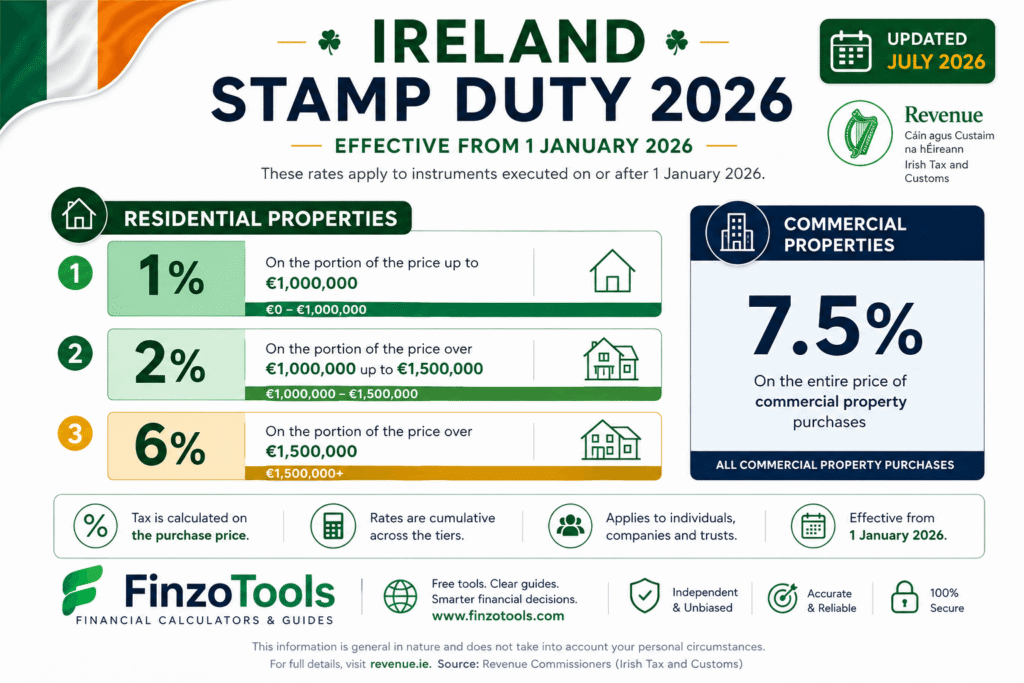
Stamp duty on residential property in Ireland is 1% on the first €1 million, 2% on the portion between €1 million and €1.5 million, and 6% on anything above €1.5 million. Commercial property is taxed at a flat 7.5%. First-time buyers pay the same rates — there’s no stamp duty exemption — but the Help to Buy scheme provides a separate rebate of up to €30,000 on new builds. Use our free Ireland Stamp Duty Calculator to get your exact figure in seconds.
Buying a property in Ireland? Stamp duty is one of those costs that catches people off guard — partly because it’s a lump sum due at closing, and partly because the rules changed in Budget 2025 with a new 6% tier for high-value homes.
This guide covers every stamp duty rate currently in effect, walks through real examples across different price points, and explains exactly what first-time buyers, new-build purchasers, commercial investors and farmers need to know.
Ireland stamp duty rates 2026 — all current rates
Residential property rates
These rates apply to all residential property purchases — houses, apartments, holiday homes, and sites with building agreements — since 2 October 2024.
| Purchase Price Portion | Stamp Duty Rate | Notes |
|---|---|---|
| First €1,000,000 | 1% | Applies to all residential purchases |
| €1,000,001 to €1,500,000 | 2% | Only on the amount in this band |
| Above €1,500,000 | 6% | New rate introduced in Budget 2025 |
| Bulk purchases (10+ houses in 12 months) | 15% | Excludes apartments. Increased from 10% in Budget 2025 |
Source: Revenue Commissioners — Stamp Duty Rates, Finance Act 2024 (Section 90)
The system is tiered, not flat. You don’t pay 6% on the entire price of a €2 million house — you pay 1% on the first million, 2% on the next €500,000, and 6% only on the final €500,000.
Non-residential (commercial) property rate
| Property Type | Stamp Duty Rate | Effective Since |
|---|---|---|
| Commercial premises | 7.5% | 9 October 2019 |
| Industrial property | 7.5% | 9 October 2019 |
| Development land | 7.5% | 9 October 2019 |
| Agricultural land | 7.5% | 9 October 2019 (reliefs may apply) |
The 7.5% rate is flat — it applies to the full purchase price with no tiered bands. However, agricultural land transfers to qualifying young trained farmers may be fully exempt (more on this below).
Other stamp duty rates at a glance
| Transaction Type | Rate |
|---|---|
| Shares in Irish-registered companies | 1% |
| Shares on UK stock exchanges | 0.5% |
| Shares on US/EU/other exchanges | No Irish stamp duty |
| Intellectual property transfers | Exempt |
| Property received through inheritance | No stamp duty (CAT may apply instead) |
Stamp duty examples — real calculations at every price point
Here’s what you’d actually pay on a second-hand residential property at various price points in 2026:
| Purchase Price | Stamp Duty Calculation | Total Stamp Duty | Effective Rate |
|---|---|---|---|
| €250,000 | €250,000 × 1% | €2,500 | 1.00% |
| €400,000 | €400,000 × 1% | €4,000 | 1.00% |
| €600,000 | €600,000 × 1% | €6,000 | 1.00% |
| €1,000,000 | €1,000,000 × 1% | €10,000 | 1.00% |
| €1,200,000 | (€1M × 1%) + (€200K × 2%) | €14,000 | 1.17% |
| €1,500,000 | (€1M × 1%) + (€500K × 2%) | €20,000 | 1.33% |
| €2,000,000 | (€1M × 1%) + (€500K × 2%) + (€500K × 6%) | €50,000 | 2.50% |
| €3,000,000 | (€1M × 1%) + (€500K × 2%) + (€1.5M × 6%) | €110,000 | 3.67% |
For the vast majority of buyers — anyone purchasing below €1 million — stamp duty remains a straightforward 1% of the purchase price. The 6% rate introduced in Budget 2025 only affects properties above €1.5 million, which is a small fraction of the market.
New builds — stamp duty is calculated differently
If you’re buying a newly constructed home, you get a meaningful advantage. New-build properties include VAT at 13.5% in the listed price, but stamp duty is charged on the VAT-exclusive amount — not the full sticker price.
The formula:
VAT-exclusive price = Listed price ÷ 1.135
| Listed Price (incl. VAT) | VAT-Exclusive Price | Stamp Duty (1%) | Saving vs Second-Hand |
|---|---|---|---|
| €300,000 | €264,317 | €2,643 | Save €357 |
| €400,000 | €352,423 | €3,524 | Save €476 |
| €500,000 | €440,529 | €4,405 | Save €595 |
The saving isn’t enormous at typical price points — around €350 to €600 — but it’s money back in your pocket. And for new-build buyers who also qualify for Help to Buy, the combined benefit is much more significant.
First-time buyers — what you actually get
There’s a common misconception that first-time buyers are exempt from stamp duty. They’re not. First-time buyers pay the same 1%/2%/6% rates as everyone else.
What first-time buyers do get is the Help to Buy (HTB) scheme, which is a completely separate incentive — an income tax rebate, not a stamp duty relief. Here’s how it works:
- Applies to: New-build properties only (or self-builds). Not second-hand homes.
- Property value limit: Maximum purchase price of €500,000
- Rebate amount: The lesser of 10% of the purchase price, €30,000, or the total income tax and DIRT paid over the previous four years
- Extended to: 31 December 2029 (per Budget 2025)
A first-time buyer purchasing a new-build home at €350,000 would pay approximately €3,084 in stamp duty (on the VAT-exclusive price of €308,370) but could receive up to €30,000 back through Help to Buy — a net benefit of roughly €27,000.
That’s a powerful combination, but it only works for new builds under €500,000.
The 6% rate explained — who it affects and who it doesn’t
The 6% rate, introduced on 2 October 2024 through Budget 2025, targets the upper end of the residential market. It only applies to the portion of the purchase price above €1.5 million.
There’s an important exception: purchases of three or more apartments in the same apartment block are excluded from the 6% rate. Those transactions continue to attract 1% on the first €1 million and 2% above that. This carve-out was specifically designed to avoid discouraging apartment development.
For a single apartment purchase or a purchase of two apartments, the 6% rate still applies if the price exceeds €1.5 million.
Bulk purchase rate — 15% on 10+ houses
The 15% bulk purchase rate aims to deter institutional investors from buying up entire housing estates. It kicks in when a person or entity acquires 10 or more residential houses or duplexes within any 12-month period.
Key points:
- The rate applies to houses and duplexes only — apartments are excluded
- Once the tenth property is acquired, the 15% rate applies retrospectively to all units in the transaction
- Properties acquired before 2 October 2024 count toward the threshold, but the 15% rate only applies to units acquired on or after that date
- The rate was increased from 10% to 15% in Budget 2025
Commercial property stamp duty — the 7.5% rate
Every non-residential property transaction attracts a flat 7.5% stamp duty. There are no tiers and no thresholds.
Example: A commercial unit purchased for €750,000 incurs stamp duty of €56,250.
This rate applies to offices, retail units, warehouses, industrial premises, development land, and agricultural land. The rate has been 7.5% since October 2019 when it was increased from 6%.
Residential Development Refund Scheme
If you buy non-residential land at 7.5% and then develop it for housing, you can claim a refund of up to eleven-fifteenths of the stamp duty paid under the Residential Development Stamp Duty Refund Scheme. Building work must start within 30 months (36 months for large-scale developments), and the scheme has been extended to 31 December 2030.
Agricultural land — reliefs for young trained farmers
Agricultural land transfers normally attract the standard 7.5% commercial rate. But there’s a valuable relief for qualifying young farmers.
The Young Trained Farmer stamp duty relief provides a full exemption on agricultural land transfers, subject to conditions:
- The farmer must be under 35 years of age at the date of transfer
- Must hold a relevant agricultural qualification (Level 6 or higher — commonly the “Green Cert”)
- Must farm the land for a minimum of six years
- If the conditions are broken within six years, the full stamp duty is clawed back with interest
The consanguinity relief — a reduced rate for transfers between close family members — previously applied to farmland but was discontinued for non-residential property.
How and when stamp duty is paid
You don’t need to file anything yourself. Your solicitor handles the entire process as part of conveyancing.
- Your solicitor calculates the stamp duty due based on the purchase price and property type
- They request the funds from you before completion — it’s typically included in the closing statement
- The stamp duty return is filed and payment made through Revenue’s eStamping system
- Payment must be completed within 44 days of the deed of transfer being signed
- Revenue stamps the property deeds, and the transfer can then be registered with Tailte Éireann (formerly the Property Registration Authority)
Late payment triggers interest at 0.0219% per day (roughly 8% per annum) plus a flat penalty. Don’t let this happen — it’s entirely avoidable since your solicitor manages the timeline.
Common stamp duty mistakes
These are the errors that trip people up most often:
- Assuming first-time buyers are exempt. They’re not. The HTB scheme is a separate income tax refund, not a stamp duty relief.
- Calculating stamp duty on the VAT-inclusive price of a new build. Always use the VAT-exclusive amount — you’ll overpay by roughly 12% otherwise.
- Forgetting stamp duty when budgeting. On a €400,000 purchase, stamp duty alone is €4,000. Add legal fees, valuation fees, and mortgage protection, and closing costs can easily hit €8,000–€12,000.
- Not factoring in the 44-day deadline. While your solicitor manages this, delays in providing funds to your solicitor can push past the deadline and trigger penalties.
- Confusing stamp duty with Local Property Tax. Stamp duty is a one-off transaction tax. LPT is an annual charge on property ownership — completely separate.
Budget 2025 changes — what’s different since October 2024
Two significant changes were introduced in Budget 2025, both effective from 2 October 2024:
- New 6% tier: A third residential rate of 6% now applies to the portion of the purchase price above €1.5 million. Previously, the maximum rate was 2% on everything above €1 million.
- Bulk purchase rate increase: The rate for acquiring 10+ houses in 12 months jumped from 10% to 15%. Apartments remain excluded from this measure.
Budget 2026 extended the Residential Development Stamp Duty Refund Scheme to 31 December 2030, but no further changes to stamp duty rates were announced.
Frequently asked questions — Ireland stamp duty 2026
How much is stamp duty in Ireland in 2026?
Residential property: 1% on the first €1 million, 2% between €1 million and €1.5 million, 6% above €1.5 million. Non-residential: flat 7.5%. Bulk residential purchases (10+ houses): 15%.
Do first-time buyers pay stamp duty in Ireland?
Yes. First-time buyers pay the same rates as all other buyers. There is no stamp duty exemption. The Help to Buy scheme is a separate income tax rebate (up to €30,000) on new builds under €500,000.
How is stamp duty calculated on a new build in Ireland?
On the VAT-exclusive price. New homes include 13.5% VAT in the listed price, but stamp duty is charged before VAT. Divide the listed price by 1.135 to get the taxable amount, then apply the 1% rate.
What is the stamp duty rate on commercial property in Ireland?
A flat 7.5% on the entire purchase price. This applies to all non-residential property — offices, retail, industrial, development land and agricultural land.
When must stamp duty be paid in Ireland?
Within 44 days of the deed of transfer being executed. Your solicitor files and pays through Revenue’s eStamping system. Late payment incurs daily interest plus penalties.
Is stamp duty payable on inherited property in Ireland?
No. Inherited property is not subject to stamp duty. Capital Acquisitions Tax (CAT) may apply instead, depending on the value and the relationship to the deceased.
What is the bulk purchase stamp duty rate in Ireland?
15% — applying when 10 or more residential houses or duplexes (not apartments) are acquired within any 12-month period. The rate applies retrospectively to all units once the tenth is purchased.
Can I get a stamp duty refund on development land?
Yes. The Residential Development Stamp Duty Refund Scheme refunds up to eleven-fifteenths of the 7.5% paid on non-residential land developed for housing. Building must start within 30 months. Extended to 31 December 2030.
Is there stamp duty relief for farmers in Ireland?
Yes. Young trained farmers (under 35, with relevant qualification) are fully exempt from stamp duty on agricultural land transfers. The land must be farmed for six years or the relief is clawed back.
How much stamp duty on a €400,000 house in Ireland?
Second-hand: €400,000 × 1% = €4,000. New build: approximately €352,423 (VAT-exclusive) × 1% = €3,524.
Related tools and guides
- 🧮 Ireland Stamp Duty Calculator 2026 — calculate your exact stamp duty in seconds
- 💰 Ireland Salary & PAYE Calculator 2026 — see your take-home pay after tax
- 🏠 Irish Mortgage Calculator 2026 — estimate your monthly repayments
- 👴 Irish Pension Calculator 2026 — estimate your State Pension entitlement
- 📖 PRSI Contributions for Irish Pension — how many contributions you need
- 📖 Irish State Pension 2026 — Full Guide — rates, age rules and eligibility
Sources & references
- Revenue Commissioners — Stamp Duty Rates on Property
- Revenue Commissioners — eBrief 004/25 — Stamp Duty Rate Changes
- Citizens Information — Stamp Duty on Property
- Revenue Commissioners — Help to Buy Incentive
- Finance Act 2024, Section 90 — Stamp Duty Rate Changes
© 2026 FinzoTools — For educational purposes only. This is not legal or tax advice. Verify all rates and figures with Revenue.ie or your solicitor before making property purchase decisions.
Pingback: €50k Salary Ireland: Take Home Pay After PAYE, USC & PRSI 26