
✅ Last verified: July 2026 — Source: South African Revenue Service (SARS), National Treasury 2026-27
By Abdul Basit | July 25, 2026 | FinzoTools Blog
⚡ QUICK ANSWER
South Africa PAYE is calculated using 7 SARS tax brackets from 18% to 45% for 2026-27. The primary rebate of R17,235 means you pay no tax below R95,750/year. UIF is deducted at 1% capped at R177/month. On a R25,000/month salary, take-home is approximately R21,246/month. Use our free South Africa Salary Calculator 2026 to calculate your exact take-home pay.
Understanding your PAYE deductions in South Africa can be confusing — with seven tax brackets, age-based rebates, UIF contributions, and optional medical aid credits all affecting your final take-home pay. Many South African employees have no idea how SARS calculates their monthly tax deduction.
In this guide, we break down exactly how PAYE works in South Africa for 2026-27 — using official SARS figures, real salary examples, and a step-by-step calculation you can follow yourself.
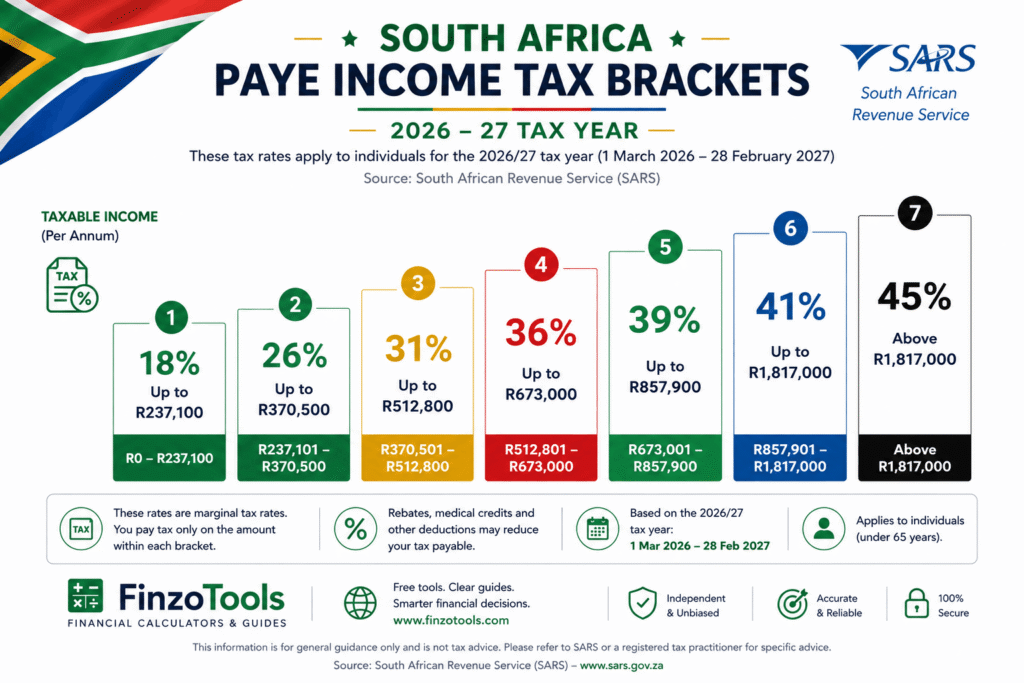
SARS income tax brackets 2026-27 — full table
| Taxable Income | Tax Rate | Tax on Band | Cumulative Tax |
|---|---|---|---|
| R0 – R237,100 | 18% | R42,678 | R42,678 |
| R237,101 – R370,500 | 26% | R34,684 | R77,362 |
| R370,501 – R512,800 | 31% | R44,113 | R121,475 |
| R512,801 – R673,000 | 36% | R57,672 | R179,147 |
| R673,001 – R857,900 | 39% | R72,111 | R251,258 |
| R857,901 – R1,817,000 | 41% | R393,251 | R644,489 |
| Above R1,817,000 | 45% | — | R644,489 + 45% |
Source: SARS — Income Tax rates of tax for individuals 2026-27 (1 March 2026 – 28 February 2027)
Tax rebates 2026-27 — what reduces your tax bill
Every South African taxpayer receives a rebate that is subtracted directly from their calculated tax — not from their income. This is why the effective tax-free threshold is higher than R0.
| Rebate Type | Who Gets It | Annual Amount 2026-27 | Effective Tax-Free Threshold |
|---|---|---|---|
| Primary Rebate | All taxpayers under 65 | R17,235 | R95,750/year |
| Secondary Rebate | Age 65 – 74 (additional) | R9,444 | R148,217/year |
| Tertiary Rebate | Age 75+ (additional) | R3,145 | R165,689/year |
Source: SARS — Tax rebates 2026-27
Real take-home pay examples — South Africa 2026-27
| Monthly Salary | Annual Salary | PAYE Tax/Month | UIF/Month | Take-Home/Month | Effective Rate |
|---|---|---|---|---|---|
| R10,000 | R120,000 | R323 | R100 | R9,577 | 3.2% |
| R15,000 | R180,000 | R1,073 | R150 | R13,777 | 7.2% |
| R20,000 | R240,000 | R2,173 | R177 | R17,650 | 10.9% |
| R25,000 | R300,000 | R3,577 | R177 | R21,246 | 14.3% |
| R35,000 | R420,000 | R6,652 | R177 | R28,171 | 19.0% |
| R50,000 | R600,000 | R11,985 | R177 | R37,838 | 24.0% |
| R80,000 | R960,000 | R22,652 | R177 | R57,171 | 28.3% |
Figures based on SARS 2026-27 rates. Primary rebate applied. No medical aid credits included. UIF capped at R177.12/month.
💡 Want your exact take-home? Use our free South Africa Salary Calculator 2026 — includes PAYE, UIF, age rebates and medical aid credits.
How PAYE is calculated in South Africa — step by step
Here is the exact calculation SARS uses for a R25,000/month (R300,000/year) salary:
- Calculate annual tax on R300,000:
R237,100 × 18% = R42,678
(R300,000 − R237,100) × 26% = R16,874
Total tax before rebate = R59,552 - Subtract primary rebate:
R59,552 − R17,235 = R42,817/year - Divide by 12 for monthly PAYE:
R42,817 ÷ 12 = R3,568/month - Add UIF (1%, capped at R177.12):
R25,000 × 1% = R250 → capped at R177 - Take-home:
R25,000 − R3,568 − R177 = R21,255/month
UIF — what it is and how it works
UIF (Unemployment Insurance Fund) is a mandatory contribution of 1% of your monthly salary, capped at R177.12 per month (annual ceiling R17,712 × 1%). Your employer also contributes 1% — so the total UIF contribution is 2% of salary.
| Monthly Salary | Your UIF (1%) | Employer UIF (1%) | Total UIF |
|---|---|---|---|
| R10,000 | R100 | R100 | R200 |
| R15,000 | R150 | R150 | R300 |
| R17,712+ | R177 (max) | R177 (max) | R354 (max) |
Source: Department of Employment and Labour — UIF contribution ceiling 2026
Medical aid tax credits 2026-27
If you contribute to a registered medical aid scheme, you receive a medical tax credit that directly reduces your PAYE — not just your taxable income. This is one of the most valuable tax benefits for South African employees.
| Member Type | Monthly Credit 2026-27 | Annual Tax Saving |
|---|---|---|
| Principal member | R364/month | R4,368/year |
| First dependant | R364/month | R4,368/year |
| Each additional dependant | R246/month | R2,952/year |
Source: SARS — Medical scheme fees tax credit 2026-27
Example: A married employee with 2 children on medical aid gets R364 + R364 + R246 + R246 = R1,220/month directly off their tax bill — R14,640/year in tax savings.
South Africa vs other countries — tax comparison
| Country | Salary (equiv. R300K) | Effective Tax Rate | Take-Home % |
|---|---|---|---|
| 🇿🇦 South Africa | R300,000/year | 14.3% | 85.7% |
| 🇬🇧 United Kingdom | ~£13,500 | ~12% | 88% |
| 🇦🇺 Australia | ~A$24,000 | ~8% | 92% |
| 🇮🇪 Ireland | ~€15,000 | ~15% | 85% |
| 🇦🇪 UAE | Equiv. | 0% | 100% |
Approximate comparisons at equivalent purchasing power. Each country has different social contributions and benefits.
6 tips to reduce your South African tax bill in 2026
- Join a medical aid scheme — the medical tax credit of R364/month per member directly reduces your PAYE. Even a basic hospital plan qualifies and the tax saving partially offsets the premium cost.
- Contribute to a retirement annuity (RA) — contributions up to 27.5% of taxable income (max R350,000/year) are tax deductible. On a R300,000 salary at 26% marginal rate, a R30,000 RA contribution saves R7,800 in tax.
- Claim your home office deduction — if you work from home and have a dedicated workspace, you can deduct a proportion of rent, rates, and utilities from your taxable income.
- Use your travel allowance correctly — keep a detailed logbook if you receive a travel allowance. SARS allows deduction of business travel at R4.84/km (2026-27) — unclaimed kilometres are a common missed deduction.
- Check your tax certificate (IRP5) annually — errors in your IRP5 from your employer can result in underpayment or overpayment. Verify it against your payslips every February.
- File your tax return on time — SARS auto-assesses many taxpayers now. If you have deductions to claim, submit manually before the October deadline to avoid losing refunds.
Frequently asked questions — South Africa PAYE 2026
What are the SARS income tax brackets for 2026-27?
The SARS tax brackets for 2026-27 are: 18% up to R237,100; 26% on R237,101–R370,500; 31% on R370,501–R512,800; 36% on R512,801–R673,000; 39% on R673,001–R857,900; 41% on R857,901–R1,817,000; and 45% above R1,817,000.
What is the tax-free threshold in South Africa 2026?
The effective tax-free threshold for taxpayers under 65 is R95,750/year — this is the primary rebate (R17,235) divided by the 18% base rate. For ages 65–74 it is R148,217, and for 75+ it is R165,689.
How is PAYE calculated in South Africa?
Apply SARS tax brackets to annual taxable income, subtract the primary rebate (R17,235), divide by 12 for monthly tax. Add UIF at 1% capped at R177/month. Subtract medical aid tax credits if applicable.
What is UIF in South Africa 2026?
UIF is 1% of monthly salary, capped at R177.12/month. Your employer also contributes 1%. UIF provides benefits if you lose your job, become ill, or go on maternity/adoption leave.
What is the primary rebate in South Africa 2026?
The primary rebate for 2026-27 is R17,235. It is subtracted from your calculated tax bill — not your income. Every South African taxpayer under 65 receives this rebate automatically.
How much tax do I pay on R25,000 salary in South Africa?
On R25,000/month (R300,000/year), you pay approximately R3,568/month PAYE plus R177 UIF. Take-home is approximately R21,255/month. Effective tax rate is 14.3%.
What is the medical aid tax credit in South Africa 2026?
The medical aid tax credit is R364/month for the principal member and first dependant, and R246/month for each additional dependant. These directly reduce your monthly PAYE tax bill.
Bracket Creep in 2026/27 — The Silent Tax Increase
SARS raised all income tax brackets by 3.4% from 1 March 2026 — the first inflation-linked adjustment since 2023/24. When brackets don’t move with inflation, annual salary increases push you into higher brackets even though your real purchasing power hasn’t grown. The 2026/27 adjustment partially offsets this, giving most workers a modest reduction in their effective tax rate compared to 2025/26.
Related tools and guides
- 🇿🇦 South Africa Salary Calculator 2026 — PAYE, UIF, rebates and take-home pay
- 🇦🇺 Australia Salary Calculator 2026-27 — compare SA vs Australia take-home
- 🇬🇧 UK Salary Calculator 2026 — PAYE comparison UK vs South Africa
- 🇮🇪 Irish Pension Calculator 2026 — retirement planning for Irish workers
- 🇦🇪 UAE Salary Calculator 2026 — zero tax take-home comparison
- 📖 Australia New Tax Rates July 2026 — how SA compares to Australia
Sources & references
- SARS — Rates of tax for individuals 2026-27
- SARS — Tax rebates and thresholds 2026-27
- SARS — Medical scheme fees tax credit 2026-27
- Department of Employment and Labour — UIF contribution ceiling 2026
© 2026 FinzoTools — For educational purposes only. Verify all figures at sars.gov.za before making financial decisions.