
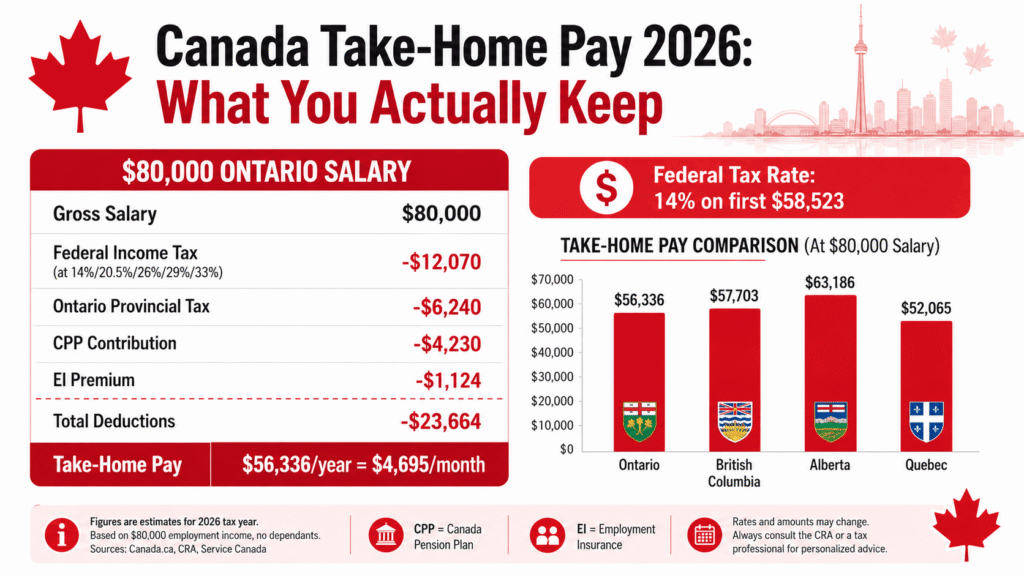
On an $80,000 salary in Ontario in 2026, your take-home pay is approximately $56,336 per year — or $4,695 per month after federal income tax, Ontario provincial tax, CPP contributions, and EI premiums. Canada’s federal tax rate on the first bracket dropped to 14% in 2026, saving most workers a modest amount compared to the previous 14.5% rate.
Use our free Canada Salary Calculator — updated with confirmed 2026 CRA rates for all provinces — to see your exact take-home pay by province.
Canada Federal Income Tax Brackets 2026 (CRA Confirmed)
Canada uses a progressive federal tax system — you only pay the higher rate on income within that bracket. The federal brackets for 2026, confirmed by the Canada Revenue Agency (CRA), are:
| Taxable Income | Federal Tax Rate 2026 | Change from 2025 |
|---|---|---|
| $0 – $58,523 | 14% | ↓ from 14.5% in 2025 |
| $58,524 – $117,043 | 20.5% | No change |
| $117,044 – $162,832 | 26% | No change |
| $162,833 – $232,600 | 29% | No change |
| Above $232,600 | 33% | No change |
The federal Basic Personal Amount (BPA) for 2026 is $16,452 — income below this threshold is not subject to federal tax. The BPA is indexed annually to inflation. Source: Canada Revenue Agency (CRA), canada.ca
What You Actually Take Home — By Province (2026)
Your take-home pay in Canada depends on both federal and provincial taxes. Here is a comparison of take-home pay at common salary levels across the four most populated provinces in 2026:
Ontario — 2026 Take-Home Pay
| Gross Salary | Federal Tax | Ontario Tax | CPP | EI | Take-Home/Year | Take-Home/Month |
|---|---|---|---|---|---|---|
| $50,000 | $4,754 | $2,965 | $2,775 | $703 | $38,803 | $3,234 |
| $60,000 | $6,574 | $4,015 | $3,364 | $843 | $45,204 | $3,767 |
| $80,000 | $12,070 | $6,240 | $4,230 | $1,124 | $56,336 | $4,695 |
| $100,000 | $14,814 | $8,326 | $4,230 | $1,124 | $71,506 | $5,959 |
| $120,000 | $19,937 | $10,226 | $4,230 | $1,124 | $84,483 | $7,040 |
| $150,000 | $28,087 | $14,226 | $4,230 | $1,124 | $102,333 | $8,528 |
These figures use the 2026 Ontario provincial rates and assume standard deductions only (Basic Personal Amount). They do not include RRSP deductions, other credits, or Ontario surtax adjustments. Use our Canada Salary Calculator for a personalised figure.
Province Comparison — Take-Home Pay on $80,000 (2026)
Where you live in Canada significantly affects your take-home pay. Here is how $80,000 compares across the four largest provinces:
| Province | Provincial Tax | Take-Home/Year | Take-Home/Month | Effective Rate |
|---|---|---|---|---|
| 🏆 Alberta | $3,920 (8%/10%) | $63,186 | $5,265 | 21.0% |
| British Columbia | $5,265 (5.06%–7.7%) | $57,703 | $4,809 | 27.9% |
| Ontario | $5,926 (5.05%–9.15%) | $56,336 | $4,695 | 26.9% |
| Quebec | $10,390 (14%–19%) | $52,065 | $4,339 | 34.9% |
Alberta has no provincial sales tax (PST) and the lowest provincial income tax rates in Canada — making it the highest take-home province for most salary levels. Quebec has the highest combined rates but also the most comprehensive social services (subsidised childcare, lower university tuition).
CPP Contributions 2026 — What Gets Deducted
The Canada Pension Plan (CPP) is a mandatory contribution for most employees aged 18 to 70 earning above $3,500 per year. CPP contributions fund your retirement pension, disability benefits, and survivor benefits.
| CPP Component | 2026 Rate | Earnings Range | Max Contribution |
|---|---|---|---|
| CPP (base) | 5.95% | $3,500 – $74,600 | $4,230.45/year |
| CPP2 (enhanced) | 4.00% | $74,600 – $85,000 | $416.00/year |
| Total max (employee) | — | Up to $85,000 | $4,646.45/year |
What is CPP2? Since 2024, Canada added a second tier of CPP contributions (CPP2) for employees earning between $74,600 and $85,000. This enhances your future retirement benefit but does mean slightly higher deductions for higher earners. CPP2 contributions are tax deductible — unlike regular CPP which is a tax credit — giving you a larger tax saving per dollar contributed.
When do CPP deductions stop? Once your earnings reach the Year’s Maximum Pensionable Earnings (YMPE) of $74,600 (or $85,000 for CPP2), your employer stops deducting CPP for the rest of the year — giving you a larger net paycheck for the final months.
EI Premiums 2026 — Employment Insurance
Employment Insurance (EI) provides temporary income replacement when you lose your job, take parental leave, or face illness. EI premiums are mandatory for most employees.
| EI Detail | 2026 Figure |
|---|---|
| Employee EI rate | $1.63 per $100 of insurable earnings |
| Maximum insurable earnings | $68,900 |
| Maximum employee EI premium | $1,124.07/year |
| Employer EI rate | 1.4 × employee rate = $2.282 per $100 |
| Quebec EI rate (employee) | $1.31 per $100 (lower — QPP instead of CPP) |
The EI premium rate decreased slightly in 2026 (from $1.64 to $1.63 per $100), but maximum insurable earnings increased from $65,700 to $68,900. The net effect for most workers is a very small change of a few dollars per year. Once your earnings reach $68,900, EI deductions stop for the rest of the year.
Canada Groceries and Essentials Benefit (CGEB) — New in 2026
From July 2026, the Canada Groceries and Essentials Benefit (CGEB) replaced the GST/HST Credit for most low-to-middle-income Canadians. This provides quarterly payments to eligible individuals to help with the cost of groceries and essential goods.
| CGEB Detail | Amount |
|---|---|
| Single individual (no children) | Up to $519/year (quarterly payments) |
| Married/common-law couples | Up to $680/year |
| Per child under 19 | Additional amount per qualifying child |
| Income threshold (single) | Phases out above ~$38,000 net income |
| Payment schedule | Quarterly — January, April, July, October |
The CGEB is paid automatically to eligible Canadians who file their tax return — no application required. It effectively supplements take-home pay for lower earners, adding up to $519/year in tax-free quarterly payments.
How to Reduce Your Canadian Tax Bill in 2026
There are several legal strategies to keep more of your Canadian salary:
| Strategy | How It Works | Typical Saving |
|---|---|---|
| RRSP contributions | Reduce taxable income — 18% of prior year income, max $32,490 in 2026 | Depends on marginal rate — up to 33% savings |
| TFSA contributions | Tax-free growth and withdrawals — $7,000 limit in 2026 | Tax-free investment returns |
| FHSA (First Home Savings) | Tax-deductible contributions + tax-free withdrawal for first home | Up to $40,000 lifetime + tax deduction |
| Spousal income splitting | Pension income splitting reduces overall household tax rate | Hundreds to thousands per year |
| Home office deduction | If employer certified — deduct a portion of home expenses | $2/day flat rate or detailed method |
Canada Salary Calculator 2026 — Get Your Exact Figure
Your take-home pay in Canada depends on:
- Your gross salary and pay frequency
- Your province or territory of residence
- RRSP contributions (reduce taxable income)
- Whether you have CPP2 deductions (earnings above $74,600)
- Additional credits (Basic Personal Amount, pension income, disability)
- Quebec residents — QPP instead of CPP applies
Use the free finzotools.com Canada Salary Calculator — updated with 2026 CRA confirmed rates for all provinces and territories — to get your exact monthly and annual take-home pay.
👉 Calculate Your 2026 Canada Take-Home Pay Now →
Frequently Asked Questions
What is the federal income tax rate in Canada for 2026?
The federal income tax rate in Canada for 2026 starts at 14% on income up to $58,523 — reduced from 14.5% in 2025 and 15% before that. Higher income is taxed at 20.5%, 26%, 29%, and 33% on income above $232,600. The Basic Personal Amount of $16,452 means the first $16,452 of income is not subject to federal tax.
How much CPP do I pay in 2026?
In 2026, employees pay CPP at 5.95% on earnings between $3,500 and $74,600, with a maximum employee contribution of $4,230.45. If you earn between $74,600 and $85,000, you also pay CPP2 at 4% on that additional amount, adding up to $416 more. Total maximum CPP+CPP2 for employees is $4,646.45 in 2026.
How much EI do I pay in 2026?
In 2026, employees pay EI at $1.63 per $100 of insurable earnings, up to maximum insurable earnings of $68,900. The maximum employee EI premium is $1,124.07 per year. Quebec residents pay a lower rate ($1.31 per $100) because Quebec operates its own parental insurance plan.
What province has the lowest income tax in Canada?
Alberta has the lowest provincial income tax rates in Canada for most income levels. Alberta’s provincial tax starts at 8% on the first $60,000 of income (a new lower rate introduced in 2025 and continuing in 2026), making it the best province for take-home pay. Alberta also has no provincial sales tax (PST).
What is the Canada Groceries and Essentials Benefit (CGEB)?
The CGEB replaced the GST/HST Credit from July 2026. It provides quarterly tax-free payments to eligible low-to-middle-income Canadians — up to $519/year for single individuals and $680/year for couples. Payments are automatic for Canadians who file their tax return. The benefit phases out at higher income levels.
When do CPP and EI deductions stop in 2026?
CPP deductions stop once your annual earnings reach the Year’s Maximum Pensionable Earnings of $74,600 (or $85,000 for CPP2). EI deductions stop once earnings reach $68,900. After hitting these limits, your employer stops deducting CPP or EI for the rest of the year — typically resulting in a larger net paycheck in the later months of the year for higher earners.
Related Calculators on Finzotools
- 🇨🇦 Canada Salary Calculator — Take-home pay by province after tax, CPP and EI 2026
- 🇦🇺 Australia Salary Calculator — Take-home after ATO tax and Medicare Levy
- 🇬🇧 UK Salary Calculator — Take-home after income tax and National Insurance
- 🇮🇪 Ireland Salary Calculator — Take-home after PAYE, USC and PRSI
- 🇸🇬 Singapore Income Tax Calculator — YA 2026 progressive rates
Last updated: June 2026. Tax figures based on confirmed 2026 CRA rates, provincial tax schedules, CPP and EI maximums announced October 2025. Sources: Canada Revenue Agency (canada.ca), TaxTips.ca, Virtus Group, Statistics Canada. The CGEB figures reflect announced benefit levels effective July 2026. Always verify at canada.ca or consult a registered tax professional for advice specific to your circumstances.