
What Is the 50/30/20 Rule for Budgeting?
The 50/30/20 rule is one of the simplest and most effective personal budgeting strategies in the world. It was popularized by U.S. Senator Elizabeth Warren in her book All Your Worth and has since become a go-to framework for anyone looking to get their finances under control — whether you earn in dollars, rupees, Canadian dollars, or pounds.
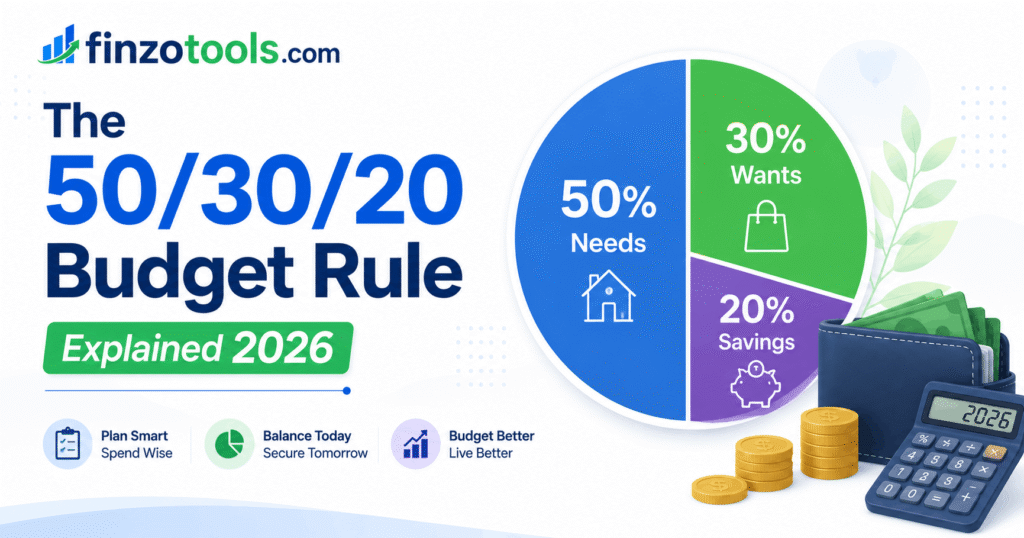
The idea is beautifully simple: divide your after-tax income into three buckets:
- 50% → Needs (rent, groceries, utilities, minimum loan payments)
- 30% → Wants (dining out, subscriptions, holidays, entertainment)
- 20% → Savings & Debt Repayment (emergency fund, investments, paying off credit cards faster)
That’s it. No complex spreadsheets. No tracking every single coffee purchase. Just three categories that keep you spending consciously and building wealth at the same time.
Why the 50/30/20 Rule Works (And Who It’s Best For)
Most budgets fail because they’re too restrictive. When you’re told you can never eat out or buy anything fun, you give up within a week.
The 50/30/20 rule works because it gives you permission to spend on things you enjoy — the 30% wants bucket is guilt-free money. You’ve already covered your needs and future savings, so whatever is left in that 30% is yours to enjoy completely freely.
It’s best suited for:
- People who are new to budgeting and want a simple starting framework
- Anyone with a steady monthly income (salaried employees especially)
- Those who want to start saving without feeling deprived
- People in any country — the percentages work regardless of currency
How to Apply the 50/30/20 Rule: Step-by-Step
Step 1: Calculate Your After-Tax Monthly Income
Start with your take-home pay — the amount that actually hits your bank account after taxes, National Insurance (UK), PF deductions (India), or CPP/EI contributions (Canada).
If you have multiple income streams (freelance, rental income, dividends), add them all together.
Example: If you earn $5,000/month after tax in the US, your budget splits into $2,500 (needs), $1,500 (wants), and $1,000 (savings).
Step 2: List Your Needs (Target: 50% or less)
Needs are expenses you cannot reasonably live without. This includes:
| Category | US/Canada Examples | India Examples | UK Examples |
|---|---|---|---|
| Housing | Rent / Mortgage | Rent / Home Loan EMI | Rent / Mortgage |
| Food | Groceries | Groceries / Ration | Groceries |
| Transport | Car payment, gas | Fuel, auto EMI | Train pass, fuel |
| Utilities | Electricity, internet | Electricity, mobile | Council tax, energy |
| Insurance | Health, auto | Health, term plan | Home, car insurance |
| Minimum debt payments | Credit card minimum | Loan EMI minimum | Credit card minimum |
Important: If your needs exceed 50% of income, that’s a signal to look at reducing fixed costs — like moving to a cheaper home, refinancing a loan, or cutting an unused subscription that crept into the “needs” bucket.
Step 3: Identify Your Wants (Target: 30% or less)
Wants are the things that improve your quality of life but aren’t survival-critical:
- Eating out and takeaways
- Netflix, Spotify, gaming subscriptions
- New clothes beyond basics
- Gym membership
- Weekend trips and holidays
- Hobbies
The 30% bucket is not a guilty category — it’s intentional spending on joy. The key is staying within the limit.
Step 4: Automate Your Savings (Target: 20% minimum)
This is the most powerful bucket of the three. The 20% savings bucket should cover:
- Emergency fund (aim for 3–6 months of expenses)
- Retirement contributions — 401(k) or Roth IRA (US), RRSP or TFSA (Canada), PPF or SIP mutual funds (India), pension (UK)
- Extra debt repayment beyond minimums
- Short-term savings goals — house deposit, new car, wedding
Pro tip: Automate this transfer on the day your salary arrives. Savings you never see are savings you never spend.
The 50/30/20 Rule by Country: Key Adjustments
🇺🇸 United States
In high cost-of-living cities like New York or San Francisco, housing alone can consume 35–40% of income. If your needs genuinely exceed 50%, try adjusting to a 60/20/20 or 70/15/15 split temporarily while you work on reducing fixed costs. The key is always keeping savings above zero.
Useful tools: Use our US 50/30/20 Budget Planner and Savings Goal Calculator to build your personal plan.
🇨🇦 Canada
Canadian salaries are lower on average than US equivalents, but so are some costs (healthcare is covered). Watch out for high housing costs in Toronto and Vancouver. The TFSA is your best friend for the savings bucket — contributions grow completely tax-free.
Useful tools: Try our Canadian Budget Planner and TFSA Growth Calculator to see how much your savings bucket could grow.
🇮🇳 India
For salaried Indians, the 50/30/20 rule pairs perfectly with the popular SIP (Systematic Investment Plan) strategy for the savings bucket. Automate a monthly SIP into a mutual fund with your 20% savings on salary day, before you touch the rest.
Useful tools: Use our 50/30/20 Budget Planner in ₹ and SIP Calculator to project your wealth-building journey.
🇬🇧 United Kingdom
UK renters in London face some of the highest housing-to-income ratios in the world. If rent consumes most of your needs bucket, the Stocks & Shares ISA is an excellent tax-efficient home for your 20% savings — all growth is sheltered from capital gains tax.
Useful tools: Try our UK Budget Planner in £ and ISA Calculator to model your savings growth tax-free.
What to Do With Your 20% Savings: A Priority Order
Not sure where to put your savings bucket? Follow this priority ladder:
- Build a starter emergency fund — at least £1,000 / $1,000 / ₹50,000 first
- Get your full employer match — free money from your 401(k) / RRSP / pension match
- Pay off high-interest debt — anything above 7–8% interest rate
- Max out tax-sheltered accounts — Roth IRA, TFSA, ISA, PPF
- Build 3–6 months emergency fund fully
- Invest the rest — index funds, SIPs, or other low-cost investments
How to Calculate Your Net Worth: The Next Step After Budgeting
Once you’ve been budgeting for a few months, the natural next question is: am I actually making progress?
That’s where tracking your net worth comes in. Your net worth is simply:
Net Worth = Total Assets − Total Liabilities
Assets include: savings accounts, investments, property value, pension/retirement fund value, cash.
Liabilities include: mortgage balance, credit card debt, student loans, car finance, personal loans.
Calculate it once a month to see your wealth growing over time. Even if the number starts negative (very common when you’re young and have student loans), watching it move upward month by month is one of the most motivating financial habits you can build.
👉 Use our free Net Worth Calculator — available in USD, CAD, INR, and GBP — to get your baseline number today.
How Much Should I Save Monthly to Reach a Goal?
One of the most common questions people ask once they start the 50/30/20 rule is: “If I save X per month, how long until I can afford Y?”
For example:
- How long to save a $20,000 house deposit at $500/month?
- How much to save monthly to reach ₹10 lakh in 5 years?
- How many years to build a £50,000 emergency fund?
The answer depends on your monthly savings amount, time horizon, and the interest rate your savings earn. Our Savings Goal Calculator does this in seconds — just enter your target amount, monthly contribution, and interest rate.
👉 Try the free Savings Goal Calculator →
Common 50/30/20 Mistakes to Avoid
Mistake 1: Using gross income instead of after-tax income Always start with what actually lands in your account. Using your pre-tax salary will make your budget look much healthier than it really is.
Mistake 2: Treating loan minimum payments as savings Minimum payments on debt are a need, not a saving. Only extra payments beyond the minimum count toward your 20% savings bucket.
Mistake 3: Forgetting irregular expenses Car insurance paid yearly, annual subscriptions, and holiday costs are real expenses. Divide them by 12 and include the monthly equivalent in your needs or wants buckets.
Mistake 4: Being too rigid The 50/30/20 rule is a guideline, not a law. A month where you spend 35% on needs and 25% on wants isn’t failure — life is variable. The goal is the average over time.
Frequently Asked Questions
Is the 50/30/20 rule good for low income?
Yes, but you may need to adjust the split. If your income is low and needs genuinely consume more than 50%, try a 60/20/20 or even 70/10/20 split. The critical thing is to always keep a savings percentage — even 5% — because the habit matters more than the amount when you’re starting out.
Does the 50/30/20 rule work in India?
Absolutely. The percentages work regardless of currency. For Indian earners, the 20% savings bucket pairs especially well with SIP mutual fund investments and PPF contributions, both of which can be automated monthly.
What if I have a lot of debt?
If you’re aggressively paying off debt, consider temporarily adjusting to 50/20/30 — keeping needs at 50%, pushing savings/debt to 30%, and trimming wants to 20%. Once high-interest debt is cleared, you’ll have significantly more cash flow to redirect to investments.
Is 20% savings realistic?
For many people, especially in high cost-of-living cities, 20% savings feels impossible at first. Start with whatever percentage you can manage — even 5% or 10% — and increase by 1% every few months. The habit is what matters most early on.
Start Your Budget Plan Today — Free Tools, No Signup
FinzoTools offers free finance calculators for US, Canada, India, and UK — no account needed, no ads following you around.
Here’s everything you might need after reading this guide:
- 📋 50/30/20 Budget Planner — Enter your income and get your exact budget split instantly
- 💰 Savings Goal Calculator — Find out how much to save monthly to hit any financial goal
- 📊 Net Worth Calculator — Track your total wealth across assets and liabilities
- 📈 SIP Calculator (India) — Project your mutual fund growth over any time horizon
- 🏦 TFSA Growth Calculator (Canada) — Model tax-free savings account growth
- 📈 ISA Calculator (UK) — See your ISA grow tax-free year after year
This article is for educational purposes only and does not constitute financial advice. Always consult a qualified financial advisor before making major financial decisions.