
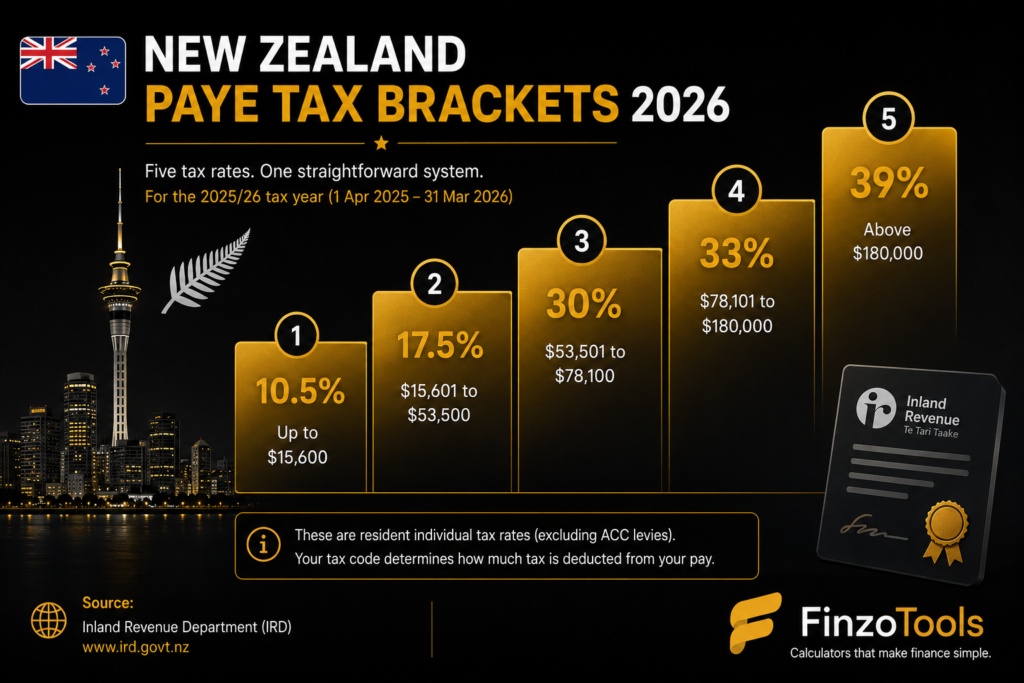
New Zealand’s income tax system is one of the simplest in the developed world — five progressive brackets, no tax-free threshold, and PAYE deducted automatically by your employer. For the 2025–26 tax year (1 April 2025 to 31 March 2026), rates range from 10.5% on the first NZ$15,600 to 39% on income above NZ$180,000. The same brackets continue unchanged into 2026–27.
But simplicity does not mean there is nothing to understand. Most Kiwis do not realise that New Zealand has no tax-free threshold — unlike Australia, the UK, or Canada, you pay tax from the very first dollar. Combined with the ACC earners’ levy, KiwiSaver contributions, and student loan repayments, your actual take-home pay can be significantly lower than the gross figure on your employment agreement.
This guide covers every bracket, all the deductions that come out alongside PAYE, and worked examples showing exactly what you keep at common salary levels.
The Five PAYE Tax Brackets — 2025–26 and 2026–27
These brackets apply to the current tax year (1 April 2025 to 31 March 2026) and are confirmed unchanged for 2026–27. The thresholds were adjusted on 31 July 2024 — the first change in 14 years after being frozen since 2010.
| Taxable Income (NZ$) | Tax Rate | Cumulative Tax (NZ$) |
|---|---|---|
| $0 – $15,600 | 10.5% | $1,638 |
| $15,601 – $53,500 | 17.5% | $8,270.50 |
| $53,501 – $78,100 | 30% | $15,650.50 |
| $78,101 – $180,000 | 33% | $49,277.50 |
| $180,001 and above | 39% | $49,277.50 + 39% of excess |
The critical difference between New Zealand and most comparable countries is the absence of a tax-free threshold. In Australia, the first A$18,200 is tax-free. In the UK, the first £12,570 is tax-free. In New Zealand, every dollar from the first is taxed at 10.5%. This means even minimum wage workers pay income tax on their entire earnings.
What Changed in 2024 — And Why It Matters
From 2010 to July 2024, the tax brackets were completely frozen. During that period, average wages rose by more than 40%, dragging thousands of Kiwis into higher brackets without any real increase in purchasing power — a phenomenon known as bracket creep or fiscal drag.
The July 2024 adjustment widened the lower three brackets: the 17.5% bracket now starts at $15,600 (up from $14,000), the 30% bracket at $53,500 (up from $48,000), and the 33% bracket at $78,100 (up from $70,000). The top rate of 39% at $180,000 was untouched.
For a worker on $80,000, the 2024 bracket change saved approximately $50 per fortnight. It was a meaningful but modest correction — 14 years of bracket creep was not fully reversed, and with brackets now frozen again, the creep resumes immediately.
Worked Examples: Tax at Common NZ Salaries
| Annual Salary (NZ$) | Income Tax | ACC Levy | Total Deductions | Effective Rate |
|---|---|---|---|---|
| $45,000 | $6,786 | $752 | $7,538 | 16.8% |
| $60,000 | $10,220 | $1,002 | $11,222 | 18.7% |
| $80,000 | $16,278 | $1,336 | $17,614 | 22.0% |
| $100,000 | $22,878 | $1,670 | $24,548 | 24.5% |
| $200,000 | $57,078 | $2,552 | $59,630 | 29.8% |
*ACC levy at 1.67% (2025-26 rate). KiwiSaver and student loan not included — see sections below.
On $80,000, the effective combined rate of income tax plus ACC is 22%. Add KiwiSaver at the default 3% ($2,400) and the total deduction rises to $20,014, or 25% of gross. For workers also repaying a student loan, the effective deduction can exceed 30%.
ACC Earners’ Levy: The Hidden Deduction
Every PAYE earner in New Zealand pays the ACC earners’ levy alongside their income tax. This is not a tax — it funds New Zealand’s no-fault accident compensation scheme, which covers medical costs, rehabilitation, and lost earnings if you are injured (at work or otherwise).
| Tax Year | Levy Rate | Maximum Liable Earnings | Maximum Annual Levy |
|---|---|---|---|
| 2025–26 | 1.67% | $152,790 | $2,551.59 |
| 2026–27 | 1.75% | $156,641 | $2,741.22 |
The ACC levy is deducted through PAYE but appears as a separate line on your payslip. For most workers, it adds approximately 1.7% on top of their income tax rate. If you earn above the maximum liable earnings cap, no further levy is charged on the excess.
KiwiSaver: Your Retirement Deduction
KiwiSaver is New Zealand’s voluntary (but opt-in-by-default) retirement savings scheme. If you are enrolled, your employer deducts your chosen contribution rate from your gross pay before depositing it into your KiwiSaver account. Your employer matches with a minimum 3% contribution.
You can choose from five employee contribution rates: 3%, 4%, 6%, 8%, or 10% of gross salary. The default rate for new enrolments is 3%. You can change your rate by notifying your employer or through myIR.
On a $70,000 salary, a 3% KiwiSaver deduction is $2,100 per year ($40.38 per week). Your employer adds another $2,100, giving you $4,200 per year going into retirement savings. The government also contributes up to $521.43 per year as a member tax credit if you contribute at least $1,042.86 during the year.
KiwiSaver is deducted after income tax is calculated — it does not reduce your taxable income like CPF in Singapore or super in Australia. This means your tax bill is the same whether you contribute 3% or 10%. The trade-off is lower take-home pay now in exchange for a larger retirement fund later.
Student Loan Repayments
If you have a student loan from StudyLink, repayments are deducted through PAYE once your income exceeds the repayment threshold. For the 2026 tax year, the threshold is $24,128 per year ($464 per week). You pay 12% of every dollar earned above this threshold.
On a $60,000 salary, the annual student loan repayment is 12% × ($60,000 − $24,128) = $4,305 per year ($82.79 per week). Combined with income tax, ACC, and KiwiSaver, total deductions on $60,000 can exceed $17,000 — leaving take-home pay of around $43,000 or $827 per week.
The Independent Earner Tax Credit (IETC)
The IETC is a tax credit worth up to $520 per year ($10 per week) for New Zealand tax residents who earn between $24,000 and $48,000 per year and do not receive any government assistance (Working for Families, NZ Super, or a main benefit). It abates at incomes above $44,000 and fully phases out at $48,000.
The IETC is claimed automatically through your PAYE if you use the correct tax code (M or ME). It reduces your weekly PAYE by $10, meaning you see the benefit in every pay packet rather than waiting for a year-end refund.
NZ Tax Compared to Other Countries
How does New Zealand compare on effective tax rates at common salary levels?
| Country | Tax-Free Threshold | Top Rate | Effective Rate on ~NZ$80K |
|---|---|---|---|
| New Zealand | None | 39% | ~20.3% |
| Australia | A$18,200 | 45% | ~22% |
| UK | £12,570 | 45% | ~24% |
| Canada | C$16,129 | 33% | ~21% |
| Singapore | S$20,000 | 24% | ~4% |
Despite having no tax-free threshold, New Zealand’s effective rate on $80,000 is actually competitive with Australia and lower than the UK. The absence of a separate social insurance contribution (like the UK’s National Insurance or Australia’s Medicare levy) keeps the overall burden manageable. However, the ACC levy and KiwiSaver push the total deduction closer to 25% when included.
GST: The Other Tax You Pay
New Zealand’s Goods and Services Tax (GST) is a flat 15% on most goods and services — one of the highest consumption tax rates in the OECD. Unlike many countries, New Zealand applies GST broadly with very few exemptions (financial services and residential rent are the main ones). There is no reduced rate for food, clothing, or other essentials.
This means a significant portion of your after-tax income is further reduced by GST when you spend it. On $80,000 gross income, after tax and ACC you keep about $63,700. If you spend all of that, approximately $8,300 goes to GST. The combined effective burden of income tax, ACC, and GST on a median earner is closer to 30–32% when spending patterns are included.
Tax Codes: Getting Them Right
Your PAYE deduction depends on your tax code, which tells your employer how to calculate your withholding. The most common codes are M (primary employment, no student loan) and ME (primary employment with IETC). If you have a second job, that income should use code S (secondary, flat 33%) or SH (secondary, flat 39% for higher earners).
Using the wrong tax code is the most common reason for an unexpected tax bill at the end of the year. If you have multiple income sources and all are coded M, you may be under-withheld throughout the year and face a lump-sum bill when IRD issues your automatic income tax assessment after 31 March.
Calculate Your NZ Take-Home Pay
The FinzoTools New Zealand Salary Calculator applies all five PAYE brackets, the ACC earners’ levy, KiwiSaver at your chosen rate, and student loan repayments to show your exact weekly, fortnightly, and monthly take-home pay. For a broader understanding of how New Zealand’s tax system compares with other countries, see our NZ take-home pay guide.
Source: Tax brackets verified against IRD Individual Tax Rates. ACC levy rates from IRD ACC earner levy schedule, July 2026.