
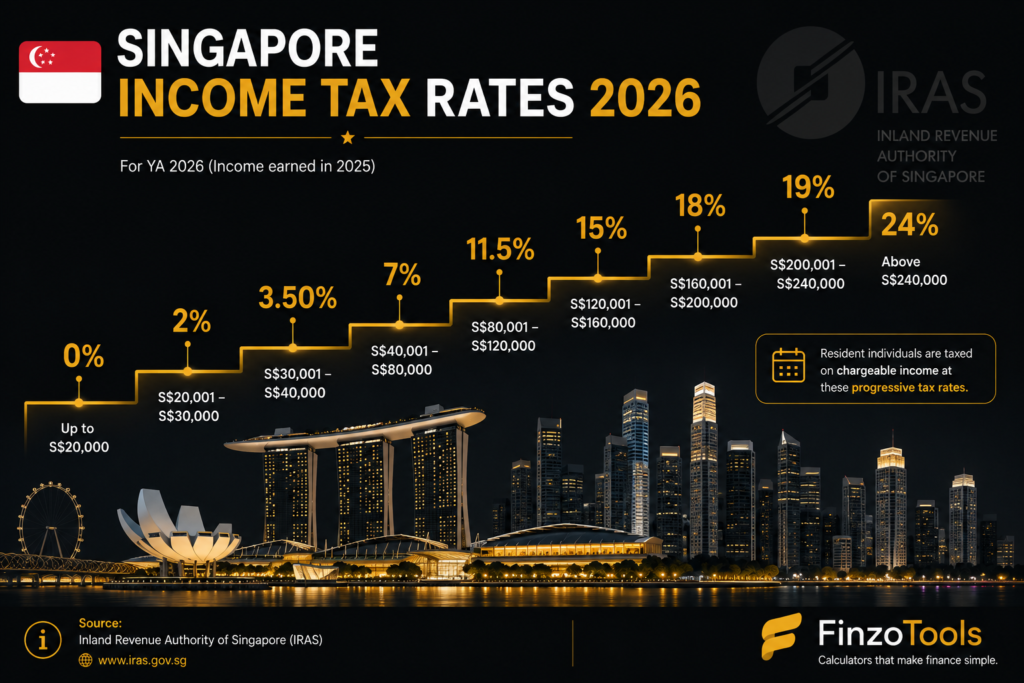
Singapore has one of the most competitive personal income tax systems in the developed world. For the Year of Assessment 2026, resident tax rates start at 0% on the first S$20,000 of chargeable income and rise to a maximum of 24% on income above S$1,000,000. There is no capital gains tax, no inheritance tax, and no tax on dividends received from Singapore companies. For most salaried workers, the effective tax rate stays comfortably in single digits.
But the system has layers that many workers do not fully understand — from CPF deductions that reduce taxable income before brackets even apply, to personal reliefs worth up to tens of thousands of dollars, to the critical 183-day rule that determines whether you pay progressive rates or a flat 24%. This guide covers every bracket, relief, and filing rule for YA 2026, with worked examples showing exactly how much tax you pay at common salary levels.
What Is Year of Assessment 2026?
Singapore’s tax system works on a preceding year basis. Year of Assessment (YA) 2026 refers to the tax filing that takes place in 2026 for income earned in the calendar year 2025. When IRAS refers to YA 2026 brackets, they mean the rates applied to income you earned between 1 January 2025 and 31 December 2025. The filing window for YA 2026 runs from 1 March to 18 April 2026 for paper filing, and up to 18 April 2026 for e-filing.
Singapore Income Tax Brackets — YA 2026 (Residents)
Tax residents in Singapore pay progressive rates on their chargeable income — the amount remaining after CPF contributions and personal reliefs are deducted from total income.
| Chargeable Income (S$) | Tax Rate | Gross Tax Payable (S$) |
|---|---|---|
| First 20,000 | 0% | 0 |
| Next 10,000 (20,001–30,000) | 2% | 200 |
| Next 10,000 (30,001–40,000) | 3.5% | 550 |
| Next 40,000 (40,001–80,000) | 7% | 3,350 |
| Next 40,000 (80,001–120,000) | 11.5% | 7,950 |
| Next 40,000 (120,001–160,000) | 15% | 13,950 |
| Next 40,000 (160,001–200,000) | 18% | 21,150 |
| Next 40,000 (200,001–240,000) | 19% | 28,750 |
| Next 40,000 (240,001–280,000) | 19.5% | 36,550 |
| Next 40,000 (280,001–320,000) | 20% | 44,550 |
| Next 180,000 (320,001–500,000) | 22% | 84,150 |
| Next 500,000 (500,001–1,000,000) | 23% | 199,150 |
| Above 1,000,000 | 24% | 199,150 + 24% of excess |
The first S$20,000 is completely tax-free. For a typical salaried employee earning S$60,000, only S$40,000 is subject to tax after the zero-rate band — and the effective rate stays remarkably low because the early brackets are taxed at just 2% and 3.5%.
How Much Tax Do You Actually Pay? Worked Examples
The marginal rate tells you what you pay on the last dollar earned, but the effective rate — the actual percentage of your total income that goes to tax — is what matters for financial planning.
| Annual Income (S$) | Marginal Rate | Tax Payable (S$) | Effective Rate |
|---|---|---|---|
| 40,000 | 3.5% | 550 | 1.4% |
| 60,000 | 7% | 1,950 | 3.3% |
| 80,000 | 7% | 3,350 | 4.2% |
| 120,000 | 11.5% | 7,950 | 6.6% |
| 200,000 | 18% | 21,150 | 10.6% |
| 500,000 | 22% | 84,150 | 16.8% |
Even at S$200,000 — a salary well above the national median — the effective tax rate is only 10.6%. This is why Singapore consistently ranks among the lowest-taxed jurisdictions in the world for employment income. By comparison, a UK taxpayer earning the equivalent amount would face an effective rate above 30%, and an Australian worker would pay closer to 28%.
These figures are before personal reliefs and CPF deductions, which reduce chargeable income further. With standard reliefs applied, the actual tax payable is lower still.
CPF Deductions: How They Reduce Your Tax
For Singapore Citizens and Permanent Residents, mandatory CPF contributions are automatically excluded from taxable income. If you are aged 55 or below and earn S$8,000 per month (the CPF Ordinary Wage ceiling), your annual employee CPF contribution of S$19,200 (20% × S$8,000 × 12) is deducted before tax brackets apply.
On a gross salary of S$96,000, your chargeable income drops to S$76,800 before any personal reliefs — moving you from the 11.5% bracket to the 7% bracket. This automatic deduction saves most workers between S$500 and S$3,000 in tax per year depending on income level.
Voluntary CPF top-ups under the Retirement Sum Topping-Up Scheme provide additional tax relief of up to S$8,000 per year for your own account and S$8,000 for a family member’s account — a combined S$16,000 deduction on top of mandatory contributions.
Key Personal Tax Reliefs — YA 2026
IRAS offers a range of personal reliefs that reduce your chargeable income. The most commonly claimed reliefs include:
| Relief | Maximum Amount (S$) |
|---|---|
| Earned Income Relief (below 55) | 1,000 |
| Earned Income Relief (55–59) | 6,000 |
| Earned Income Relief (60+) | 8,000 |
| Spouse Relief | 2,000 |
| Qualifying Child Relief (per child) | 4,000 |
| Working Mother’s Child Relief (per child) | 15%–25% of earned income |
| Parent Relief (living with you) | 9,000 |
| Parent Relief (not living with you) | 5,500 |
| CPF Top-Up Relief (own account) | 8,000 |
| CPF Top-Up Relief (family member) | 8,000 |
| SRS Contribution Relief | 15,300 (citizens/PRs) |
| Course Fees Relief | 5,500 |
| NSman Relief (self) | 3,000 |
| Total personal relief cap | 80,000 |
The total personal relief cap is S$80,000 per YA. Even if your individual reliefs add up to more, the maximum deduction from chargeable income is limited to S$80,000. For most workers, the earned income relief, CPF top-up relief, and qualifying child relief form the core of their claim.
Non-Resident Tax Rates
If you work in Singapore for fewer than 183 days in the calendar year, you are classified as a non-resident for tax purposes. Non-resident rates are significantly less favourable:
Employment income: Taxed at a flat 15% or at the progressive resident rates — whichever produces the higher tax amount. Non-residents do not qualify for personal reliefs.
Director’s fees, consultation fees, and rental income: Taxed at a flat 24% with no deductions.
Short-stay exemption: Foreigners working in Singapore for 60 days or fewer in a calendar year are completely exempt from Singapore income tax on their employment income. This exemption does not apply to company directors or public entertainers.
The 183-day rule is based on physical presence in Singapore, not on visa type or passport. A single day’s difference can shift your entire YA treatment from competitive progressive rates to the flat non-resident rate — making accurate day-counting essential for professionals who split time between countries.
What Singapore Does NOT Tax
Singapore’s tax system is notable as much for what it does not tax as for what it does. Understanding these exclusions is essential for comprehensive financial planning:
No capital gains tax. Profits from selling shares, property, cryptocurrency, or any other asset are not taxed. However, if IRAS determines that you are trading assets as a business activity (based on frequency, volume, and intent), gains may be reclassified as business income and taxed at normal rates.
No inheritance tax. Singapore abolished estate duty in 2008. Assets pass to beneficiaries without any death tax, regardless of value.
No tax on Singapore-source dividends. Dividends received from Singapore-resident companies are tax-exempt under the one-tier corporate tax system because the company has already paid corporate tax at 17%.
No tax on overseas income (in most cases). Singapore operates a territorial tax system. Income earned outside Singapore is generally not taxed unless it is received in Singapore. This makes Singapore particularly attractive for individuals with international income streams.
Supplementary Retirement Scheme (SRS)
The SRS is a voluntary savings scheme that provides significant tax benefits. Singapore citizens and PRs can contribute up to S$15,300 per year (S$35,700 for foreigners) and deduct the full amount from taxable income. SRS funds can be invested in a range of approved instruments including stocks, bonds, unit trusts, and fixed deposits.
At withdrawal (from the statutory retirement age, currently 63), only 50% of the withdrawn amount is taxed as income. This effectively halves your tax rate on SRS savings. For a worker in the 15% bracket, the effective tax on SRS withdrawals is just 7.5% — making SRS one of the most tax-efficient retirement savings vehicles available in Singapore.
Tax Filing in Singapore: Key Dates
IRAS requires all individuals with annual income of S$22,000 or more to file a tax return, even if no tax is owed. For YA 2026, the key dates are:
| Deadline | Date |
|---|---|
| E-filing opens | 1 March 2026 |
| Paper filing deadline | 15 April 2026 |
| E-filing deadline | 18 April 2026 |
| No-Filing Service (NFS) — auto-assessed | Selected employees notified by March |
Many salaried employees in Singapore are covered by IRAS’s No-Filing Service (NFS), which means their tax is auto-assessed based on employer-submitted data and they do not need to file a return. IRAS notifies eligible taxpayers by SMS or letter. If you receive an NFS notification and agree with the assessment, no action is needed — the tax is automatically calculated and a bill is issued.
Singapore vs Other Countries: Effective Tax Comparison
To put Singapore’s tax rates in global perspective, here is how the effective tax rate on S$120,000 (approximately US$89,000) compares across the countries covered by FinzoTools:
| Country | Effective Tax Rate |
|---|---|
| Singapore | ~6.6% |
| UAE | 0% (no income tax) |
| Pakistan | ~7% |
| New Zealand | ~22% |
| Canada | ~23% |
| Australia | ~25% |
| UK | ~27% |
| Ireland | ~30% |
Only the UAE (with zero income tax) beats Singapore on effective rates. For skilled professionals comparing international career options, Singapore’s combination of low income tax, no capital gains tax, and no inheritance tax makes it one of the most tax-efficient jurisdictions globally.
Calculate Your Singapore Tax
The FinzoTools Singapore Income Tax Calculator applies the full YA 2026 bracket table, CPF deductions, and standard reliefs to show your exact annual tax and monthly take-home pay. Enter your gross salary and age bracket, and the calculator handles the rest — including the CPF split across your OA, SA, and MediSave accounts.
Source: Tax brackets and reliefs verified against IRAS Individual Income Tax Rates and IRAS Tax Reliefs, July 2026.