
After two consecutive years with no inflationary relief, South African taxpayers finally caught a break in the 2026 Budget. Finance Minister Enoch Godongwana announced a 3.4% adjustment to all personal income tax brackets, rebates, and thresholds — the first inflation-linked relief since the 2023/24 tax year. It is not a tax cut, but it stops bracket creep from dragging more of your income into higher tax bands simply because your salary kept pace with inflation.
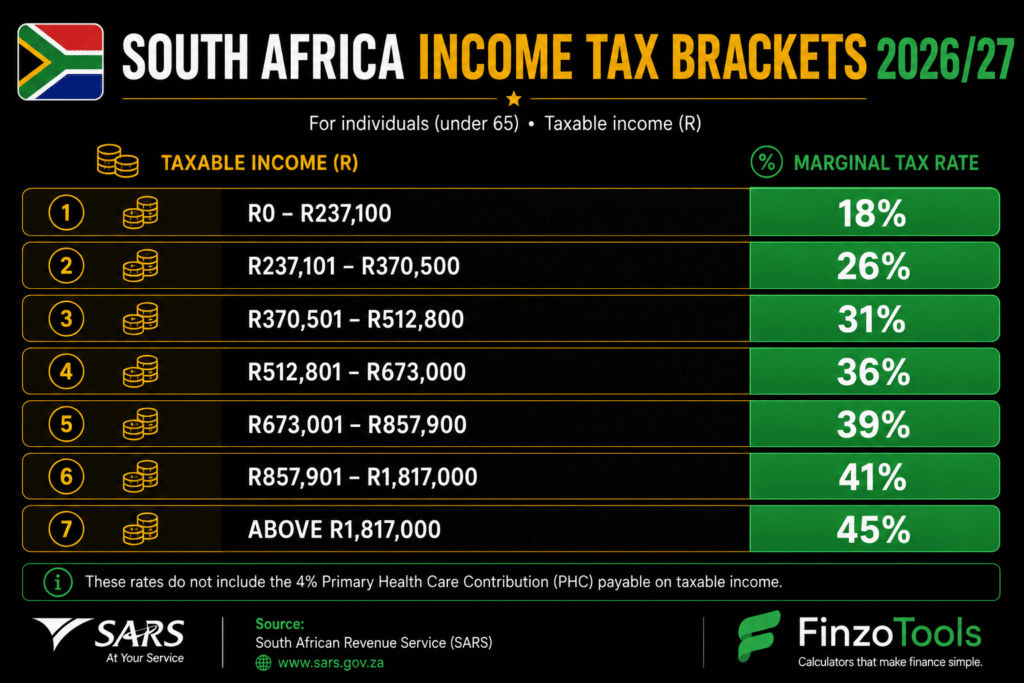
For the 2026/27 year of assessment (1 March 2026 to 28 February 2027), South Africa has seven progressive tax brackets ranging from 18% to 45%. Combined with three age-based rebates, medical tax credits, UIF deductions, and a significantly increased retirement fund contribution cap, the system is more layered than most South Africans realise.
This guide breaks down every bracket, rebate, threshold, and deduction for 2026/27, explains what changed from the previous year, and shows you how the numbers apply to real salaries.
The 7 Income Tax Brackets for 2026/27
South Africa uses a progressive system where different portions of your annual taxable income are taxed at different rates. Only the income within each band is taxed at that band’s rate — you never pay the top rate on your entire salary.
| Taxable Income (Annual) | Tax Rate | Tax Payable |
|---|---|---|
| R0 – R245,100 | 18% | 18% of taxable income |
| R245,101 – R383,100 | 26% | R44,118 + 26% of amount above R245,100 |
| R383,101 – R530,200 | 31% | R80,998 + 31% of amount above R383,100 |
| R530,201 – R695,800 | 36% | R126,599 + 36% of amount above R530,200 |
| R695,801 – R887,000 | 39% | R186,215 + 39% of amount above R695,800 |
| R887,001 – R1,878,600 | 41% | R260,783 + 41% of amount above R887,000 |
| R1,878,601 and above | 45% | R667,339 + 45% of amount above R1,878,600 |
The key point many taxpayers miss is how progressive taxation actually works. If you earn R500,000 per year, you do not pay 31% on the entire amount. The first R245,100 is taxed at 18%, the next R138,000 (R245,101 to R383,100) at 26%, and only the remaining R116,900 at 31%. After the primary rebate, your effective tax rate is approximately 17% — far below the 31% marginal rate.
The 3.4% Bracket Adjustment: What It Means
For the 2024/25 and 2025/26 tax years, SARS did not adjust the tax brackets for inflation. This meant that even if your salary only increased in line with inflation, a portion of your raise was captured by the next higher bracket — a phenomenon known as bracket creep or fiscal drag. Over two years, this silent tax increase cost the average employed taxpayer thousands of rands in additional PAYE.
The 2026 Budget reversed this by adjusting all bracket thresholds upward by 3.4%, broadly matching the expected inflation rate. The practical effect is that a worker whose salary increased by only 3.4% will pay roughly the same effective tax rate as the previous year — neither more nor less. It is inflation relief, not a tax cut.
To put a number on it: a worker earning R300,000 per year saves approximately R1,200 over the full tax year compared to what they would have paid under the unadjusted 2025/26 brackets. For higher earners at R800,000, the saving is closer to R3,500.
Rebates and Tax-Free Thresholds
South Africa does not use a tax-free income band like some countries. Instead, it applies rebates — fixed rand amounts deducted from your calculated tax liability. These rebates effectively create a tax-free threshold below which no PAYE is due.
| Rebate | Who Qualifies | Annual Amount | Tax-Free Threshold |
|---|---|---|---|
| Primary | All taxpayers | R17,820 | R99,000 |
| Secondary | Age 65 and older | R9,444 | R153,250 |
| Tertiary | Age 75 and older | R3,145 | R171,300 |
The primary rebate of R17,820 means that the first R99,000 of income is effectively tax-free for everyone. At 18%, R99,000 generates a tax liability of exactly R17,820 — which is fully offset by the primary rebate. If you earn below R99,000 per year (about R8,250 per month), you owe zero income tax.
For those aged 65–74, the combined primary and secondary rebates total R27,264, creating a higher tax-free threshold of R153,250. For those 75 and older, the three rebates combined total R30,409, with a threshold of R171,300.
Medical Tax Credits 2026/27
If you belong to a medical scheme, you qualify for the Medical Scheme Fees Tax Credit, which directly reduces your monthly PAYE. The 2026 Budget increased these credits in line with inflation:
| Beneficiary | Monthly Credit | Annual Credit |
|---|---|---|
| Main member | R376 | R4,512 |
| First dependant | R376 | R4,512 |
| Each additional dependant | R254 | R3,048 |
A family of four (main member + spouse + two children) receives a combined monthly credit of R376 + R376 + R254 + R254 = R1,260 per month, or R15,120 per year. These credits are subtracted directly from your PAYE — they are not dependent on how much you actually pay in medical scheme contributions.
There is also an Additional Medical Expenses Tax Credit for out-of-pocket medical expenses. Taxpayers aged 65 and older or with disabilities can claim 33.3% of qualifying expenses. Others can claim 25% of expenses exceeding 7.5% of taxable income.
UIF: The Mandatory 1% Deduction
Every employed South African contributes to the Unemployment Insurance Fund. Both the employee and employer pay 1% of the employee’s remuneration, for a combined 2%. The contribution is capped at a maximum monthly earnings ceiling of R17,712, making the maximum employee UIF deduction R177.12 per month.
If you earn R25,000 per month, your UIF deduction is R250 (1% of R25,000). But if you earn R30,000 per month, the deduction is still capped at R177.12 because your salary exceeds the R17,712 ceiling. Your employer matches your contribution, bringing the total to R354.24 per month.
Retirement Fund Deductions: The R430,000 Cap
One of the most significant changes in the 2026 Budget is the increase in the retirement fund contribution deduction cap from R350,000 to R430,000 per year. This applies to contributions to pension funds, provident funds, and retirement annuities.
You can deduct retirement fund contributions up to 27.5% of the greater of your remuneration or taxable income, subject to the R430,000 annual maximum. For a taxpayer earning R1,000,000, the deduction is limited to R275,000 (27.5% of R1,000,000). For someone earning R2,000,000, the deduction caps at R430,000 regardless of the percentage.
This deduction is powerful because it reduces your taxable income before the bracket calculation. A taxpayer in the 36% bracket saves R360 for every R1,000 contributed to a retirement fund. Maximising this deduction is one of the most effective legal tax reduction strategies available to South African taxpayers.
The Two-Pot Retirement System
Introduced on 1 September 2024, the two-pot system fundamentally changed how retirement fund contributions are structured. From that date, new contributions to any retirement fund are split into two components:
Savings pot (one-third): Accessible once per tax year, with a minimum withdrawal of R2,000. Withdrawals are taxed as ordinary income at your marginal tax rate. This pot gives members access to a portion of their retirement savings before retirement without having to resign.
Retirement pot (two-thirds): Fully preserved until retirement. Cannot be accessed early under any circumstances. This ensures that the majority of retirement savings remains intact for its intended purpose.
Existing fund members received a one-time seeding of up to R30,000 into their savings pot when the system launched. Any savings pot withdrawal is added to your taxable income for the year — so if you are in the 31% bracket and withdraw R30,000, you will owe approximately R9,300 in additional tax. This makes withdrawals expensive for higher-bracket taxpayers and should only be used when genuinely needed.
Worked Example: Tax on R500,000 Annual Salary
Here is how the 2026/27 brackets apply to a taxpayer under 65 earning R500,000 per year, with no dependants and standard deductions:
| Calculation Step | Amount |
|---|---|
| First R245,100 at 18% | R44,118 |
| Next R138,000 (R245,101–R383,100) at 26% | R35,880 |
| Remaining R116,900 (R383,101–R500,000) at 31% | R36,239 |
| Gross tax before rebates | R116,237 |
| Less: Primary rebate | −R17,820 |
| Net annual PAYE | R98,417 |
| UIF (1%, capped at R177.12/month) | R2,126/year |
| Effective tax rate | ~20.1% |
| Monthly take-home (before medical/retirement) | ~R33,288 |
The marginal rate is 31% (the bracket that captures the last rand earned), but the effective rate — the actual percentage of total income paid in tax — is only about 20%. This is the power of progressive taxation: the effective rate is always significantly lower than the marginal rate.
VAT at 16%: The Second Increase
South Africa’s VAT rate increased to 16% from 1 April 2026, completing a phased two-step increase from the long-standing 15% rate. The first 0.5% increase took effect on 1 May 2025, and the second 0.5% increase on 1 April 2026. This is the first VAT rate increase since 2018.
To offset the impact on lower-income households, the basket of zero-rated food items was expanded to include tinned or canned vegetables, dairy liquid blends, and certain meat products (sheep, poultry, goat, and swine). The existing 21 zero-rated items — including brown bread, maize meal, rice, fresh fruit and vegetables, eggs, and milk — remain unaffected by the increase.
The compulsory VAT registration threshold also increased significantly to R2.3 million in annual taxable supplies (from R1 million), while the voluntary registration threshold rose to R120,000 (from R50,000). These higher thresholds mean many small businesses that were previously required to register for VAT no longer need to.
Other Key Tax Numbers for 2026/27
| Item | 2026/27 Amount |
|---|---|
| Tax-Free Savings Account annual limit | R46,000 |
| TFSA lifetime limit | R500,000 |
| Interest exemption (under 65) | R23,800/year |
| Interest exemption (65+) | R34,500/year |
| Dividends Tax | 20% (withheld at source) |
| CGT annual exclusion (individuals) | R50,000 |
| CGT inclusion rate (individuals) | 40% |
| Primary residence CGT exclusion | R3,000,000 |
| Retirement lump sum tax-free (at retirement) | R550,000 |
| Corporate income tax rate | 27% |
Several of these numbers changed in the 2026 Budget. The TFSA annual limit increased from R36,000 to R46,000, the CGT annual exclusion rose from R40,000 to R50,000, and the primary residence CGT exclusion jumped from R2,000,000 to R3,000,000. These are meaningful improvements that reward long-term savers and homeowners.
How to Reduce Your Taxable Income Legally
The most effective tax-saving strategies available to South African taxpayers in 2026/27 revolve around three pillars: retirement contributions, medical scheme membership, and tax-free savings.
Maximise retirement contributions up to the 27.5% limit (capped at R430,000). Every rand contributed reduces your taxable income before the bracket calculation. A taxpayer in the 36% bracket saves R360 per R1,000 contributed.
Ensure medical scheme credits are correctly claimed by your employer’s payroll. The R376 per member credit is automatic if your employer has the correct information, but check your payslip to confirm.
Use your Tax-Free Savings Account. The R46,000 annual contribution grows completely free of income tax, dividends tax, and capital gains tax — forever. Over a 30-year working career, the R500,000 lifetime limit compounding at 10% produces over R2 million in tax-free wealth.
Calculate Your 2026/27 Tax
The FinzoTools South Africa Income Tax Calculator applies the full 2026/27 SARS brackets, all three rebates, UIF deductions, and medical tax credits to show your exact monthly and annual take-home pay. Enter your gross salary, age, number of medical scheme dependants, and retirement contributions to see a complete breakdown.
Source: All rates and thresholds verified against SARS Budget 2026 FAQ and the National Treasury Budget 2026 Tax Guide, June 2026.