
✅ Last verified: July 2026 — Source: HMRC, GOV.UK, Inheritance Tax Act 1984 s.7(4), Autumn Budget 2025
By Abdul Basit | July 2026 | FinzoTools Blog
⚡ QUICK ANSWER
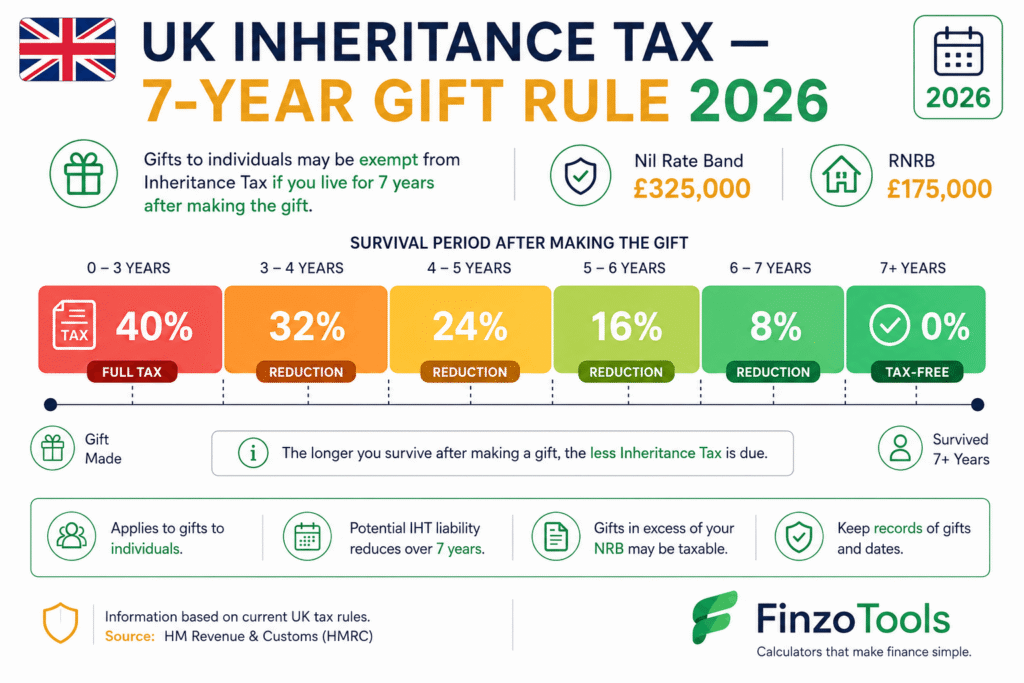
Taper relief reduces the inheritance tax rate — not the gift value — on gifts made 3 to 7 years before death. The rate drops from 40% to 32%, then 24%, 16%, and finally 8%, depending on how many years passed between the gift and death. Gifts made more than 7 years before death are completely IHT-free. But taper relief only saves tax if your gifts in the 7 years before death exceed the £325,000 nil rate band. Below that threshold, no IHT is due regardless of timing. Use our free UK Inheritance Tax Calculator to estimate your estate’s liability.
The 7-year gift rule is one of the most misunderstood parts of UK inheritance tax. People hear “give it away and wait 7 years” and assume taper relief gradually reduces their tax bill from day one. It doesn’t. The first 3 years carry the full 40% rate. And taper relief only matters at all when gifts exceed the nil rate band — which many never do.
This guide explains exactly how taper relief works, when it actually saves money, and where the common traps lie — with worked examples at real gift amounts.
How the 7-year gift rule works
When you give money, property, or assets to another individual during your lifetime, HMRC treats it as a potentially exempt transfer (PET). If you survive for 7 full years after the gift, it becomes completely exempt from inheritance tax — no matter how large it was.
If you die within 7 years of making the gift, the PET “fails” and gets added back into your estate for IHT purposes. The gift uses up your nil rate band first, and any amount above £325,000 is taxed.
That’s where taper relief comes in.
Taper relief rates 2026/27 — the full sliding scale
Taper relief reduces the rate of tax charged on gifts that exceed the nil rate band, based on how many years passed between the gift and death.
| Years Between Gift and Death | IHT Rate Applied | Reduction from Full Rate |
|---|---|---|
| 0 to 3 years | 40% | No reduction — full rate |
| 3 to 4 years | 32% | 20% off |
| 4 to 5 years | 24% | 40% off |
| 5 to 6 years | 16% | 60% off |
| 6 to 7 years | 8% | 80% off |
| More than 7 years | 0% | Fully exempt — no IHT |
Source: GOV.UK — Inheritance Tax on Gifts, IHTA 1984 s.7(4)
The critical detail most people miss: taper relief reduces the tax rate, not the value of the gift. A £500,000 gift made 5 years before death isn’t treated as if it were worth less — it’s still valued at £500,000 for IHT. The difference is that the tax on the amount exceeding the nil rate band is charged at 16% instead of 40%.
When taper relief actually saves tax — and when it doesn’t
This is where confusion runs deepest. Taper relief only produces a saving when the total value of gifts made in the 7 years before death exceeds the £325,000 nil rate band. If your gifts are below that threshold, no IHT is due in the first place — and taper relief is irrelevant.
Scenario A — Taper relief saves nothing
You gift £200,000 to your daughter and die 5 years later with an estate of £100,000.
- Total chargeable: £200,000 (gift) + £100,000 (estate) = £300,000
- Nil rate band: £325,000
- IHT due: £0 — the total is below the NRB
- Taper relief: irrelevant. No tax to reduce.
Scenario B — Taper relief saves real money
You gift £500,000 to your son and die 5 years later.
- Gift exceeds NRB by: £500,000 − £325,000 = £175,000
- Without taper: £175,000 × 40% = £70,000 IHT
- With taper (5-6 years band = 16%): £175,000 × 16% = £28,000 IHT
- Saving from taper relief: £42,000
Scenario C — Multiple gifts, chronological order matters
You gift £250,000 to your daughter in 2020, then £200,000 to your son in 2022, and die in 2026.
- HMRC applies gifts oldest first against the NRB
- Gift 1 (2020, 6 years ago): £250,000 uses £250,000 of the NRB. Remaining NRB: £75,000. Taper rate: 8%
- Gift 2 (2022, 4 years ago): £200,000. First £75,000 covered by remaining NRB. Excess: £125,000. Taper rate: 24%
- IHT on Gift 1: £0 (within NRB)
- IHT on Gift 2: £125,000 × 24% = £30,000
Notice how the older, larger gift used up most of the NRB — leaving the newer, smaller gift partially exposed. The order and timing of gifts can matter as much as the amounts.
Taper relief worked examples — tax saved at each stage
How much IHT is actually saved by taper relief on a £500,000 gift (the amount above the £325,000 NRB = £175,000 taxable):
| Years Survived | IHT Rate | IHT Due on £175K | Tax Saved vs Full Rate |
|---|---|---|---|
| Under 3 years | 40% | £70,000 | £0 |
| 3–4 years | 32% | £56,000 | £14,000 |
| 4–5 years | 24% | £42,000 | £28,000 |
| 5–6 years | 16% | £28,000 | £42,000 |
| 6–7 years | 8% | £14,000 | £56,000 |
| 7+ years | 0% | £0 | £70,000 |
Every additional year you survive beyond year 3 saves roughly £14,000 on a £500,000 gift. Survive the full 7 years and the entire £70,000 tax bill disappears.
IHT nil rate band and thresholds 2026/27
Understanding taper relief requires understanding the thresholds that determine when IHT kicks in at all.
| Threshold | Amount | Frozen Until | Notes |
|---|---|---|---|
| Nil Rate Band (NRB) | £325,000 | April 2031 | Frozen since 2009 — unchanged for 22 years |
| Residence Nil Rate Band (RNRB) | £175,000 | April 2031 | Only applies when home passes to direct descendants |
| RNRB taper threshold | £2,000,000 | April 2031 | RNRB reduces by £1 for every £2 above £2M |
| Maximum per individual | £500,000 | — | £325,000 NRB + £175,000 RNRB |
| Maximum per married couple | £1,000,000 | — | Combined transferable NRB + RNRB |
| IHT rate | 40% | — | 36% if 10%+ of net estate goes to charity |
Source: GOV.UK — Inheritance Tax, Autumn Budget 2025
The NRB freeze since 2009 is the longest in history. Had it kept pace with inflation, it would be roughly £525,000 today. That 22-year freeze is the single biggest reason IHT receipts hit a record £8.2 billion in 2024/25 — and are projected to reach £14 billion by 2029/30.
Gifts that are immediately IHT-free — no 7-year rule needed
Not every gift requires a 7-year wait. Several exemptions apply from the moment you make the gift:
| Exemption | Annual Limit | Rules |
|---|---|---|
| Annual gift exemption | £3,000/year | Can carry forward 1 unused year (max £6,000) |
| Small gifts | £250/person | Unlimited recipients, but not same person as annual exemption |
| Wedding — to child | £5,000 | Must be given before the wedding |
| Wedding — to grandchild | £2,500 | Must be given before the wedding |
| Wedding — to anyone else | £1,000 | Must be given before the wedding |
| Spouse/civil partner | Unlimited | Both must be UK-domiciled |
| Charity donations | Unlimited | Must be recognised UK charity |
| Normal expenditure out of income | No limit | Must be regular, from income (not capital), without affecting living standard |
The “normal expenditure out of income” exemption is particularly powerful for people with surplus income. If you can demonstrate a regular pattern of giving — say, paying a grandchild’s school fees or making monthly gifts — the amounts are immediately exempt with no 7-year wait, regardless of size.
Married couples — how transferable nil rate bands work with gifts
When the first spouse dies, any unused NRB and RNRB can transfer to the surviving spouse. This means a married couple or civil partnership can potentially pass up to £1,000,000 (£650,000 combined NRB + £350,000 combined RNRB) without any IHT.
Transfers between spouses during lifetime are completely exempt — no IHT, no 7-year rule, no limits. The real planning opportunity is what happens after the first death: the surviving spouse inherits the unused allowance and can then make gifts to children or others with the full combined NRB protecting them.
A common strategy: the first spouse leaves everything to the surviving partner (exempt transfer), preserving both NRBs. The surviving spouse then has £650,000 of combined NRB before any gift triggers potential IHT — and if those gifts are made 7+ years before their own death, taper relief and eventual full exemption apply.
The RNRB doesn’t shelter gifts — a common trap
The £175,000 residence nil rate band only applies to property passing on death to direct descendants. It does not protect lifetime gifts. If you gift your home to your children during your lifetime, the RNRB doesn’t apply — the gift is a PET subject to the 7-year rule and taper relief, but only the £325,000 NRB (not the RNRB) shelters it.
There’s an additional complication: if you gift your home but continue to live in it, HMRC treats it as a “gift with reservation of benefit” — and it remains part of your estate for IHT regardless of how many years pass. To genuinely remove a property from your estate, you must stop benefiting from it entirely.
Common misconceptions about taper relief
- “Taper relief reduces the value of the gift.” Wrong. It reduces the tax rate. A £500,000 gift is still valued at £500,000 — but the tax on the excess over the NRB is charged at a lower rate.
- “Any gift made 5 years ago is taxed at 16%.” Only if the gift exceeds the NRB. A £200,000 gift is covered entirely by the £325,000 NRB — no tax, no taper needed.
- “Taper relief starts from day one.” No. The first 3 years carry the full 40% rate. Relief only begins after year 3.
- “I gave my house away 6 years ago so it’s nearly tax-free.” Not if you still live in it. Gifts with reservation of benefit stay in your estate regardless of the 7-year rule.
- “My gifts are in the NRB so taper relief is saving me tax.” Taper relief is irrelevant when gifts fall within the NRB — there’s no tax to reduce in the first place.
- “The RNRB covers my lifetime gifts.” The RNRB only applies to the death estate when a home passes to direct descendants. It doesn’t protect lifetime gifts.
Practical tips for IHT gift planning
- Start early. The 7-year clock only begins when you make the gift. Every year of delay is a year closer to potential IHT liability.
- Use the £3,000 annual exemption every year. It’s immediate, no 7-year wait, and unused allowance carries forward one year. A couple can give away £6,000/year (or £12,000 using carried-forward allowances) completely tax-free.
- Keep a gift log. Record the date, amount, and recipient of every gift. Your executors will need this to calculate any IHT due.
- Consider your running 7-year total. Before making a large gift, add up everything you’ve given in the past 7 years. If the total is near or above £325,000, the new gift will be exposed to IHT if you die within 7 years.
- Don’t give away money you might need. Gifts are irrevocable. If your circumstances change — care home fees, for example — you can’t take the money back.
- Take advice before gifting property. Gifts of property trigger CGT, potential SDLT, and reservation of benefit rules. The IHT saving can be wiped out by other taxes if not structured correctly.
Frequently asked questions — IHT taper relief 2026
What is taper relief for inheritance tax?
Taper relief is a sliding scale that reduces the rate of inheritance tax on gifts made 3 to 7 years before death. The full 40% rate applies for the first 3 years, then drops to 32%, 24%, 16% and 8% for each subsequent year. Gifts made more than 7 years before death are fully exempt.
Does taper relief reduce the value of the gift?
No. Taper relief reduces the tax rate, not the gift value. A £500,000 gift is still valued at £500,000 for IHT purposes. The reduction applies only to the tax charged on the amount exceeding the nil rate band.
When does taper relief actually save money?
Only when the total gifts made in the 7 years before death exceed the £325,000 nil rate band. If your gifts are below that threshold, no IHT is due regardless of timing — and taper relief is irrelevant.
What is the nil rate band for 2026/27?
The nil rate band is £325,000, frozen at this level since 2009 and now extended to April 2031 following the Autumn Budget 2025. The residence nil rate band adds £175,000 when a main home passes to direct descendants.
Can a married couple pass £1 million IHT-free?
Yes — potentially. Each spouse has a £325,000 NRB and a £175,000 RNRB. Unused allowances transfer to the surviving spouse, creating a combined threshold of up to £1 million. The RNRB requires the main home to pass to direct descendants (children or grandchildren).
Does the 7-year rule apply to gifts between spouses?
No. Gifts between married couples and civil partners are completely exempt from IHT with no limit and no 7-year requirement. Both must be UK-domiciled for the full exemption to apply.
What happens if I give my house away but keep living in it?
HMRC treats it as a “gift with reservation of benefit” and the property remains in your estate for IHT purposes — regardless of how many years have passed. To remove it from your estate, you must stop benefiting from the property entirely (e.g., move out or pay full market rent).
What gifts are immediately exempt from IHT?
The £3,000 annual exemption, small gifts of up to £250 per person, wedding gifts (£5,000 to children, £2,500 to grandchildren, £1,000 to others), gifts between spouses, charity donations, and regular gifts from surplus income are all immediately exempt with no 7-year wait.
How do I keep track of gifts for IHT?
Keep a simple record of every gift: date, amount, recipient, and description. Your executors will need this after your death to calculate any IHT liability on gifts made within 7 years. HMRC form IHT403 is used to report lifetime gifts as part of the estate.
Is taper relief available on gifts to trusts?
Yes. Taper relief applies to chargeable lifetime transfers (CLTs) into trusts if the donor dies within 7 years. The CLT is initially charged at 20% on creation. On death within 7 years, HMRC recalculates at the death rate (40%), applies taper relief, and charges the difference after crediting the 20% already paid.
Related tools and guides
- 🧮 UK Inheritance Tax Calculator 2026 — estimate your estate’s IHT liability
- 📖 UK IHT 2026 — Thresholds, Rules & How to Reduce Your Bill
- 💰 UK Salary & Tax Calculator 2026 — see your take-home pay
- 📖 £40K UK Salary — Take-Home Pay After Tax & NI
- 📖 Stocks & Shares ISA vs Cash ISA 2026 — compare tax-free savings
- 🏠 UK Mortgage Calculator 2026 — monthly repayment estimates
Sources & references
- GOV.UK — Inheritance Tax on Gifts
- GOV.UK — Inheritance Tax Thresholds and Rates
- HMRC — Inheritance Tax Act 1984, Section 7(4) — Taper Relief
- Autumn Budget 2025 — NRB and RNRB freeze extended to April 2031
- Office for Budget Responsibility — IHT Forecast and Receipts
© 2026 FinzoTools — For educational purposes only. This is not legal, tax, or financial advice. Consult a qualified advisor before making estate planning decisions.
t